Homology of Connected Sum of Two Projective Planes, P^2 # P^2

  • Context: Graduate 
  • Thread starter Thread starter Math Amateur
  • Start date Start date
  • Tags Tags
    Planes Sum
Click For Summary
SUMMARY

The discussion centers on Theorem 6.5 from James Munkres' "Elements of Algebraic Topology," which establishes the homology groups of the connected sum of two projective planes, denoted as H_1(P^2 # P^2) ≅ ℤ ⊕ ℤ/2 and H_2(P^2 # P^2) = 0. Participants seek clarification on Munkres' assertion that H_2(P^2 # P^2) = 0 is "clear," with references to algebraic and topological methods for understanding homology. The conversation highlights the relationship between cycles and boundaries in homology, emphasizing the geometric implications of removing cycles from spaces.

PREREQUISITES
  • Understanding of homology groups in algebraic topology
  • Familiarity with the concepts of cycles and boundaries
  • Knowledge of projective planes and their properties
  • Basic grasp of algebraic topology terminology and notation
NEXT STEPS
  • Study the proof of Theorem 6.5 in Munkres' "Elements of Algebraic Topology"
  • Explore the Jordan curve theorem and its implications in topology
  • Review John Hocking's "Topology" for alternative perspectives on simplicial homology
  • Investigate the relationship between orientability and homology groups
USEFUL FOR

Students and researchers in algebraic topology, particularly those focusing on homology theory, as well as educators seeking to clarify complex concepts in topology.

Math Amateur
Gold Member
MHB
Messages
3,920
Reaction score
48
I am reading James Munkres' book, Elements of Algebraic Topology.

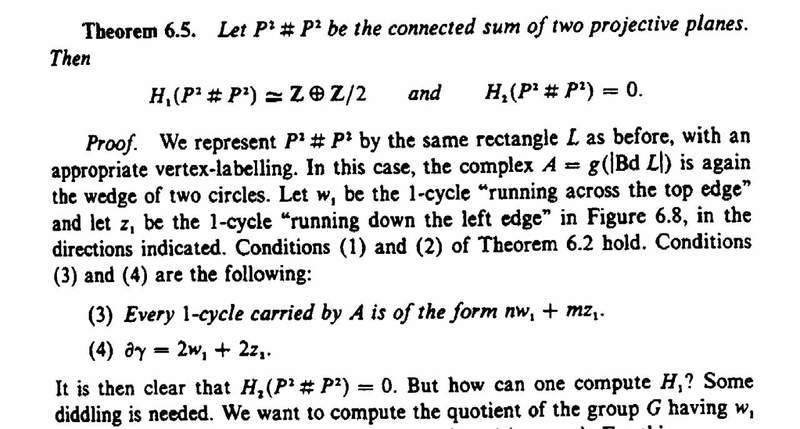
Theorem 6.5 on page 39 concerns the homology groups of the connected sum of two projected planes.

Munkres demonstrates the following:

H_1 ( P^2 \# P^2 ) \simeq \mathbb{Z} \oplus \mathbb{Z} / 2 ... ... ... (1)

and

H_2 ( P^2 \# P^2 ) = 0 ... ... ... (2)

I would appreciate some help in understanding how Munkres establishes H_2 ( P^2 \# P^2 ) = 0. He does this moderately early in the proof after setting up the definitions and notation.

The Theorem and the early part of the proof up to the statement that "it is clear that H_2 ( P^2 \# P^2 ) = 0" is as follows:
attachment.php?attachmentid=68952&stc=1&d=1398230520.jpg

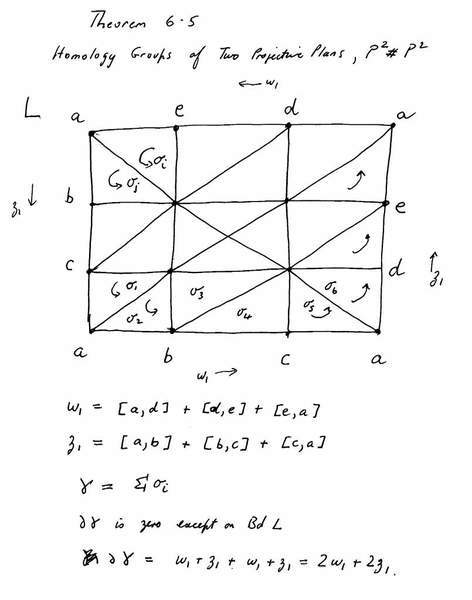
I have labelled L in a manner that I think is appropriate as follows:
attachment.php?attachmentid=68953&stc=1&d=1398230616.jpg


Early in the proof (see above) Munkres refers to conditions 1 and 2. These conditions are as follows:

attachment.php?attachmentid=68954&stc=1&d=1398230616.jpg

As I mentioned above, Munkres states, early in the proof, that

"It is clear that H_2 ( P^2 \# P^2 ) = 0"

BUT ... this is anything but clear to me ...

Can anyone explain why this 'clearly' follows:

Would appreciate some help.

Peter
 

Attachments

  • Theorem 6.5 & Beginning of Proof - Munkres - Elements of Algebraic Topology.jpg
    Theorem 6.5 & Beginning of Proof - Munkres - Elements of Algebraic Topology.jpg
    50.3 KB · Views: 1,077
  • Theorem 6.5 - Appropriate Labelling of L - Munkres.jpg
    Theorem 6.5 - Appropriate Labelling of L - Munkres.jpg
    23.5 KB · Views: 1,203
  • Theorem 6.5 - Conditions 1 and 2.jpg
    Theorem 6.5 - Conditions 1 and 2.jpg
    12.6 KB · Views: 860
Physics news on Phys.org
Sorry, I cannot read your post because it does not fit my screen, but there is a standard result that the top homology over a coefficient ring is 0 iff the space is not orientable, and the homology equals the coefficient ring the space is orientable. The homology of the connected sum is, I think the direct sum of the homology of the spaces, because you can glue your spaces so that the essential curves of each space stay within that space.
 
  • Like
Likes   Reactions: 1 person
Thanks for the help ... will work on what you have said ...

Pity you cannot read the post ... not sure what I can do to improve readability ...

There is a version of my post on Math Help Boards, Topology and Advanced Geometry forum ...

Math Help Boards is here ...

http://mathhelpboards.com/

and the forum concerned is here

http://mathhelpboards.com/topology-advanced-geometry-13/

Any help you (or anyone) can provide regarding Munkres' logic in the above post in achieving the conclusion H_2 (P^2 \# P^2 ) = 0 would be very much appreciated.

Thanks again for the help

Peter
 
Last edited:
O.K, I will look into the board.Sorry, I don't have Munkres ( nor his book :) ) available. I am at home; I will check my school's library.

Just curious: are you considering the algebraic method, or a purely topological one? From the algebra perspective, it comes down to finding the quotient:

## H_n:=Ker (d_n ) / I am (d_{n+1}) ##

i.e., n-cycles mod (n+1)-boundaries. I hope I am not telling you something you already know; maybe understanding this perspective will be helpful to you; sorry if it is not, or if you already know this. The general idea here is to
have the algebraic aspect reflect/reveal/ be-parallel-to the geometry of the space. Informally, a cycle c(geometrically) bounds in the space X if, removing the cycle disconnects the space; this is modeled algebraically by the machinery of cycles and boundaries. One of the connected components A,B left when the space is disconnected by removing c , i.e., X-c= A\/B is the subspace being bounded by c . Maybe the Jordan curve theorem is in play in here. You see, e.g., a cycle , i.e., a s.c.c ( simple-closed curve) going around T^2 , i.e., a parallel, does not bound any subspace of the torus; try removing it (if you cannot see it, do it physically) and notice that removing it will not disconnect the torus. But notice that, e.g., for the 2-sphere , if you remove any s.c.c, you will disconnect the space.

If you feel stuck with Munkres' approach, why not try, if you have it available, John Hocking's "Topology" , or some other text?
 
Last edited:
Thanks WWGD ... appreciate the help ...

You write:

"O.K, I will look into the board.Sorry, I don't have Munkres ( nor his book :) ) available. I am at home; I will check my school's library."

Thanks!

You also write:

"Just curious: are you considering the algebraic method, or a purely topological one? From the algebra perspective, it comes down to finding the quotient:"

If you read Chapter 1 of Munkres, Elements of Algebraic Topology you will find his approach in Theorems 6.1 to 6.5 is largely topological and geometric.

Just now reflecting on the rest of your post ... and re-reading Munkres ...

Any further insights you get on Theorem 6.5 would be really welcome!

BTW, I do have the book Topology by Hocking and Young - will have a closer look at its treatment of simplicial homology. At first glance, Munkres looks easier to follow - but maybe I am fooing myself!

Thanks again,

Peter
 

Similar threads

  • · Replies 4 ·
Replies
4
Views
4K
  • · Replies 1 ·
Replies
1
Views
5K
  • · Replies 12 ·
Replies
12
Views
5K
  • · Replies 27 ·
Replies
27
Views
4K
Replies
17
Views
3K
  • · Replies 9 ·
Replies
9
Views
3K
  • · Replies 3 ·
Replies
3
Views
2K
Replies
2
Views
2K
Replies
6
Views
3K
  • · Replies 2 ·
Replies
2
Views
2K