Horizontal lift, or parallel transport

Click For Summary

Discussion Overview

The discussion centers around a problem encountered in connection theory as presented in Nakahara's book, "Geometry, Topology and Physics." Participants are examining a specific equation involving terms related to parallel transport and the role of the group action in the context of differential geometry.

Discussion Character

  • Technical explanation
  • Debate/contested

Main Points Raised

  • One participant questions the presence of the term g_i(t)^{-1} in an equation, suggesting it should take a different form based on their interpretation of the figures provided.
  • Another participant agrees with the first claim, labeling it as a mistake and referencing a subsequent equation as correct.
  • A different participant challenges the assertion of a mistake, asking for clarification on which equation is being referenced and arguing against the existence of a pullback of a right action.
  • Several participants reiterate a specific equation involving ω and its components, indicating a shared understanding of the mathematical expressions involved, though without consensus on the correctness of the initial claim regarding the term g_i(t)^{-1}.

Areas of Agreement / Disagreement

Participants express disagreement regarding the interpretation of the equation and the presence of the term g_i(t)^{-1}. There is no consensus on whether it is a mistake, as some participants support the original formulation while others challenge it.

Contextual Notes

The discussion involves complex mathematical expressions and assumptions that may not be fully articulated, leading to potential misunderstandings regarding the definitions and operations involved in the equations.

qinglong.1397
Messages
108
Reaction score
1
Hello, everyone!

I'm studying Nakahara's book, Geometry, Topology and Physics and now studying the connection theory. I come across a problem. Please look at the two attachments.

In the attachment
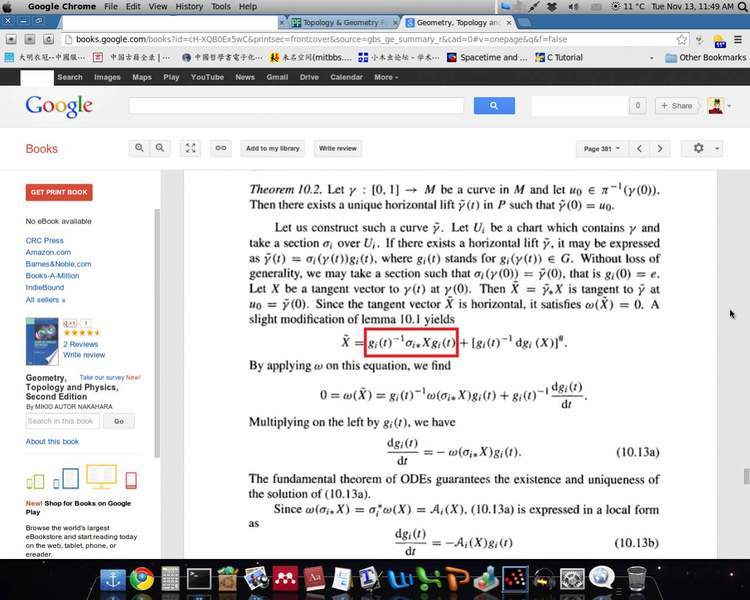
Screenshot-1.jpg
, Nakahara said we could use the similar method in the attachment
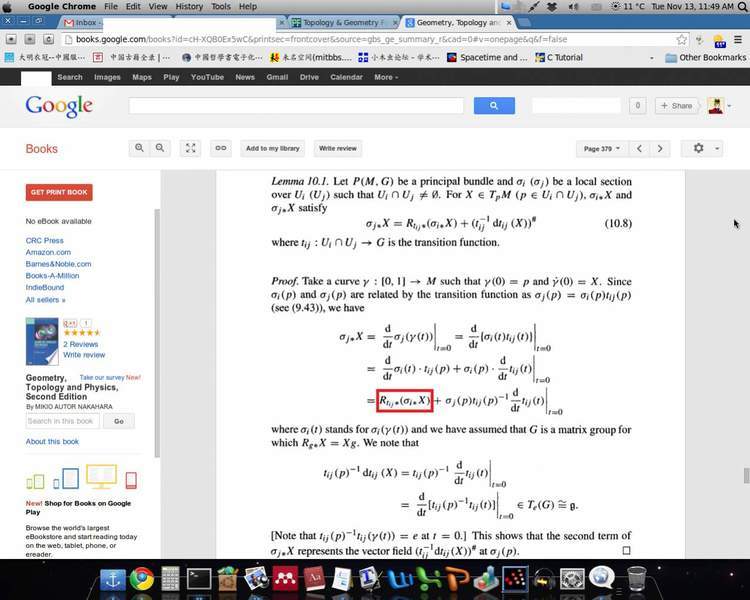
Screenshot.jpg
to get \tilde X, but why does the first term have g_i(t)^{-1}. According to the first figure, the first term should have the following form

R_{g_i(t)*}\sigma_{i*}X

Since R_{g*}X=Xg, it becomes

(\sigma_{i*}X)g_i(t)

So there shouldn't be g_i(t)^{-1}. But why did the author put it there? Thank you!
 
Physics news on Phys.org
Hello.
When I read this chapter I found this strange. I think it's a mistake. The next equation however is right by (10.3b')
 
bloby said:
Hello.
When I read this chapter I found this strange. I think it's a mistake. The next equation however is right by (10.3b')

Hey, thanks for your reply! But what is "the next equation", the second equation in the first attachment? If so, I cannot agree with you, because there is no a pullback of a right action.
 
I have to read this chapter again. Here is what I wrote for me:

0=\omega\left(\tilde{X}\right)=\omega\left(R_{g_{i}*}\left(\sigma_{i*}X\right)\right)+\omega\left(\left[g_{i}^{-1}dg_{i}\left(X\right)\right]^{\#}\right)=R_{g_{i}}^{*}\omega\left(\sigma_{i*}X\right)+g_{i}^{-1}dg_{i}\left(X\right)=g_{i}^{-1}\omega\left(\sigma_{i*}X\right)g_{i}+g_{i}^{-1}\frac{dg_{i}}{dt}
 
0=\omega(\tilde{X})=\omega(R_{g_{i}*}(\sigma_{i*}X))+\omega([g_{i}^{-1}dg_{i}(X)]^{\sharp})=R_{g_{i}}^{*}\omega(\sigma_{i*}X)+g_{i}^{-1}dg_{i}(X)=g_{i}^{-1}\omega(\sigma_{i*}X)g_{i}+g_{i}^{-1}\frac{dg_{i}}{dt}
 
bloby said:
0=\omega(\tilde{X})=\omega(R_{g_{i}*}(\sigma_{i*}X))+\omega([g_{i}^{-1}dg_{i}(X)]^{\sharp})=R_{g_{i}}^{*}\omega(\sigma_{i*}X)+g_{i}^{-1}dg_{i}(X)=g_{i}^{-1}\omega(\sigma_{i*}X)g_{i}+g_{i}^{-1}\frac{dg_{i}}{dt}

Great! Thank you very much!
 

Similar threads

  • · Replies 21 ·
Replies
21
Views
1K
  • · Replies 2 ·
Replies
2
Views
2K
  • · Replies 7 ·
Replies
7
Views
2K
  • · Replies 9 ·
Replies
9
Views
3K
  • · Replies 22 ·
Replies
22
Views
6K
  • · Replies 9 ·
Replies
9
Views
4K
Replies
7
Views
1K
Replies
3
Views
7K
  • · Replies 13 ·
Replies
13
Views
2K
  • · Replies 5 ·
Replies
5
Views
2K