How are expectation values calculated?

Click For Summary

Discussion Overview

The discussion revolves around the calculation of expectation values in quantum mechanics, specifically in the context of the harmonic oscillator. Participants seek clarification on the mathematical steps involved in deriving these values and the nature of the states involved.

Discussion Character

  • Exploratory
  • Technical explanation
  • Conceptual clarification
  • Debate/contested

Main Points Raised

  • One participant asks for clarification on the calculation of expectation values, specifically what operations are performed after the brackets in the expression.
  • Another participant questions the nature of the |z> states, suggesting that if they are energy eigenstates of the harmonic oscillator, the expectation value should equal z, not |z|^2.
  • Several participants express confusion about how to derive average expressions involving the |z> states and seek specific values for and .
  • One participant explains that and equal zero, providing reasoning based on the properties of creation and annihilation operators.
  • A participant suggests using integrals to calculate mean values of position (x) and momentum (p), questioning the simplicity of the method shown in an attached picture.
  • Another participant provides formulas to express x and p in terms of the operators a and a+, indicating how to derive these quantities from the definitions of the operators.

Areas of Agreement / Disagreement

Participants express varying levels of understanding regarding the calculation of expectation values, with some agreeing on the properties of the operators while others remain uncertain about the specific calculations and interpretations of the states involved. No consensus is reached on the best approach to calculate the expectation values.

Contextual Notes

Participants reference a PDF document for further explanation, indicating that there may be additional context or definitions necessary for a complete understanding of the calculations. The discussion also highlights potential confusion regarding the interpretation of quantum states and operators.

Who May Find This Useful

This discussion may be useful for students and practitioners of quantum mechanics, particularly those studying the harmonic oscillator and expectation value calculations.

Cosmossos
Messages
100
Reaction score
0
Hello,
Can someone explain to me how the expectation values are calculated in the following picture:
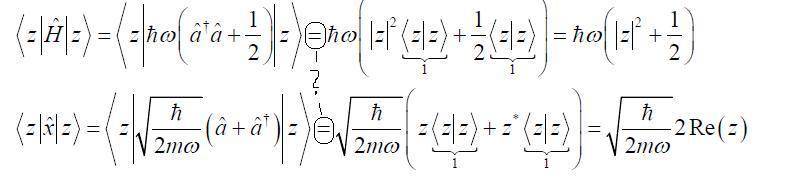
untitled.JPG

I mean , What did they do after the brackets? What did they multiply with what?
thanks
 
Physics news on Phys.org
what kind of states are those [tex]|z>[/tex] states?

If those were energy-eigen-states of the harmonic oscillator, [tex]<z|a^\dagger a|z> \neq |z|^2[/tex].

[tex]<z|a^\dagger a|z> = z[/tex] would be correct.
 
Yes, I'm talking about harmonic oscillator. I don't understand how did they get the avg expression with the zs. (from the question mark to the right)

For exmple, what's the value of <z|a|z> , <z|a+|z> etc. and why?
 
Cosmossos said:
Yes, I'm talking about harmonic oscillator. I don't understand how did they get the avg expression with the zs. (from the question mark to the right)

For exmple, what's the value of <z|a|z> , <z|a+|z> etc. and why?

<z|a|z> =<z|a+|z>=0

since a and a+ are creation and annihilation operators:
a|z> is proportional to |z-1>
a+|z> is proportional to |z+1>

for further explanation please see this pdf file: http://iftia9.univ.gda.pl/~sjk/skok/ou01.pdf
 
Last edited by a moderator:
Thank but I don't see there how to calculate mean value (expectation value) of x and p for exmple. Can you try to explain to me how did they got what they wrote in the picture I attached earlier?

should I calculate them with integral accordering to the formula <a|x|a>=integral(a*xa)?
But it seems like they did it in a much simpler and easy way.
 
You can write x and p in terms of a and a+

since by definition:

[tex]a := \sqrt{\frac{m\omega}{2\hbar}}(x+\frac{ip}{m\omega})[/tex]
and
[tex]a^\dagger := \sqrt{\frac{m\omega}{2\hbar}}(x-\frac{ip}{m\omega})[/tex]

You can invert these two formulas to get x an p:

[tex]x = \sqrt{\frac{\hbar}{2m\omega}}(a+a^\dagger)[/tex]
[tex]p = \sqrt{\frac{\hbar m \omega}{2}}i(a^\dagger-a)[/tex]

Now you can use formulas 8.38a and 8.38b from the pdf-file to calculate x and p.
 
o.k I'll try it, and is true :
untitled.JPG
 

Similar threads

  • · Replies 3 ·
Replies
3
Views
2K
  • · Replies 8 ·
Replies
8
Views
2K
  • · Replies 8 ·
Replies
8
Views
2K
  • · Replies 2 ·
Replies
2
Views
1K
  • · Replies 4 ·
Replies
4
Views
2K
  • · Replies 2 ·
Replies
2
Views
2K
  • · Replies 5 ·
Replies
5
Views
2K
  • · Replies 17 ·
Replies
17
Views
2K
  • · Replies 4 ·
Replies
4
Views
2K
  • · Replies 3 ·
Replies
3
Views
2K