How can I find the angle of a curve in a shape with a given length and radius?

  • Context: Undergrad 
  • Thread starter Thread starter uperkurk
  • Start date Start date
  • Tags Tags
    Angle Curve
Click For Summary

Discussion Overview

The discussion revolves around determining the angle of a curve in a geometric shape, specifically focusing on the relationship between the length of a line segment and the radius of a circle. Participants explore the necessary information and mathematical relationships required to find the angle at which the line curves.

Discussion Character

  • Exploratory
  • Technical explanation
  • Mathematical reasoning

Main Points Raised

  • One participant seeks clarification on what is meant by "angle of a curve" and whether the curve meets the triangle smoothly.
  • Another participant suggests that the angles will depend on both the length of the line segment and the radius of the circle, indicating that a simple answer may not exist.
  • A mathematical approach is proposed involving the cosine law to relate the lengths and angles, with a formula provided for calculating the angle based on the radius and segment length.
  • There is an acknowledgment of the complexity involved in finding the angle, with one participant expressing gratitude for the detailed explanation despite the work required.

Areas of Agreement / Disagreement

Participants do not reach a consensus on a simple solution, and multiple views on the complexity of the problem remain. The discussion reflects uncertainty regarding the specifics of the angle measurement and the conditions under which it can be calculated.

Contextual Notes

The discussion assumes that the line segment is less than the diameter of the circle, which may limit the applicability of the provided mathematical relationships. There is also a lack of clarity on the definitions of the angles being discussed.

uperkurk
Messages
167
Reaction score
0
Hello everyone, I've been googling how to find the angle of a curve but the results are not the kind I'm looking for.

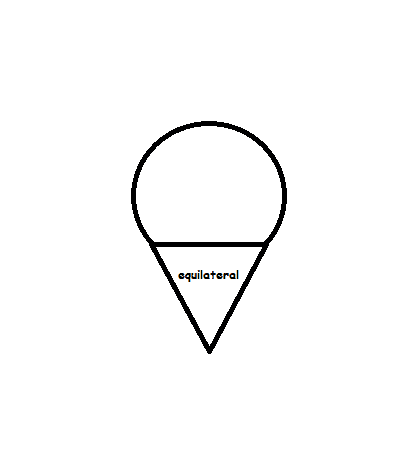
Let's say I have a shape that has a curve in it at some point. Something like this.
w97xc0V.png


I'm curious what I need to be reading in order to find the angle of the curve. what information do I need to know about the top part in order to find the angle at which the line curves?
 
Physics news on Phys.org
First you will have to tell us what you mean by "angle of a curve". In this picture, does the circle meet the triangle "smoothly"?
 
I've labled the shape a bit better.

L8yFNfP.png


I want to measure the angle of a and b and then I want to find out the degree at which the line curves.

Is is a smooth 70 degree curve? Maybe a smooth 60 degree curve?

This is basically what I'm asking myself. Sorry I'm not being that clear, I'm not even sure if what I'm asking can be solved. I'm just playing with what I'm learned so far.
 
No, this is not going to have any simple answer like '60' or '70'. The angles will depend both on the length of ab and the radius of the circle.

I am going to assume ab is less than the diameter of the circle. In particular, drawing lines from a and b to the center of the circle, call it O, gives a triangle with two sides of length Oa= Ob= r, the radius of the circle and one side of length ab. If we call the angle Oa and Ob make, then, by the cosine law, ab^2= 2r^2- 2r^2cos(\theta)= 2r^2(1- cos(\theta)). From that, cos(\theta)= (2r^2- ab^2)/2r^2 so that the angle between Oa and ab is \theta= arccos(2r^2- ab^2)/2r^2. Since the angle between a tangent to a circle and a radius is 90 degrees, to find the angle between ab and the tangent, add 90 degrees to that:
arccos(2r^2- ab^2)/2r^2)+ 90 degrees.
 
HallsofIvy said:
No, this is not going to have any simple answer like '60' or '70'. The angles will depend both on the length of ab and the radius of the circle.

I am going to assume ab is less than the diameter of the circle. In particular, drawing lines from a and b to the center of the circle, call it O, gives a triangle with two sides of length Oa= Ob= r, the radius of the circle and one side of length ab. If we call the angle Oa and Ob make, then, by the cosine law, ab^2= 2r^2- 2r^2cos(\theta)= 2r^2(1- cos(\theta)). From that, cos(\theta)= (2r^2- ab^2)/2r^2 so that the angle between Oa and ab is \theta= arccos(2r^2- ab^2)/2r^2. Since the angle between a tangent to a circle and a radius is 90 degrees, to find the angle between ab and the tangent, add 90 degrees to that:
arccos(2r^2- ab^2)/2r^2)+ 90 degrees.


Thanks so much. Quite a bit more work than I thought but thanks for making the effort to help :)
 

Similar threads

  • · Replies 8 ·
Replies
8
Views
3K
  • · Replies 21 ·
Replies
21
Views
2K
  • · Replies 10 ·
Replies
10
Views
3K
  • · Replies 2 ·
Replies
2
Views
3K
  • · Replies 3 ·
Replies
3
Views
3K
  • · Replies 2 ·
Replies
2
Views
5K
  • · Replies 5 ·
Replies
5
Views
3K
  • · Replies 3 ·
Replies
3
Views
1K
Replies
3
Views
2K
  • · Replies 2 ·
Replies
2
Views
2K