How can I rotate a coordinate system and write functions in the rotated system?

Click For Summary
To rotate a coordinate system to align with y = x and y = -x, one can use the transformation equations x' = x - y and y' = x + y, which effectively rotate points by 45 degrees counter-clockwise and scale them by √2. The goal is to map the original point (1, 0) to (1, 1) and (0, 1) to (-1, 1). It’s important to note that both rotation and scaling are necessary to achieve the desired mapping of points. The discussion emphasizes the need for linear transformations to maintain uniformity across the plane. Understanding these transformations is crucial for analyzing fixed points in the new coordinate system.
Gackhammer
Messages
13
Reaction score
0
Hey

So, I was wondering how to convert from one coordinate axes to another... in particular, where the new axes are y = x and y = -x, as seen by the picture below
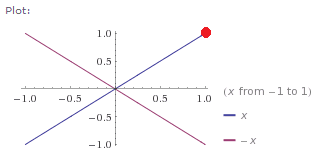
axes_zps960a5326.png


I want it so that the Red dot in the new coordinate system will be (\sqrt2,0). Is there an easy way to do this? (My lookings on the internet have not come up with anything good yet)

EDIT: Ok, I just found the equations to rotate, but I was wondering how I can write functions in this rotated coordinate system (Im trying to relate this to my recurrences work/fixed point stuff). I am trying to rotate the coordinate system then find the zeros in the rotated coordinate system to find the fixed points of the function
 
Last edited:
Mathematics news on Phys.org
Find formulas to transform your old parameters (x & y) into your new ones, and then substitute one for the other in equations.

Are you sure a rotation will be enough for you? (A.K.A., what x,y point do you want to be mapped to your new point root(2),0 ?)
 
Vorde's point is that the distance from (0, 0) to (1, 0) is, of course, 1 while the distance from (0, 0) to your red point is \sqrt{2}. You will need an expansion as well as a rotation.

x'= x- y, y'= x+ y will map (1, 0) to (1, 1) and map (0, 1) to (-1, 1).
That is, essentially, a rotation by 45 degree, counter-clockwise and a multiplication by \sqrt{2}.

You could have gotten those relations more easily by seeing that they must be linear, of the form x'= ax+ by and y'= cx+dy, since you do not want one part of the plane "stretched" or "squeezed" more than another. Further, you want (1, 0) to be mapped to (1, 1) so 1= a(1)+ b(0) and 1= c(1)+ d(0) giving a= 1, c= 1. You also want (0, 1) mapped to (-1, 1) so -1= a(0)+ b(1) and 1= c(0)+ d(1) giving b= -1, d= 1: x'= x- y, y'= x+ y as I said.
 
Here is a little puzzle from the book 100 Geometric Games by Pierre Berloquin. The side of a small square is one meter long and the side of a larger square one and a half meters long. One vertex of the large square is at the center of the small square. The side of the large square cuts two sides of the small square into one- third parts and two-thirds parts. What is the area where the squares overlap?

Similar threads

  • · Replies 2 ·
Replies
2
Views
2K
  • · Replies 1 ·
Replies
1
Views
1K
  • · Replies 1 ·
Replies
1
Views
2K
  • · Replies 1 ·
Replies
1
Views
1K
  • · Replies 1 ·
Replies
1
Views
2K
Replies
1
Views
2K
  • · Replies 3 ·
Replies
3
Views
2K
  • · Replies 2 ·
Replies
2
Views
2K
  • · Replies 6 ·
Replies
6
Views
2K
  • · Replies 1 ·
Replies
1
Views
1K