How can I solve a dynamic vibration problem?

  • Thread starter Thread starter deuel18
  • Start date Start date
  • Tags Tags
    Dynamic Vibration
Click For Summary

Discussion Overview

The discussion revolves around solving a dynamic vibration problem related to a bar in equilibrium, focusing on the effects of weight and spring constants in the context of homework assistance. Participants explore the application of equations of motion and the implications of including weight in the analysis.

Discussion Character

  • Homework-related
  • Technical explanation
  • Conceptual clarification

Main Points Raised

  • One participant expresses uncertainty about their approach to a dynamic vibration problem and seeks help.
  • Another participant suggests writing the equation of motion to identify effective inertia and stiffness.
  • A question is raised about whether to consider the weight of the bar in the analysis, comparing it to a suspended mass with a spring.
  • Some participants emphasize the importance of accounting for weight, indicating that the bar is in equilibrium and that the weight affects the spring's compression.
  • A participant proposes using the sum of moments method at a pivot point and questions the relationship between weight and spring force in equilibrium.
  • There is a discussion about the condition for equilibrium and how it relates to the forces acting on the system.
  • One participant expresses confidence in their understanding but indicates difficulty with numerical calculations.

Areas of Agreement / Disagreement

Participants generally agree on the importance of considering weight in the problem, but there are varying interpretations of how it affects the equilibrium and the equations involved. The discussion remains unresolved regarding the specific calculations and their implications.

Contextual Notes

Participants reference specific variables and conditions (e.g., preload, equilibrium) without fully resolving the mathematical relationships or assumptions involved in the problem.

deuel18
Messages
34
Reaction score
1
Thread moved from the technical forums, so no Homework Template is shown
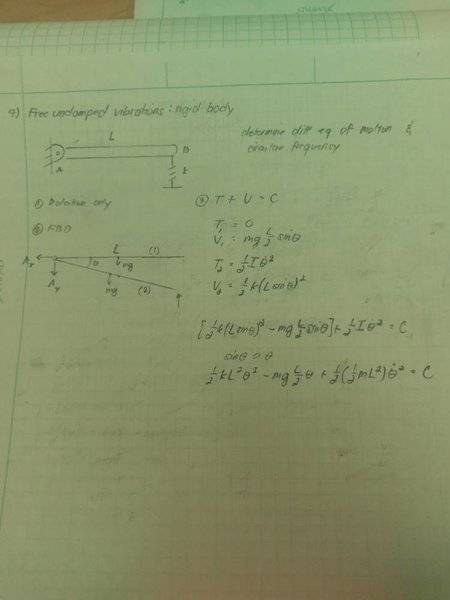
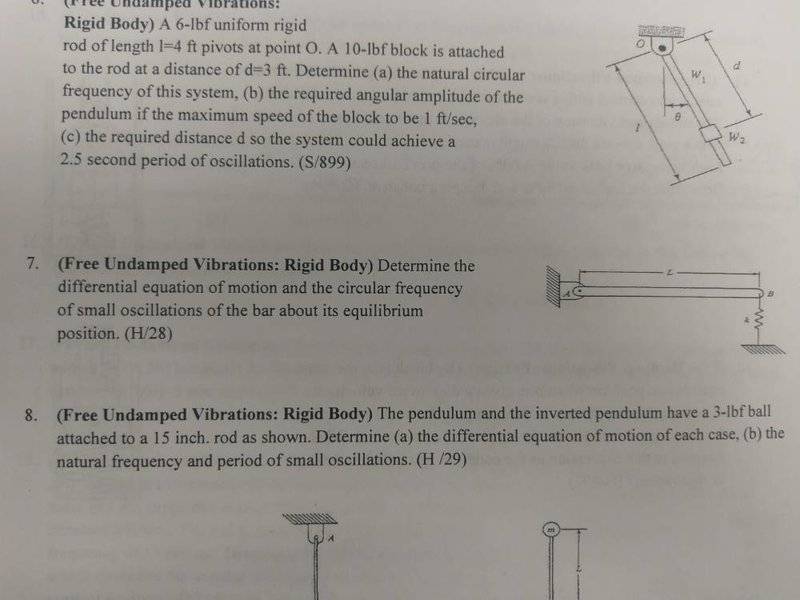
Hello. I need some help for my HW. I've been trying this particular problem but I don't know if I am on the right track. The problem and my progress in answering the problem is down below.
IMAG0366%7E2.jpg

IMAG0368.jpg
 
Physics news on Phys.org
I cannot read your work (I'm an old man with poor eyesight), but this is not a hard problem. Simply write the equation of motion and pull out the effective inertia and the effective stiffness from there.
 
Dr.D said:
I cannot read your work (I'm an old man with poor eyesight), but this is not a hard problem. Simply write the equation of motion and pull out the effective inertia and the effective stiffness from there.
I see. I guess my specific question is, if the bar as shown in number 7 is placed as is, should i take into account the weight? Like a suspended mass with spring, the weight is not considered. Is the same applies for this particular problem?
 
For your own learning, you should definitely take the weight into account. The implication seems to be that the bar is in equilibrium in the horizontal position shown, so that means that the weight is supported on compression in the spring. Determine the amount of preload on the spring, and then take that and the weight of the bar into account. If done properly, the prelaod and the weight terms should all cancel, leaving you with an equation for small displacements away from equilibrium.
 
Dr.D said:
For your own learning, you should definitely take the weight into account. The implication seems to be that the bar is in equilibrium in the horizontal position shown, so that means that the weight is supported on compression in the spring. Determine the amount of preload on the spring, and then take that and the weight of the bar into account. If done properly, the prelaod and the weight terms should all cancel, leaving you with an equation for small displacements away from equilibrium.
I got those in mind but if I choose sum of the moment method at pivot A, it gives mg(L/2) - k(delta)(L) - k(y)(L) = I(alpha). Does that mean mg(L/2) is equal to k(delta)(L)?
 
Well, what is the condition for equilibrium?
 
Ah i see. So the equilibrium cancels the mg with the kdelta.
 
Sounds like you've got it.
 
I do. I was able to do it on other problems. I am just having hard time crunching the numbers right. So i looked for guidance.
 

Similar threads

  • · Replies 12 ·
Replies
12
Views
3K
  • · Replies 2 ·
Replies
2
Views
1K
  • · Replies 1 ·
Replies
1
Views
2K
  • · Replies 1 ·
Replies
1
Views
2K
  • · Replies 1 ·
Replies
1
Views
1K
Replies
22
Views
4K
  • · Replies 1 ·
Replies
1
Views
2K
  • · Replies 1 ·
Replies
1
Views
3K
Replies
5
Views
1K
  • · Replies 1 ·
Replies
1
Views
2K