How can the Maclaurin series for sin^2(x) be simplified?

Click For Summary
SUMMARY

The Maclaurin series for sin^2(x) can be simplified using the half-angle property, which is the most straightforward method. When squaring the series for sin(x), the alternating signs do not cancel out as one might expect; instead, the series remains alternating. The Cauchy product can also be used to multiply two series, but this approach is more complex. Deriving sin^2(x) explicitly to find a pattern is another method, though it is not simple.

PREREQUISITES
  • Understanding of Maclaurin series
  • Familiarity with trigonometric identities, specifically the half-angle formulas
  • Knowledge of the Cauchy product for series multiplication
  • Basic calculus, including differentiation of trigonometric functions
NEXT STEPS
  • Study the half-angle identities for trigonometric functions
  • Learn about the Cauchy product and its applications in series
  • Explore the derivation of sin^2(x) and its patterns
  • Investigate the properties of alternating series in calculus
USEFUL FOR

Mathematicians, students studying calculus, and anyone interested in series expansions and trigonometric simplifications.

John112
Messages
19
Reaction score
0
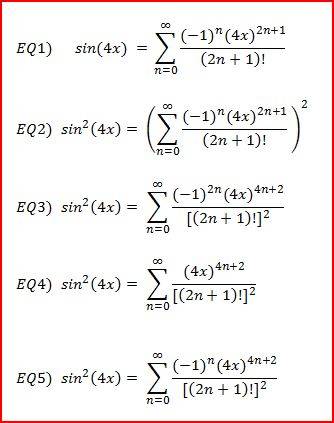
since the maclaurin series for sin x is alternating in sign (EQ1) so when you square it to get sin^{2}(x) (EQ2) the (-1)^{n} should become (-1)^{2n} (EQ3) which can be simplified down to (EQ4), but when i checked that series at wolframalpha the series was still alternating like: Why is that? So when we square it do we ignore squaring the (-1)^{n} and put that after we're done squaring the series?In the above post when I say EQ#, I'm referring to these equations
140jd7c.jpg
 
Last edited by a moderator:
Physics news on Phys.org
You seem to think that ##\left(\sum \alpha_n\right)^2 = \sum \alpha_n^2##. This is of course false. It's the same thing as saying that ##(x + y)^2 = x^2 + y^2##.
 
micromass said:
You seem to think that ##\left(\sum \alpha_n\right)^2 = \sum \alpha_n^2##. This is of course false. It's the same thing as saying that ##(x + y)^2 = x^2 + y^2##.
I can now see why sin^{2}(x) should be alternating, but how would I then simplify this algerbracially? how would I simplify ##\left(\sum \alpha_n\right)^2## ? Is using the half angle property for sin^{2}(x) my only method?
 
Last edited:
John112 said:
I can now see why sin^{2}(x) should be alternating, but how would I then simplify this algerbracially? how would I simplify ##\left(\sum \alpha_n\right)^2## ? Is using the half angle property for sin^{2}(x) my only method?
It's probably the easiest way to go.
 
John112 said:
I can now see why sin^{2}(x) should be alternating, but how would I then simplify this algerbracially? how would I simplify ##\left(\sum \alpha_n\right)^2## ? Is using the half angle property for sin^{2}(x) my only method?

The half-angle property is indeed the easiest way. But there also is a explicit way to multiply two series. This is called the Cauchy product: http://en.wikipedia.org/wiki/Cauchy_product So you can solve it with this too, but this is a lot more complicated.

Another way is to explicitely find the derivatives of ##\sin^2(x)## and see if you can find a pattern. But this is also not a very simple way to go.
 

Similar threads

  • · Replies 6 ·
Replies
6
Views
2K
  • · Replies 3 ·
Replies
3
Views
1K
  • · Replies 4 ·
Replies
4
Views
3K
  • · Replies 2 ·
Replies
2
Views
5K
  • · Replies 16 ·
Replies
16
Views
3K
  • · Replies 1 ·
Replies
1
Views
2K
  • · Replies 2 ·
Replies
2
Views
2K
  • · Replies 1 ·
Replies
1
Views
2K
Replies
3
Views
2K
  • · Replies 12 ·
Replies
12
Views
3K