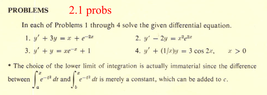
How can we solve the differential equation $y^\prime - 2y = x^2 e^{-2x}$?

  • Context: MHB 
  • Thread starter Thread starter karush
  • Start date Start date
Click For Summary

Discussion Overview

The discussion revolves around solving the differential equation \(y' - 2y = x^2 e^{-2x}\). Participants explore various methods for finding the solution, including the use of integrating factors and integration by parts. The conversation includes attempts to clarify steps in the solution process and to verify results against known answers.

Discussion Character

  • Technical explanation
  • Mathematical reasoning
  • Debate/contested

Main Points Raised

  • One participant proposes using the integrating factor \(u(x) = e^{-2x}\) to solve the ODE.
  • Another participant confirms the need to multiply through by the integrating factor and simplifies the equation.
  • There is a discussion about rewriting the left-hand side as the derivative of a product, but confusion arises regarding the correct form of the derivative.
  • Participants express uncertainty about the presence of a factor of 2 in the derivative and discuss the next steps involving integration.
  • One participant suggests integrating first before solving for \(y(x)\), while another provides a specific integral result using integration by parts.
  • There is a challenge to the correctness of the book's answer, with one participant questioning whether the ODE was stated correctly.
  • Another participant cites a result from Wolfram Alpha that appears to differ from both the book's answer and the ongoing calculations.

Areas of Agreement / Disagreement

Participants express differing views on the correctness of the book's answer and the approach to solving the ODE. There is no consensus on the final solution, and multiple competing interpretations of the steps and results remain present.

Contextual Notes

There are unresolved questions regarding the integration steps and the correctness of the initial differential equation as stated. Participants also note discrepancies between their calculations and results from external sources.
karush
Gold Member
MHB
Messages
3,240
Reaction score
5
ok going to try the next de!

$$\displaystyle y^\prime - 2y = x^2 e^{-2x}$$

I would assume that first

$$u(x) = e^{-2x}$$

book answer is:

$$y=\color{red}{\displaystyle ce^{2x}+\frac{x^3}{3}e^{2x}}$$
 
Physics news on Phys.org
You've correctly computed the integrating factor, so what does the ODE become after you multiply though by this integrating factor?
 
karush said:
I think we just multiply every term

$$\displaystyle (e^{-2x})y^\prime - 2(e^{-2x})y = x^2 e^{-2x}(e^{-2x})$$

if so the next would be to simplify

Yes, rewrite the LHS as the derivative of a product, and simplify the RHS. :)
 
karush said:
$$\frac{d}{dx}\left(e^{-2x}2y\right)=e^x(xe^{2x}+1)$$

really?

No, you would have:

$$\frac{d}{dx}\left(e^{-2x}y\right)=x^2e^{-4x}$$
 
MarkFL said:
No, you would have:

$$\frac{d}{dx}\left(e^{-2x}y\right)=x^2e^{-4x}$$

ok it was a product
what happened to the 2?
presumed next step...

$$\displaystyle y=e^{2x}\int x^2e^{-4x} \, dx + ce^{2x}$$

IBP??
 
Last edited:
karush said:
ok it was a product
what happened to the 2?

I'm not sure which 2 you're talking about...

karush said:
presumed next step...

$$\displaystyle e^{-2x}y=\int x^2e^{-4x} \, dx$$

IBP??

Yes, IBP for the RHS. :)
 
Personally, I would integrate first and then solve for $y(x)$. Either way though.
 
MarkFL said:
Personally, I would integrate first and then solve for $y(x)$. Either way though.

W|A returned this I don't see this heading towards the answer

$$\displaystyle\int x^2 e^{-4x} \, dx = -\frac{1}{32}e^{-4x} (8x^2+4x+1)+c$$

then

$$\displaystyle e^{-2x}y= -\frac{1}{32}e^{-4x} (8x^2+4x+1)+c$$

and

$$\displaystyle y= -\frac{1}{32}e^{-2x}(8x^2+4x+1)+ce^{2x}$$

But ? W|A says

$$y(x)=c_1 e^{2e} -\frac{1}{2} e^{-2e}x^2-\frac{1}{2}e^{-2e}x-\frac{ e^{-2e}}{4}$$
 
Last edited:
karush said:
W|A returned this I don't see this heading towards the answer

$\displaystyle\int x^2 e^{-4x} \, dx = -\frac{1}{32}e^{-4x} (8x^2+4x+1)+c$

The answer you cited as being given by the book is incorrect. Are you sure the ODE is given correctly?
 
  • #10
answer #2
https://www.physicsforums.com/attachments/8206
problem #2
View attachment 8205

W|A returned this:

$$\displaystyle y(x)=c_1 e^{2e} -\frac{1}{2} e^{-2e} x^2-\frac{1}{2} e^{-2e}x-\frac{ e^{-2e}}{4}$$
 

Attachments

  • Capture+_2018-06-08-07-45-01 (1).png
    Capture+_2018-06-08-07-45-01 (1).png
    30.2 KB · Views: 131
Last edited:

Similar threads

  • · Replies 10 ·
Replies
10
Views
2K
  • · Replies 2 ·
Replies
2
Views
2K
  • · Replies 5 ·
Replies
5
Views
2K
  • · Replies 10 ·
Replies
10
Views
2K
  • · Replies 2 ·
Replies
2
Views
2K
  • · Replies 2 ·
Replies
2
Views
2K
  • · Replies 4 ·
Replies
4
Views
5K
Replies
11
Views
2K
  • · Replies 12 ·
Replies
12
Views
3K
  • · Replies 2 ·
Replies
2
Views
2K