How Do Drag and Gravity Affect Projectile Motion?

Click For Summary
Projectile motion in a fluid is affected by drag and gravity, with drag represented by the acceleration term a_d = -kv, where k is a constant. The x-component of velocity can be expressed as v_x = v_{x0}e^{-kt}, indicating an exponential decay due to drag. The y-component incorporates both drag and gravitational acceleration, leading to the equation a_y = -kv_y - g. As time progresses, the projectile reaches terminal velocity when kv_y equals g, resulting in zero acceleration. Understanding these dynamics is crucial for accurately modeling projectile motion in fluid environments.
Warr
Messages
119
Reaction score
0
A projectile is ejected into an experimental fluid at time t = 0. The initial speed is v0 and the angle to the horizontal is theta. The drag in the projectile results in an acceleration term a_d=-kv, where k is a constant and v is the velocity of the projectile. Determine the x- and y-components of both the velocity and displacement as functions of time. What is the terminal velocity? Include the effects of gravitational acceleration.

here's a diagram:
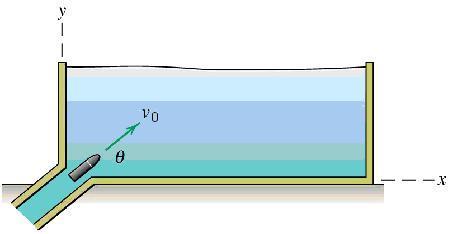
attachment.php?attachmentid=4891&stc=1.jpg


I don't really know what I'm doing here.

What I tried was splitting it into components and solving the dif eqs. I didn't know what 'constants' of integration would do so I just left them out.

a_x = -kv_x
v_x = e^(-kt)

a_y = -kv_y - g
v_y = -(gt)e^(-k*t)

let me just say I seriously do not know what I'm doing. Thus far we hadn't had any dif. eqs in the examples in class. No drag forces with gravity or anything. Btw this has to be solved with dynamics not statics I believe. I'm probably going in the completely wrong direction..
 

Attachments

  • yah.JPG
    yah.JPG
    7.2 KB · Views: 863
Last edited:
Physics news on Phys.org
Warr said:
A projectile is ejected into an experimental fluid at time t = 0. The initial speed is v0 and the angle to the horizontal is theta. The drag in the projectile results in an acceleration term a_d=-kv, where k is a constant and v is the velocity of the projectile. Determine the x- and y-components of both the velocity and displacement as functions of time. What is the terminal velocity? Include the effects of gravitational acceleration.

I don't really know what I'm doing here.

What I tried was splitting it into components and solving the dif eqs. I didn't know what 'constants' of integration would do so I just left them out.

a_x = -kv_x
v_x = e^(-kt)

a_y = -kv_y - g
v_y = -(gt)e^(-k*t)

let me just say I seriously do not know what I'm doing. Thus far we hadn't had any dif. eqs in the examples in class. No drag forces with gravity or anything. Btw this has to be solved with dynamics not statics I believe. I'm probably going in the completely wrong direction..
Resolving into components:

k\dot s_x + \ddot s_x = 0 the solution of which is:

v_x = v_{x0}e^{-kt}

and:

k\dot s_y + \ddot s_y = g

You can work out that solution, but you can also see that when kt is large, v_x = 0[/tex] and when kv<sub>y</sub> = g or v<sub>y</sub> = g/k there is zero acceleration and the object reaches terminal velocity. <br /> <br /> AM
 
The book claims the answer is that all the magnitudes are the same because "the gravitational force on the penguin is the same". I'm having trouble understanding this. I thought the buoyant force was equal to the weight of the fluid displaced. Weight depends on mass which depends on density. Therefore, due to the differing densities the buoyant force will be different in each case? Is this incorrect?

Similar threads

  • · Replies 7 ·
Replies
7
Views
1K
  • · Replies 8 ·
Replies
8
Views
1K
Replies
10
Views
1K
  • · Replies 1 ·
Replies
1
Views
2K
Replies
11
Views
1K
  • · Replies 2 ·
Replies
2
Views
1K
  • · Replies 13 ·
Replies
13
Views
4K
  • · Replies 13 ·
Replies
13
Views
3K
  • · Replies 6 ·
Replies
6
Views
3K
  • · Replies 1 ·
Replies
1
Views
1K