How do I find missing angles in trigonometry and geometry?

  • Context: MHB 
  • Thread starter Thread starter clhrhrklsr
  • Start date Start date
  • Tags Tags
    Angles
Click For Summary
SUMMARY

This discussion focuses on finding missing angles in trigonometry and geometry using the tangent function. The participants clarify that for angles $K$ and $L$, the opposite and adjacent sides are essential for calculations. Specifically, the tangent function is utilized to derive angle $L$ from the ratio of the opposite side (10' 3") to the adjacent side (5' 6"). The inverse tangent function, represented as $L=\tan^{-1}\left(\frac{41}{22}\right)$, is used to compute the angle, with the reminder to ensure the calculator is set to degree mode.

PREREQUISITES
  • Understanding of basic trigonometric functions: sine, cosine, and tangent.
  • Knowledge of right triangle properties and angle relationships.
  • Familiarity with using calculators for trigonometric calculations.
  • Ability to convert mixed measures to decimal form for calculations.
NEXT STEPS
  • Learn how to use the inverse tangent function on various calculators.
  • Study the properties of complementary angles in right triangles.
  • Explore the application of trigonometric functions in real-world problems.
  • Investigate the conversion of mixed numbers to decimal for easier calculations.
USEFUL FOR

Students studying trigonometry and geometry, educators teaching these subjects, and anyone needing assistance with angle calculations in right triangles.

clhrhrklsr
Messages
23
Reaction score
0
View attachment 2879
Someone please take a look at the attachment above. These two questions have me stumped and it ask on each question to find three missing angles. I don't even know where to start. Could someone be so kind and explain to me how to figure each of these. I need help with this asap to help my studying of trigonometry and geometry. Thanks
 

Attachments

Mathematics news on Phys.org
For the convenience of our helpers, I have combined the images and resized a bit so that no one has to open an attachment:

View attachment 2880
 

Attachments

  • missingangles.png
    missingangles.png
    14 KB · Views: 114
For angles $K$ and $L$, you know the sides opposite and adjacent...so which trig. function do you think will come into play here?
 
MarkFL said:
For angles $K$ and $L$, you know the sides opposite and adjacent...so which trig. function do you think will come into play here?

Honestly, I'm not sure. I don't even know where to begin or how to start this. I apologize.
 
clhrhrklsr said:
Honestly, I'm not sure. I don't even know where to begin or how to start this. I apologize.

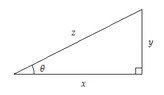
Consider the following right triangle:

View attachment 2881

With regards to the angle $\theta$, we say that side $x$ is adjacent, side $y$ is opposite, and side $z$ is the hypotenuse (the longest side, which is opposite the $90^{\circ}$ angle).

Now, in trigonometry, we define the three primary trigonometric functions as follows:

$$\sin(\theta)=\frac{\text{opposite}}{\text{hypotenuse}}=\frac{y}{z}$$

$$\cos(\theta)=\frac{\text{adjacent}}{\text{hypotenuse}}=\frac{x}{z}$$

$$\tan(\theta)=\frac{\text{opposite}}{\text{adjacent}}=\frac{y}{x}$$

So, we can see that when we know the opposite and adjacent sides, it is the tangent function which we can use to find the angle in question. Actually, it is the inverse of the tangent function that we will use, but in order to know where to begin, we decide which of the sides relative to the angle we know.

So, let's look at angle $L$. What are the opposite and adjacent sides?
 

Attachments

  • triangletrig.png
    triangletrig.png
    826 bytes · Views: 113
MarkFL said:
Consider the following right triangle:

View attachment 2881

With regards to the angle $\theta$, we say that side $x$ is adjacent, side $y$ is opposite, and side $z$ is the hypotenuse (the longest side, which is opposite the $90^{\circ}$ angle).

Now, in trigonometry, we define the three primary trigonometric functions as follows:

$$\sin(\theta)=\frac{\text{opposite}}{\text{hypotenuse}}=\frac{y}{z}$$

$$\cos(\theta)=\frac{\text{adjacent}}{\text{hypotenuse}}=\frac{x}{z}$$

$$\tan(\theta)=\frac{\text{opposite}}{\text{adjacent}}=\frac{y}{x}$$

So, we can see that when we know the opposite and adjacent sides, it is the tangent function which we can use to find the angle in question. Actually, it is the inverse of the tangent function that we will use, but in order to know where to begin, we decide which of the sides relative to the angle we know.

So, let's look at angle $L$. What are the opposite and adjacent sides?

The opposite site is the 5' - 6". The adjacent side is the 10' 3". how would I input this into my hp 48g+?
 
clhrhrklsr said:
The opposite site is the 5' - 6". The adjacent side is the 10' 3". how would I input this into my hp 48g+?

You have those reversed...the side opposite angle $L$ is 10' 3" while the side adjacent is 5' 6". So, if we convert from mixed measures, and using feet as the measure, we find:

$$\text{opposite}=10.25=\frac{41}{4}$$

$$\text{adjacent}=5.5=\frac{11}{2}$$

And so we may write:

$$\tan(L)=\frac{\frac{41}{4}}{\frac{11}{2}}=\frac{41}{4}\cdot\frac{2}{11}=\frac{41}{22}$$

And this implies:

$$L=\tan^{-1}\left(\frac{41}{22}\right)$$

Make sure your calculator is is degree mode if you wish to get a result in degrees.

Now, we could do the same for angle $K$, but if we observe that angles $K$ and $L$ are complementary, that is their sum is $90^{\circ}$, we can just use:

$$K=90^{\circ}-L$$

So, what do you get?
 
MarkFL said:
You have those reversed...the side opposite angle $L$ is 10' 3" while the side adjacent is 5' 6". So, if we convert from mixed measures, and using feet as the measure, we find:

$$\text{opposite}=10.25=\frac{41}{4}$$

$$\text{adjacent}=5.5=\frac{11}{2}$$

And so we may write:

$$\tan(L)=\frac{\frac{41}{4}}{\frac{11}{2}}=\frac{41}{4}\cdot\frac{2}{11}=\frac{41}{22}$$

And this implies:

$$L=\tan^{-1}\left(\frac{41}{22}\right)$$

Make sure your calculator is is degree mode if you wish to get a result in degrees.

Now, we could do the same for angle $K$, but if we observe that angles $K$ and $L$ are complementary, that is their sum is $90^{\circ}$, we can just use:

$$K=90^{\circ}-L$$

So, what do you get?

how do you input that 41/22 in the calculator? How does that turn into the angle for L?
 
clhrhrklsr said:
how do you input that 41/22 in the calculator? How does that turn into the angle for L?

I can't tell you how your particular calculator operates, but the inverse tangent of 41/22 represents the angle in question. I can point you to a site that will give you the angle though

arctan'('41'/'22')' - Wolfram|Alpha

If you scroll down a little, you will see it gives the angle in degrees, rounded to two decimal places.
 

Similar threads

  • · Replies 10 ·
Replies
10
Views
2K
  • · Replies 1 ·
Replies
1
Views
1K
  • · Replies 3 ·
Replies
3
Views
2K
  • · Replies 2 ·
Replies
2
Views
2K
  • · Replies 1 ·
Replies
1
Views
2K
  • · Replies 3 ·
Replies
3
Views
2K
Replies
1
Views
2K
Replies
4
Views
6K
  • · Replies 2 ·
Replies
2
Views
2K
  • · Replies 20 ·
Replies
20
Views
5K