How do I find Q without having a distance r?

  • Thread starter Thread starter BuBbLeS01
  • Start date Start date
Click For Summary

Homework Help Overview

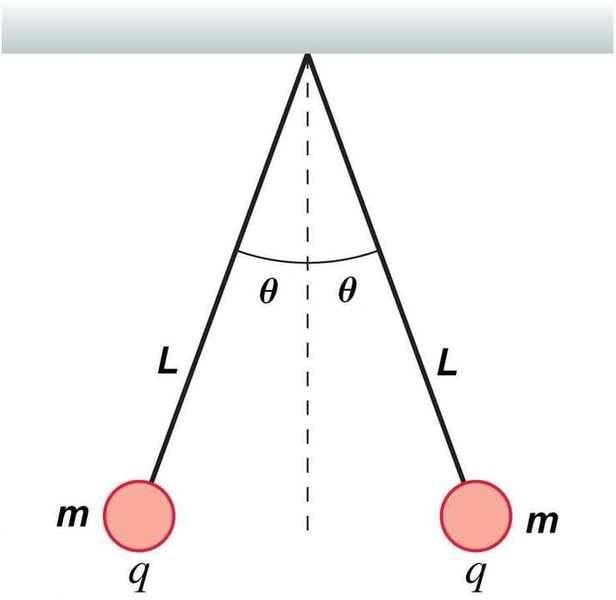
The problem involves two point charges that repel each other while suspended on threads, with the goal of determining the charge value given specific parameters such as mass, thread length, and angle. The context is rooted in electrostatics and forces in equilibrium.

Discussion Character

  • Exploratory, Conceptual clarification, Mathematical reasoning, Problem interpretation

Approaches and Questions Raised

  • Participants discuss how to derive the distance between charges using the given thread length and angle. There are attempts to set up equations based on forces acting on the charges, including tension, weight, and electrostatic forces. Questions arise about the equilibrium of forces and the inclusion of electric force in the analysis.

Discussion Status

The discussion is active, with participants exploring various aspects of the problem, including force components and their relationships. Some guidance has been provided regarding the setup of equations for equilibrium, but there is no explicit consensus on the final approach or solution.

Contextual Notes

Participants are working under the constraints of the problem statement, including the need to find charge without a direct distance measurement. There is an emphasis on understanding the vector nature of forces and the relationships between them.

BuBbLeS01
Messages
602
Reaction score
0
Charges...please help!

Homework Statement


8ayuy3l.jpg


Two 3.52 g point charges on 7.49-m-long threads repel each other after being equally charged. What is the charge q? (θ=31°.)


Homework Equations


F = KQQ/R^2


The Attempt at a Solution


How do I find Q without having a distance r?
 
Physics news on Phys.org
BuBbLeS01 said:
How do I find Q without having a distance r?
You are given the thread length and the angle--use that to figure out the distance.
 
Oh yea...so the length from the center to one of the masses is 3.858 m.
So I can do...
F = K*Q*Q/r^2
F = K*Q^2/ r^2
An wouldn't F = 0 since they cancel each other out?
 
Since the masses are in equilibrium, the net force on each is zero. What forces act on each mass?
 
Tension
 
BuBbLeS01 said:
Tension
That's one force. List them all. (And draw yourself a free body diagram showing how the force act on each mass.)
 
Tension and weight are the forces
 
So do I include the electric force? Like...
T - W + Fel = 0
 
BuBbLeS01 said:
Tension and weight are the forces
Don't forget the electrostatic force!
 
  • #10
Isn't that Fel?
 
  • #11
BuBbLeS01 said:
So do I include the electric force? Like...
T - W + Fel = 0
Yes, but realize that forces are vectors--direction counts. Set up two equations: One for the horizontal components, one for the vertical components. Combine these to solve for the charge.
 
  • #12
X.) TSINθ + qE = 0
y.) TCOSθ - mg = 0

T = mg/COSθ
mg/COSθ * SINθ + qE
q = -mg*TANθ/E
 
  • #13
BuBbLeS01 said:
X.) TSINθ + qE = 0
y.) TCOSθ - mg = 0
I'd write that first equation as:
Tsinθ - qE = 0 (since the force components are in opposite directions)

Realize that E is also a function of q, so rewrite that in terms of k, q, and r (which you figured out).

Otherwise, you are on the right track.
 
  • #14
Okay so I end up with...
-q = -(mg*tanθ) / (kq/r^2)
q = (mg*tanθ) / (kq/r^2)
and the q's cancel?
= (mg*tanθ) / (k/r^2)
 
  • #15
BuBbLeS01 said:
Okay so I end up with...
-q = -(mg*tanθ) / (kq/r^2)
q = (mg*tanθ) / (kq/r^2)
and the q's cancel?
The q's don't cancel. And when you divide by a fraction, simplify the result. (Invert and multiply.)
 

Similar threads

  • · Replies 7 ·
Replies
7
Views
1K
  • · Replies 4 ·
Replies
4
Views
6K
  • · Replies 11 ·
Replies
11
Views
2K
  • · Replies 1 ·
Replies
1
Views
3K
  • · Replies 2 ·
Replies
2
Views
1K
  • · Replies 23 ·
Replies
23
Views
2K
  • · Replies 3 ·
Replies
3
Views
1K
  • · Replies 21 ·
Replies
21
Views
3K
  • · Replies 42 ·
2
Replies
42
Views
4K
  • · Replies 3 ·
Replies
3
Views
8K