How do I find the area inside one circle and outside another?

  • Context: MHB 
  • Thread starter Thread starter Dethrone
  • Start date Start date
  • Tags Tags
    Circles Overlapping
Click For Summary

Discussion Overview

The discussion revolves around finding the area inside one circle and outside another, specifically focusing on two overlapping circles in a plane. The problem involves determining the conditions under which the area of the smaller circle, which overlaps with a larger circle, is maximized. Participants explore mathematical approaches, boundary conditions, and integral setups without reaching a consensus on the solution.

Discussion Character

  • Exploratory
  • Mathematical reasoning
  • Debate/contested

Main Points Raised

  • One participant suggests that the area inside the smaller circle and outside the larger circle is largest when $r=(1+(2/\pi)^2)^{-1/2}$, asking for hints on how to start.
  • Multiple participants inquire about the placement of the circles and boundary conditions for $r$, with suggestions to simplify the equations by positioning the larger circle at the origin.
  • There is discussion about setting up an integral to represent the area to be maximized, with some participants expressing uncertainty about how to represent the desired area mathematically.
  • Participants propose using geometric relationships, such as right triangles formed by the centers and points of intersection, to derive necessary equations.
  • One participant expresses confusion regarding the application of the Fundamental Theorem of Calculus (FTOC) in differentiating the integral, leading to further exploration of the correct approach to find the derivative of the area function.
  • There are discussions about evaluating integrals representing the areas of the circles, with some participants noting the need for trigonometric substitutions and careful differentiation.
  • Several participants identify mistakes in their calculations and reasoning, indicating a collaborative effort to refine their understanding of the problem.

Areas of Agreement / Disagreement

Participants do not reach a consensus on the correct approach to maximize the area, with various methods and interpretations of the problem being proposed and debated throughout the discussion.

Contextual Notes

Participants express uncertainty regarding boundary conditions for $r$, the correct setup of integrals, and the application of calculus principles. There are mentions of potential mistakes in calculations and the need for careful differentiation, indicating that the discussion is ongoing and unresolved.

Who May Find This Useful

This discussion may be useful for individuals interested in mathematical reasoning related to geometry, calculus, and optimization problems involving circular areas.

Dethrone
Messages
716
Reaction score
0
Two circles lie in a plane. The circle of radius 1 meter overlaps the circle of smaller radius $r$ in such a way that their points of intersection are separated by distance $2r$. Show that the area inside the small circle and outside the large circle is largest when $r=(1+(2/\pi)^2)^{-1/2}$. Note: you don't need to know the anti-derivative of $\sqrt{1-x^2}$

Any hints as to where to start? :confused:
 
Physics news on Phys.org
Where would you choose to place the circles in the plane?

What are your boundary conditions regarding $r$ and what is the area at these boundaries?

Can you set up an integral equation representing the described area we wish to maximize? What should you do then?
 
MarkFL said:
Where would you choose to place the circles in the plane?

What are your boundary conditions regarding $r$ and what is the area at these boundaries?

Can you set up an integral equation representing the described area we wish to maximize? What should you do then?

I guess I could place the center of the larger circle at the origin to simplify its equation? By boundary conditions, do you mean $0<r<\frac{1}{2}$ and $0<A<\frac{\pi}{4}$?

The desired area is the portion outside the larger circle but inside the smaller circle...I'm not sure how to represent that.
 
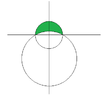
I think I would orient the smaller circle at the origin like so:

View attachment 3070

Any ideas on how to find the center of the larger circle?
 

Attachments

  • rido12a.png
    rido12a.png
    1.1 KB · Views: 153
That was exactly what I had in mind while I was waiting for you to post, but I couldn't figure out the center of the larger circle so I didn't post anything.

With renewed effort, I'll try again. Okay!
The equation of the larger circle:
$$x^2+(y-b)^2=1$$

Isolating for $b$:
$$b=y-\sqrt{1-x^2}$$

Still not sure what to do.
 
Draw a line from the centre of the large circle to one of the points of intersection. That will give you a right-angled triangle. Pythagoras??
 
I was thinking about that too...but I have one side $r$, and I don't know the length of the side from the intersection to the center, nor the center to the origin.
 
Rido12 said:
I was thinking about that too...but I have one side $r$, and I don't know the length of the side from the intersection to the center, nor the center to the origin.

What is the length of any ray from the circle's center to a point on the circle?
 
Assuming you're referring to the large circle, any ray from the center to its side is length $r$. Ah, I see what that means...I'll set up the integral now!
 
  • #10
Rido12 said:
Assuming you're referring to the large circle, any ray from the center to its side is length $r$. Ah, I see what that means...I'll set up the integral now!

Yes, and what is the radius of the larger circle? :D
 
  • #11
MarkFL said:
Yes, and what is the radius of the larger circle? :D

I think you're referring to the ray from the origin to the center of the larger circle, since we've been given the radius already...:D

$$s=\sqrt{r^2+1}$$

Therefore, the equation of the larger circle:

$$x^2+(y+\sqrt{r^2+1})^2=1$$

Am I okay to proceed?
 
  • #12
No, we have:

$$s^2+r^2=1\implies s=\sqrt{1-r^2}$$

It makes sense doesn't it that $s<1$ rather than $s>1$. :D
 
  • #13
The equation of the smaller circle:

$$x^2+y^2=r^2$$

We want only the top half:

$$y=\sqrt{r^2-x^2}$$

The equation of the larger circle:

$$x^2+(y+\sqrt{1-r^2})$$

The top portion:

$$y=\sqrt{1-x^2}-\sqrt{1-r^2}$$
 
Last edited:
  • #14
Okay, what are your limits of integration, and is there any symmetry you can employ?
 
  • #15
So I have:

$$A=2 \int_{0}^{r} \sqrt{r^2-x^2}-\sqrt{1-x^2}+\sqrt{1-r^2}\,dx$$

Is that right?
 
  • #16
Rido12 said:
So I have:

$$A=2 \int_{0}^{r} \sqrt{r^2-x^2}-\sqrt{1-x^2}+\sqrt{1-r^2}\,dx$$

Is that right?

Looks good to me. :D
 
  • #17
But I still have to prove that the area inside the small circle and outside the large circle is largest when $r=(1+(2/\pi)^2)^{-1/2}$. I'm not sure how to do it. I've tried to differentiate the integral, but I'm not sure.
 
  • #18
Okay, now to ease the computations, take the integral one term at a time. The first term simply represents the upper half of the area of the circle of radius $r$. For the other two terms, observe that one is not a function of $x$, and the other need not be integrated, since it will succumb to the derivative form of the FTOC.

Can you put all of this together to find $A'(r)$?
 
  • #19
I'm confused, is it not:
$$A'(r)=2 \d{A}{r}\int_{0}^{r} \sqrt{r^2-x^2}-\sqrt{1-x^2}+\sqrt{1-r^2}\,dx$$
Applying FTOC:
$$=\sqrt{r^2-r^2}-\sqrt{1-r^2}+\sqrt{1-r^2}$$
 
  • #20
Rido12 said:
I'm confused, is it not:
$$A'(r)=2 \d{A}{r}\int_{0}^{r} \sqrt{r^2-x^2}-\sqrt{1-x^2}+\sqrt{1-r^2}\,dx$$
Applying FTOC:
$$=\sqrt{r^2-r^2}-\sqrt{1-r^2}+\sqrt{1-r^2}$$

No, you cannot apply the derivative form of the FTOC to terms in the integrand that contain the variable with respect to which we are differentiating. Do you notice your result is simply zero?
 
  • #21
That makes sense. So for the first integral, I will have to use a trig substitution following with $cos^2x=\frac{1}{2}(1+cos2x)$?
 
  • #22
So I will have:

$$A'(r)=2\left[\frac{dA}{dr}\int_{0}^{r} \sqrt{r^2-x^2}\,dx-\frac{dA}{dr}\int_{0}^{r} \sqrt{1-x^2}\,dx+\d{A}{r}\int_{0}^{r} \sqrt{1-r^2} \,dx\right ]$$
$$=2\left[\d{A}{r}\frac{\pi r^2}{4}-\sqrt{1-r^2}+\d{A}{r}\left(r\sqrt{1-r^2}\right)\right]$$
$$=2\left[\frac{\pi r}{2}-\sqrt{1-r^2}+\sqrt{1+r^2}-\frac{r^2}{\sqrt{1-r^2}}\right]$$

(Whew)

My answer is off by a bit, where's my mistake? (Wondering) The question was very deceiving. "Note: you don't need to know the anti-derivative of $\sqrt{1-x^2}$". We needed to know the antiderivative of $\sqrt{r^2-x^2}$ which is the same thing, except with a variable...

EDIT: Found a mistake, but still another one.
 
Last edited:
  • #23
The first integral can be (cheaply) evaluated by noting it is the area under a semi-circle of radius $r$, that is:

$\displaystyle 2\int_0^r \sqrt{r^2 - x^2}\ dx = \dfrac{\pi r^2}{2}$.

As far as $x$ is concerned, the last integral is:

$\displaystyle 2\int_0^r f(r)\ dx = 2f(r)\int_0^r\ dx = 2f(r)r$, where $f(r)$ is a constant (depending on $r$).

Differentiating this with respect to $r$ gives:

$2f(r) + 2f'(r)r$

Now you can substitute in $f(r) = \sqrt{1-r^2}$. Make SURE you use the chain rule when differentiating to find $f'(r)$.
 
  • #24
We didn't actually need to know the anti derivative of the first term as it represents area of the upper half of the smaller circle. :D
 
  • #25
Rido12 said:
So I will have:

$$A'(r)=2\left[\frac{dA}{dr}\int_{0}^{r} \sqrt{r^2-x^2}\,dx-\frac{dA}{dr}\int_{0}^{r} \sqrt{1-x^2}\,dx+\d{A}{r}\int_{0}^{r} \sqrt{1-r^2} \,dx\right ]$$
$$=2\left[\d{A}{r}\frac{\pi r^2}{4}-\sqrt{1-r^2}+\d{A}{r}\left(r\sqrt{1-r^2}\right)\right]$$
$$=2\left[\frac{\pi r}{2}-\sqrt{1-r^2}+\sqrt{1+r^2}-\frac{r^2}{\sqrt{1-r^2}}\right]$$

(Whew)

My answer is off by a bit, where's my mistake? (Wondering) The question was very deceiving. "Note: you don't need to know the anti-derivative of $\sqrt{1-x^2}$". We needed to know the antiderivative of $\sqrt{r^2-x^2}$ which is the same thing, except with a variable...

EDIT: Found a mistake, but still another one.

So far, what you have looks good, note the two middle terms cancel. Now set $A'(r) = 0$, to find the critical points.
 
  • #26
Deveno said:
The first integral can be (cheaply) evaluated by noting it is the area under a semi-circle of radius $r$, that is:

$\displaystyle 2\int_0^r \sqrt{r^2 - x^2}\ dx = \dfrac{\pi r^2}{2}$.

As far as $x$ is concerned, the last integral is:

$\displaystyle 2\int_0^r f(r)\ dx = 2f(r)\int_0^r\ dx = 2f(r)r$, where $f(r)$ is a constant (depending on $r$).

Differentiating this with respect to $r$ gives:

$2f(r) + 2f'(r)r$

Now you can substitute in $f(r) = \sqrt{1-r^2}$. Make SURE you use the chain rule when differentiating to find $f'(r)$.

$$\displaystyle 2\int_0^r \sqrt{r^2 - x^2}\ dx = \dfrac{\pi r^2}{2}$$
If $\sqrt{r^2-x^2}$ is the upper area of a circle, then it should be $\frac{\pi r^2}{2}$. But there are two of them, so shouldn't it just be just $\pi r^2$?

- - - Updated - - -

I get as my critical number:

$$r=\sqrt{\frac{1}{1+(\frac{2}{\pi})^2}}$$

which is slightly different than the one given in the question...
...wait a minute...
...it's the same...I misread the question and I thought I made a mistake...(Giggle)(Headbang)(Headbang)(Headbang)(Headbang)

I thought the question read:
$$r=\sqrt{\frac{1}{1-(\frac{2}{\pi})^2}}$$
EDIT: my brain is failing me. $$\displaystyle \int_0^r \sqrt{r^2 - x^2}\ dx = \dfrac{\pi r^2}{4}$$ represents $\frac{1}{4}$ of the circle, and so...
$$\displaystyle 2\int_0^r \sqrt{r^2 - x^2}\ dx = \dfrac{\pi r^2}{2}$$

Thanks everyone, I got it now :D (Yes)
 
Last edited:
  • #27
Rido12 said:
$$\displaystyle 2\int_0^r \sqrt{r^2 - x^2}\ dx = \dfrac{\pi r^2}{2}$$
If $\sqrt{r^2-x^2}$ is the upper area of a circle, then it should be $\frac{\pi r^2}{2}$. But there are two of them, so shouldn't it just be just $\pi r^2$?

The "2" comes from the fact that we are only integrating from 0 to $r$ and doubling this. This is fine, since:

$g(x) = \sqrt{r^2 - x^2}$ is an even function and the interval $[-r,r]$ is symmetric about the origin.
 
  • #28
Here is a graph of the two circles, and you can adjust the radius of the smaller to see the area change. It is initialized at the optimum value:

[DESMOS=-2.1,2.1,-2.1,2.1]x^2+y^2=a^2;x^2+\left(y+\sqrt{1-a^2}\right)^2=1;a=0.843563608069[/DESMOS]

Click on the lower bound for the parameter $a$, and set the lower bound at 0 and the upper bound at 1, and the step size at 0.01, and then click the play button to animate it. :D
 
  • #29
Thanks guys! :D

Mark! That was super cool...(Cool)
 

Similar threads

Replies
4
Views
2K
  • · Replies 5 ·
Replies
5
Views
3K
  • · Replies 6 ·
Replies
6
Views
4K
  • · Replies 3 ·
Replies
3
Views
1K
  • · Replies 4 ·
Replies
4
Views
4K
  • · Replies 2 ·
Replies
2
Views
2K
  • · Replies 1 ·
Replies
1
Views
4K
  • · Replies 2 ·
Replies
2
Views
2K
Replies
1
Views
7K
  • · Replies 8 ·
Replies
8
Views
3K