How do I find the horizontal force/traction force of this?

  • Thread starter Thread starter riseofphoenix
  • Start date Start date
  • Tags Tags
    Force Horizontal
Click For Summary
SUMMARY

The discussion focuses on calculating the horizontal traction force exerted on a leg in a hospital setup using a pulley system. The tension in the rope supporting the leg is calculated as 78.5 N based on the formula F = mg, where m is the mass of the leg (8.00 kg) and g is the acceleration due to gravity (9.81 m/s²). The horizontal traction force, which is the total horizontal component of force acting on the foot from the pulley, is determined to be 105 N. The analysis assumes static equilibrium and frictionless pulleys for accurate calculations.

PREREQUISITES
  • Understanding of static equilibrium principles
  • Basic knowledge of pulley systems
  • Familiarity with Newton's laws of motion
  • Ability to perform vector resolution of forces
NEXT STEPS
  • Study the principles of static equilibrium in physics
  • Learn about the mechanics of pulley systems
  • Explore vector resolution techniques for force analysis
  • Investigate real-world applications of traction forces in medical settings
USEFUL FOR

Students in physics, medical professionals involved in rehabilitation, and engineers designing medical equipment will benefit from this discussion.

riseofphoenix
Messages
294
Reaction score
2
8. A setup similar to the one shown in the figure below is often used in hospitals to support and apply a traction force to an injured leg.
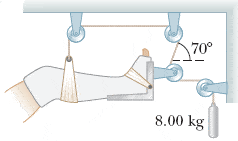
4-p-031.gif


(a) Determine the force of tension in the rope supporting the leg.

F = mg
F = (8.00)(9.81)
F = 78.48
F = 78.5 N

Is that all I had to do? It says I got the answer for this part right.

(b) What is the traction force exerted on the leg? Assume the traction force is horizontal.

This is where I'm completely lost and confused.
First of all, the horizontal traction force they are referring to is the longest one on top right?
If so, then do I have to find the value of that horizontal line?
How? o_O
They say the answer is supposed to be 105 N

Help!
 
Physics news on Phys.org
riseofphoenix said:
8. A setup similar to the one shown in the figure below is often used in hospitals to support and apply a traction force to an injured leg.

4-p-031.gif


(a) Determine the force of tension in the rope supporting the leg.

F = mg
F = (8.00)(9.81)
F = 78.48
F = 78.5 N

Is that all I had to do? It says I got the answer for this part right.
'Looks right to me! :approve:

If you still have questions why this is, you should assume that the system is in static equilibrium (i.e. nothing is moving). Second, assume that the pulleys are frictionless.

For a frictionless, simple pulley (with just one rope hanging off of it) in static equilibrium, the tension in the rope on one side is the same as the other side. [Edit, and assume the rope is ideal, mass-less, too.]
(b) What is the traction force exerted on the leg? Assume the traction force is horizontal.

This is where I'm completely lost and confused.
First of all, the horizontal traction force they are referring to is the longest one on top right?
If so, then do I have to find the value of that horizontal line?
How? o_O
They say the answer is supposed to be 105 N

Help!
What is meant by "traction force" is the total horizontal component of force on the foot, from the pulley attached to the foot. Notice that the pulley attached to the foot is being "pulled" to the right a little by the rope. (Well, technically it is still in static equilibrium due to the friction of the patient on the attached bed. But that's not the important thing. The point is that there is still a horizontal component of force acting on the foot-pulley ultimately from the rope.) This force acts to pull the foot away from the rest of the leg, in a net horizontal direction. Find this horizontal component of that force.
 
Last edited:

Similar threads

  • · Replies 1 ·
Replies
1
Views
8K
  • · Replies 3 ·
Replies
3
Views
8K
Replies
7
Views
6K
  • · Replies 6 ·
Replies
6
Views
2K
  • · Replies 3 ·
Replies
3
Views
14K
  • · Replies 41 ·
2
Replies
41
Views
4K
Replies
7
Views
3K
  • · Replies 9 ·
Replies
9
Views
3K
  • · Replies 4 ·
Replies
4
Views
2K
Replies
7
Views
7K