How Do I Find the Location of City C Relative to the Starting Point?

  • Thread starter Thread starter Kildars
  • Start date Start date
  • Tags Tags
    Vectors
Click For Summary

Homework Help Overview

The problem involves determining the location of city C relative to a starting point after a series of flights taken by a commuter airplane. The subject area pertains to vector addition and component analysis in physics.

Discussion Character

  • Exploratory, Mathematical reasoning

Approaches and Questions Raised

  • Participants suggest breaking down the flight paths into vector components and using trigonometry to calculate horizontal and vertical distances. There is an emphasis on maintaining correct signs for the directions involved.

Discussion Status

Some participants have provided guidance on how to approach the problem by focusing on vector components and trigonometric calculations. The discussion appears to be productive, with participants expressing gratitude for the assistance offered.

Contextual Notes

The original poster expresses uncertainty about how to begin the problem and notes a lack of clarity from the teacher, indicating a need for foundational understanding of vector analysis.

Kildars
Messages
95
Reaction score
0
A commuter airplane starts from an airport and takes the route shown in Figure P3.17. It first flies to city A located at 227.5 km in a direction 30.0° north of east. Next, it flies 195 km 20.0° west of north to city B. Finally, it flies 247 km due west to city C. Find the location of city C relative to the location of the starting point.

A) km (distance from the starting point)
B) ° west of north (angle from the starting point)
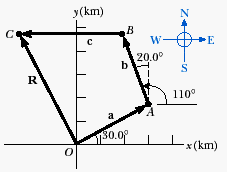
sf_route.gif


I'm not asking for people to do it for me, just show me where to start -- I don't really understand how to do it.. The teacher didn't really help me.
 
Physics news on Phys.org
Start by breaking down each vector into components. Because each of the angles are known, you should be able to break it down in x and y... Make sure to keep the sign straight (West is -x direction, South is -y direction etc...)
 
Ok. Thanks.
 
Last edited:
Use trig to work out the horizontal and vertical distance moved in each flight between cities.
Then just add them up into a resultant value, remembering to watch out for different directions.
 
Got it :) Thanks guys.
 

Similar threads

  • · Replies 2 ·
Replies
2
Views
6K
Replies
3
Views
2K
Replies
10
Views
4K
Replies
1
Views
7K
  • · Replies 7 ·
Replies
7
Views
2K
  • · Replies 2 ·
Replies
2
Views
2K
  • · Replies 4 ·
Replies
4
Views
9K
  • · Replies 1 ·
Replies
1
Views
5K
  • · Replies 17 ·
Replies
17
Views
4K
Replies
3
Views
3K