How do I simplify complex numbers and find real and imaginary parts?

Click For Summary

Homework Help Overview

The discussion revolves around simplifying complex numbers and identifying their real and imaginary parts. Participants are examining a specific approach to manipulating complex expressions and verifying the correctness of results obtained through various mathematical operations.

Discussion Character

  • Exploratory, Mathematical reasoning, Assumption checking

Approaches and Questions Raised

  • Participants discuss the method of multiplying by certain expressions to simplify complex numbers. Questions arise regarding the correctness of results and specific steps taken, such as the appearance of cosine in the denominator and the handling of certain values of x.

Discussion Status

There is an ongoing examination of the steps taken by the original poster, with some participants providing feedback on the correctness of the work shown. Suggestions for clearer presentation of the work and addressing potential typos have been made, indicating a collaborative effort to clarify the problem.

Contextual Notes

Participants note specific values of x that may lead to undefined expressions, highlighting the importance of considering these cases in the simplification process. There is also mention of a preference for typed work over images for clarity.

danik_ejik
Messages
18
Reaction score
0
Hello,
I need to simplify and find Re and I am of
gif.latex?\frac{1+e^{ix}}{1+e^{i2x}}.gif
.

I've multiplied by
gif.latex?\frac{1+e^{-i2x}}{1+e^{-i2x}}.gif
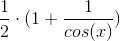
and got that Re=
gif.latex?\frac{1}{2}\cdot(1+\frac{1}{cos(x)}).gif
and Im=
gif.latex?\frac{-1}{2}tan(x).gif
.

Is that the correct way and a correct result ?
 
Physics news on Phys.org
seems fair to me
 
Show your work in detail. The final result is wrong. How did you get cos x in the denominator?

ehild
 
here's my work in details,
http://img811.imageshack.us/img811/7444/exsol.jpg"
 
Last edited by a moderator:
It is better if you type in your work.

I found a typo: You wrote that e-ix=cos (2x)-isin(2x).

ehild
 
it should have been
[URL]http://latex.codecogs.com/gif.latex?e^{-i2x}[/URL]
so the latter expansion is correct.
 
Last edited by a moderator:
OK, I see now. But you should exclude x=(2k+1)pi/2 before multiplying both numerator and denominator by 1+exp(-2ix) which is 0 if x=(2k+1)pi/2.
 
oh, forgot about that.
thanks
 
It would have been simpler to factor out exp(ix) from the denominator:

\frac{1+e^{ix}}{1+e^{2ix}}=\frac{1+e^{ix}}{e^{ix}(e^{-ix}+e^{ix})}=\frac{e^{-ix}(1+e^{ix})}{2\cos{x}}

ehild
 

Similar threads

  • · Replies 5 ·
Replies
5
Views
1K
  • · Replies 20 ·
Replies
20
Views
3K
  • · Replies 9 ·
Replies
9
Views
3K
  • · Replies 12 ·
Replies
12
Views
3K
  • · Replies 5 ·
Replies
5
Views
3K
  • · Replies 9 ·
Replies
9
Views
3K
  • · Replies 7 ·
Replies
7
Views
3K
  • · Replies 8 ·
Replies
8
Views
2K
  • · Replies 19 ·
Replies
19
Views
3K
Replies
9
Views
2K