- 2,794
- 12,343
Here's something different:
I just heard a podcast about recent biological research.
Fly are insects (arhtropods) with an exoskeleton.
An exoskeleton cuticle covers are the exposed surface areas of their equivalent of skin cells.
The cuticle is usually stiff and hard (to resist mechanical attack), but joints in things like legs and mouth parts have flexible areas going around the joints. Other parts of the cuticle get invaginated into areas where the muscles moving the legs reside (the other end of the muscle cells would be the inside of the outside cuticle on the appendage). Muscle cells move things by contracting. That is how they generate force. Lengthening is passive.
This is how things obvious from the outside of the insect move.
Crab eyes for example, can obviously move around because they are on the ends of jointed appendages.
Fly eyes are part of the head exoskeleton with out and flexible parts around it to let it move.
Insect eyes most unusually considered are compound eyes. They are not like the mobile human camera type eyes. They are formed of a curved surface of heir visual units, ommatidia, each aimed out to different areas in visual space. The visual field is filled out by combining the ommatidia outputs at higher neural levels.
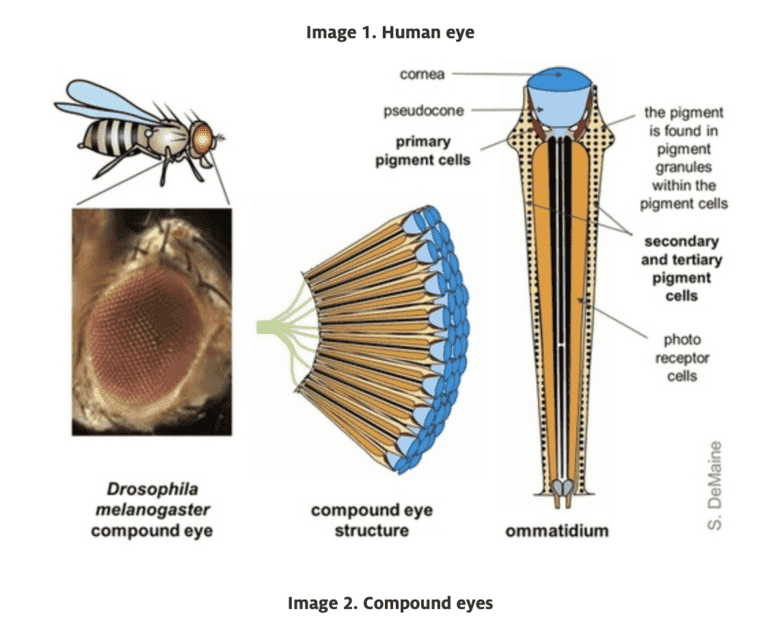
(from https://azretina.sites.arizona.edu/node/789)
The blue parts at the top of the ommatidia act as a lens so only light from a certain part of the visual field gets to the receptor cells.
The ommatidia also act as light tubes due to internal reflection.
They were interviewing researchers who seem to have found little muscles that pull on the retina (inner parts of the ommatidia). Insect neurobiologists describe insects as crunchy on the outside and squishy on the inside, so this is not so surprising.
This muscle action could change the part of the visual field they are looking at by moving the receptor cells a bit with respect to the outer lens part.
In the interview, they talked about apparent depth perception and associated behavior responses, which indicates the effect is of behavioral significance (working through the nervous system).
This is a pretty surprising finding to me. Did not know about these muscles.
I just heard a podcast about recent biological research.
Fly are insects (arhtropods) with an exoskeleton.
An exoskeleton cuticle covers are the exposed surface areas of their equivalent of skin cells.
The cuticle is usually stiff and hard (to resist mechanical attack), but joints in things like legs and mouth parts have flexible areas going around the joints. Other parts of the cuticle get invaginated into areas where the muscles moving the legs reside (the other end of the muscle cells would be the inside of the outside cuticle on the appendage). Muscle cells move things by contracting. That is how they generate force. Lengthening is passive.
This is how things obvious from the outside of the insect move.
Crab eyes for example, can obviously move around because they are on the ends of jointed appendages.
Fly eyes are part of the head exoskeleton with out and flexible parts around it to let it move.
Insect eyes most unusually considered are compound eyes. They are not like the mobile human camera type eyes. They are formed of a curved surface of heir visual units, ommatidia, each aimed out to different areas in visual space. The visual field is filled out by combining the ommatidia outputs at higher neural levels.
(from https://azretina.sites.arizona.edu/node/789)
The blue parts at the top of the ommatidia act as a lens so only light from a certain part of the visual field gets to the receptor cells.
The ommatidia also act as light tubes due to internal reflection.
They were interviewing researchers who seem to have found little muscles that pull on the retina (inner parts of the ommatidia). Insect neurobiologists describe insects as crunchy on the outside and squishy on the inside, so this is not so surprising.
This muscle action could change the part of the visual field they are looking at by moving the receptor cells a bit with respect to the outer lens part.
In the interview, they talked about apparent depth perception and associated behavior responses, which indicates the effect is of behavioral significance (working through the nervous system).
This is a pretty surprising finding to me. Did not know about these muscles.