How Do Pulley Systems Affect the Force Needed to Lift Weights?

  • Thread starter Thread starter ciubba
  • Start date Start date
  • Tags Tags
    Conceptual Pulley
Click For Summary
SUMMARY

The discussion centers on the mechanics of pulley systems and how the number of rope segments affects the force required to lift weights. In System A, only 5 kg of force is needed due to two segments of rope sharing the load, while System B requires 10 kg because it has only one segment supporting the weight. The key takeaway is that the tension in the rope is inversely proportional to the number of segments lifting the mass; more segments result in less tension needed to elevate the weight.

PREREQUISITES
  • Understanding of basic physics principles, specifically force and tension.
  • Familiarity with pulley systems and their mechanical advantages.
  • Knowledge of weight distribution and load-bearing concepts.
  • Ability to interpret diagrams illustrating mechanical systems.
NEXT STEPS
  • Study the principles of mechanical advantage in pulley systems.
  • Learn about the calculations involved in tension and force distribution in multi-pulley setups.
  • Explore real-world applications of pulley systems in engineering and construction.
  • Investigate the effects of friction in pulley systems and how it alters force requirements.
USEFUL FOR

Students of physics, engineers, and anyone interested in understanding mechanical systems and their applications in lifting and load management.

ciubba
Messages
65
Reaction score
2
I am having trouble understanding the distribution of forces present within a pulley system; namely, how the number of sections of rope that supports an item manages to decrease the force necessary to move it.

For example, look at this picture
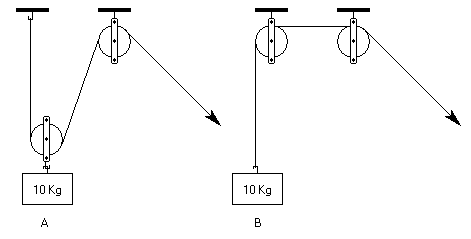
AA0809.gif


I am aware that system A only requires 5 kg force to elevate while system B requires a 10 kg force; that being said, I do not understand why that is true.
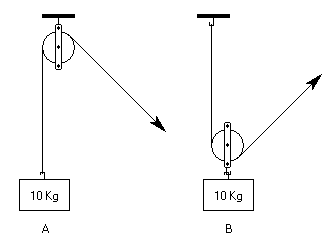

AA0808.gif


In this picture, it would appear that both weights are supported by the same number of rope-sections, yet B requires less force to elevate.
 
Physics news on Phys.org
ciubba said:
I am having trouble understanding the distribution of forces present within a pulley system; namely, how the number of sections of rope that supports an item manages to decrease the force necessary to move it.

For example, look at this picture

AA0809.gif


I am aware that system A only requires 5 kg force to elevate while system B requires a 10 kg force; that being said, I do not understand why that is true.
The amount of force that the ropes exert on the mass depends on the tension in the rope and how many rope segments are pulling up on the mass. In B there is only one segment pulling up on the mass, thus the tension in the rope must equal the weight. In A there are two segments pulling up on the mass, so the amount of tension required is less.


AA0808.gif


In this picture, it would appear that both weights are supported by the same number of rope-sections, yet B requires less force to elevate.
If you draw an imaginary box around the mass (including the attached pulley in B), you'll see that B has two segments pulling up on the mass.
 

Similar threads

  • · Replies 8 ·
Replies
8
Views
1K
  • · Replies 2 ·
Replies
2
Views
833
  • · Replies 18 ·
Replies
18
Views
5K
  • · Replies 33 ·
2
Replies
33
Views
8K
  • · Replies 13 ·
Replies
13
Views
7K
  • · Replies 8 ·
Replies
8
Views
3K
  • · Replies 8 ·
Replies
8
Views
3K
  • · Replies 3 ·
Replies
3
Views
2K
Replies
3
Views
2K
Replies
10
Views
1K