How Do Surgeons Perform Lung Transplants on Patients with Reversed Organs?

  • Context: Medical 
  • Thread starter Thread starter berkeman
  • Start date Start date
Click For Summary
SUMMARY

Surgeons face extraordinary challenges when performing lung transplants on patients with reversed thoracic organ syndrome, a condition where organs are mirrored in the body. Dr. Bharat emphasized the need for specialized 3D scans and meticulous planning to adapt donor lungs to fit the unique anatomy of these patients. The surgical process involves reattaching blood vessels in a manner that accommodates the reversed organ placement, making it a complex procedure. This adaptation is crucial for successful transplantation and requires innovative techniques to ensure compatibility.

PREREQUISITES
  • Understanding of thoracic anatomy and organ placement
  • Familiarity with surgical techniques for organ transplantation
  • Knowledge of 3D imaging technologies in medical applications
  • Basic principles of vascular anatomy and blood vessel reattachment
NEXT STEPS
  • Research advanced surgical techniques for organ transplantation in atypical anatomies
  • Explore the use of 3D printing in creating custom organ molds for surgery
  • Investigate the implications of situs inversus on other organ transplants
  • Study the genetic factors influencing organ placement and development in zebrafish models
USEFUL FOR

Medical professionals, particularly surgeons and transplant specialists, as well as researchers in anatomy and genetics, will benefit from this discussion on the complexities of lung transplants in patients with reversed organs.

berkeman
Admin
Messages
69,327
Reaction score
24,633
I knew a person back in my undergrad days who had this reversed thoracic organ syndrome. She was initially misdiagnosed for her appendicitis, but luckily had an x-ray to figure out what was going on (and a subsequent successful appendectomy).

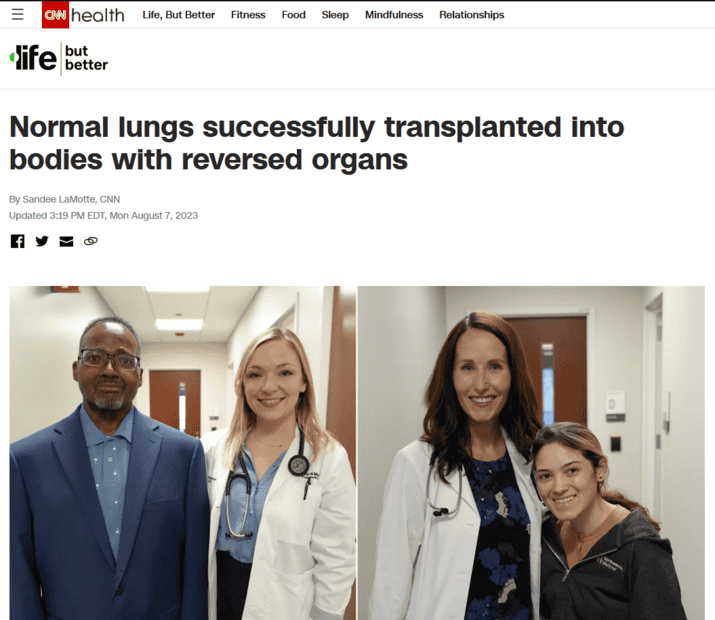
It's pretty amazing what these surgeons had to do to adapt normal lungs to the reversed thoracic anatomy of these two patients.
1691442661863.png

Years ago, people may have lived without realizing their organs were backward. Today, however, most people find out about the condition during a routine medical exam, Bharat said.

“Someone has tried to listen to their heart, and then they don’t find the heartbeat on the left side, so they get an X-ray, and everything looks reversed,” he said.

...

Complicated surgery​


Like Deer, Vega was put on the lung transplant waiting list, and like Deer, needed individualized treatment. Performing an organ transplant on patients with situs inversus is an extraordinary surgical challenge, Bharat said.

“We have to replace the old lungs — which are reversed in the body — with new lungs from a donor who has a typical or normal placement,” he said. “Because the new lungs need to fit into a chest cavity that’s a mirror image, we have to make technical modifications in order to do the surgery.”

Just reattaching blood vessels created in utero for a left lung to openings on a “normal” right lung, for example, was especially difficult. In addition, Deer’s and Vega’s lungs were unique in how their backward organs had developed and grown new blood vessels to compensate for the reversal.

“All these alterations in the anatomy require very careful planning. We had to use specialized 3D scans, mold the new lung to fit into the chest cavity, and then figure out how to tailor vessels and structures to fit in the lung that’s on the normal side,” Bharat said.

“It’s like taking a left sleeve off a shirt and then figuring out how to reattach it to the right side of the shirt instead.”

https://www.cnn.com/2023/08/07/health/reversed-organs-transplant-wellness/index.html
 
  • Like
  • Wow
Likes   Reactions: pinball1970 and BillTre
Biology news on Phys.org
There are zebrafish mutants that have this effect.
 
  • Informative
  • Like
Likes   Reactions: pinball1970 and berkeman
BillTre said:
There are zebrafish mutants that have this effect.
Interesting. Do you know if it happens at about the same rate, ~1/10,000?
 
The mutant frequency in research animals is determined by the genetics involved in breeding them and how new mutations were created in labs. So this kind of comparison is not that apt.

Its rare for studies of frequency of mutations in wild zebrafish populations.
Many of the "wild type" (meaning un-mutagenized) zebrafish genetic lines were initiated from fish from fish farms in Florida (which at the time supplied the US commercial pet fish business). These are a selected population from wild fish that might have been imported in the 1930-1950's. They would be selected for the fish farm conditions (which favor certain traits). Probably a genetically less diverse derivative population, that has changed some what. I did find a mutation (floating head) in a population of these fish, which turned out to be found by several other people on different continents because the the pet trade fish were passed around over the years.
I imported fish from India to start a new line. Even these would only be a small sample (~200 fish) of a population from a local area.
These lines were very distinct from the established lab lines in their sex-determination genetics.

Thanks for the opportunity to go on about this genetics stuff. :thumbup:
 
  • Informative
Likes   Reactions: pinball1970, Bystander and berkeman

Similar threads

  • · Replies 17 ·
Replies
17
Views
9K
  • · Replies 6 ·
Replies
6
Views
3K
  • · Replies 1 ·
Replies
1
Views
10K
  • · Replies 27 ·
Replies
27
Views
5K