Lambda96
- Messages
- 233
- Reaction score
- 77
- TL;DR
- How to calculate eigenvalues, eigenvectors, determinants and inverses of a general nxn matrix
Hi,
In my linear algebra homework, there is a bonus assignment where we are supposed to use Mathematica to calculate matrices and their determinants etc. here is the assignment.
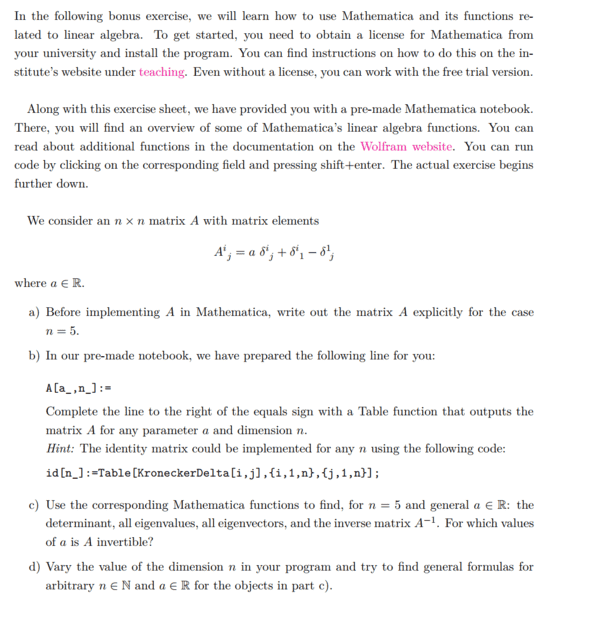
Unfortunately, I am a complete newbie when it comes to Mathematica, this is the first time I have worked with Mathematica.
I was able to calculate the task a to c. Here is the solution for task b and the Matrix for the case ##n=5##.

I have now problems with the task d, where I should calculate the determinants, eigenvalues, etc for the general case n or rather give a formula.
For the determinant as an example I proceeded as follows and unfortunately I get the following error:

Unfortunately I don't know how to fix the error or is my initial equation already wrong?
In my linear algebra homework, there is a bonus assignment where we are supposed to use Mathematica to calculate matrices and their determinants etc. here is the assignment.
Unfortunately, I am a complete newbie when it comes to Mathematica, this is the first time I have worked with Mathematica.
I was able to calculate the task a to c. Here is the solution for task b and the Matrix for the case ##n=5##.
I have now problems with the task d, where I should calculate the determinants, eigenvalues, etc for the general case n or rather give a formula.
For the determinant as an example I proceeded as follows and unfortunately I get the following error:
Unfortunately I don't know how to fix the error or is my initial equation already wrong?

