How Do You Calculate Maximum Torsion in a Spring System?

Click For Summary

Homework Help Overview

The discussion revolves around calculating the maximum torsion in a torsion spring system, focusing on the relationship between angular momentum, torque, and angular displacement. Participants explore the dynamics of a system involving a torsion spring and the conservation of energy and momentum principles.

Discussion Character

  • Mixed

Approaches and Questions Raised

  • Participants discuss the use of angular momentum and energy conservation to find the maximum angular displacement of the spring. There are attempts to relate angular speed and acceleration, with some questioning the applicability of certain equations due to the non-constant nature of acceleration in this context.

Discussion Status

Several participants have offered insights into the conservation of angular momentum and energy, suggesting that these principles are crucial for solving the problem. There is acknowledgment of confusion regarding the correct application of these concepts, and some participants express uncertainty about their understanding of the problem.

Contextual Notes

Participants note that the problem involves an inelastic collision, which complicates the conservation of mechanical energy. There are also discussions about the assumptions regarding the conservation of angular momentum and the conditions under which it applies.

NicolaiTheDane
Messages
100
Reaction score
10
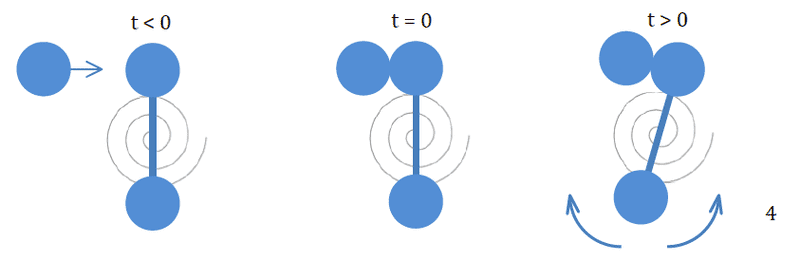
I need to find the maximum contortion of a torsion spring, for a given system. Most of the assignment I have done correct, but this last part I simply cannot get right. The pictures below is what I have used, but they are probably not necessary for this problem.
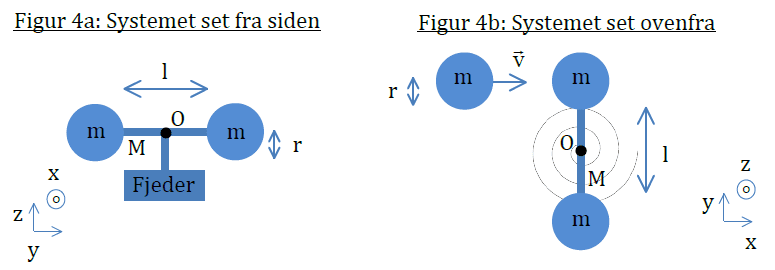
eGkMGey.png

78g8VCP.png


In prior parts of the problem, I figure out, that the angular momentum to the time 0, is

##L=-(l/2+r)*m*v##
Now the ways of writing the torque from the torsion spring, is as follows

##\tau = I*\alpha = -\kappa*\theta##

The attempt at a solution

My thought was, that to find an angular speed to a specific time, when knowing the time, the angular acceleration, and the angular speed at the start, I can use the following:

##\omega=\omega_0+\alpha*t##

I know that my angular momentum, to the specific time where the contortion is at its maximum is 0, as the spring has completely halted the rotational motion. I also know, that this happens at ##t=T/4##, where ##T## is the period (or at least I assume that, as it would make sense thinking about the spring period). As multiplying the ##I## on all factors, gives us an equal that seems desirable, we do that, and get:

$$0=I*\omega_0+I*\alpha*t \Rightarrow 0=-(l/2+r)*m*v+(-\kappa*\theta)*(T/4)$$

From my physics book I also know that ##T=2*\pi*\sqrt{\frac{I}{\kappa}}##. Plugging that in we get

$$0=I*\omega_0+I*\alpha*t \Rightarrow 0=-(l/2+r)*m*v-\frac{\kappa*\theta*\pi*\sqrt{\frac{I}{\kappa}}}{2}$$

Now the ##\theta## here, must to my understanding be the ##\Theta## I'm looking for, as that's that ##\theta## corresponding to the time I have plugged in. Solving for ##\theta## gives me:

$$\theta=\frac{2}{\pi}*\frac{(\frac{l}{2}+r)*m*v}{\sqrt{\kappa*I}}$$

Which according to the solution sheet is correct... except for that ##\frac{2}{\pi}##.

I cannot see what I'm doing wrong, or what I have misunderstood. Please help.
 

Attachments

  • eGkMGey.png
    eGkMGey.png
    8.7 KB · Views: 958
  • 78g8VCP.png
    78g8VCP.png
    8.6 KB · Views: 447
Physics news on Phys.org
NicolaiTheDane said:
My thought was, that to find an angular speed to a specific time, when knowing the time, the angular acceleration, and the angular speed at the start, I can use the following:

##\omega=\omega_0+\alpha*t##
You cannot use that equation here. It applies to constant acceleration situations. Here the acceleration is not constant; it depends on the angle.
 
kuruman said:
You cannot use that equation here. It applies to constant acceleration situations. Here the acceleration is not constant; it depends on the angle.

I suspected as much, but I have no idea on how to approach the problem then
 
I assume that ω0 is the angular speed of the combined three masses right after they are stuck together and just before the bar starts turning (θ = 0). If that's the case, then use energy conservation.
 
kuruman said:
I assume that ω0 is the angular speed of the combined three masses right after they are stuck together and just before the bar starts turning (θ = 0). If that's the case, then use energy conservation.

Using energy conservation doesn't work either.

Starting from ##1/2*I*\omega^2=1/2*\kappa*\theta^2## gets me the following

$$\theta^2=\frac{(\frac{l}{2}+r)*m*v}{\sqrt{\kappa*I}}$$

Its correct except its suppose to be ##\theta## and not ##\theta^2##. Any ideas?

EDIT: It seems to work out now, though to say that I understand what is going on, is beyond a stretch
 
NicolaiTheDane said:
Starting from ##1/2 *I*\omega=1/2*\kappa*\theta^2## gets me the following
Wrong starting point. The initial kinetic energy term is ##K=\frac{1}{2}I \omega_0^2.## Also, what is your expression for ##\omega_0## from the previous parts that you did not post?
 
kuruman said:
Wrong starting point. The initial kinetic energy term is ##K=\frac{1}{2}I \omega_0^2.## Also, what is your expression for ##\omega_0## from the previous parts that you did not post?

Yea the omega not being squared was a mistake on my part. I assumed in my solution that my omega, comes as a result of the angular momentum. So I did the following
$$L=-\left(\frac{l}{2}+r\right)*m*v=I*\omega \Rightarrow \omega =\frac{-\left(\frac{l}{2}+r\right)*m*v}{I}$$
Plugging that in gives me
$$\frac{1}{2}*I*\frac{-\left(\frac{l}{2}+r\right)*m*v}{I}^2=\frac{1}{2}*\kappa*\theta^2$$
Solving for ##\theta## gives the following:
$$\theta=\frac{(\frac{l}{2}+r)*m*v}{\sqrt{\kappa*I}}$$
Which is the desired result. Like I said, I'm not entirely sure what I'm doing here
 
NicolaiTheDane said:
Which is the desired result. Like I said, I'm not entirely sure what I'm doing here
This is what you are doing.

To find ##\omega_0## you need to conserve angular momentum before and after the collision. Linear momentum is not conserved because the two masses forming the dumbbell are presumably constrained from moving. Mechanical energy is not conserved because the collision is inelastic.

Right after the collision, mechanical energy is conserved. Initially all the mechanical energy is kinetic while at maximum angular displacement all the mechanical energy is potential. So you set the two equal to find the maximum angular displacement.
 
  • Like
Likes   Reactions: NicolaiTheDane
kuruman said:
This is what you are doing.

To find ##\omega_0## you need to conserve angular momentum before and after the collision.

By this, I presume you mean I simply have to remember, that angular moment is conserved. Because that was I presumed, and just went with it. I didn't actually "do" anything :)

Anyway thanks a bunch for the help! I had already tried conservation of energy before you suggested it. But I forgot start after the collision, so my result was non-sense. I probably wouldn't have tried again, if you hadn't pointed it out. Out of curiosity. If you were to solve it, using calculus, how would you go about it?
 
  • #10
NicolaiTheDane said:
By this, I presume you mean I simply have to remember, that angular moment is conserved.
This is not something to remember but something to consider because angular momentum is not always conserved. What you should remember is that whenever you have a collision you need to consider not assume whether any of the following three quantities are conserved before and after the collision. These are
1. Linear momentum. This is conserved if there are no forces keeping any part of the system from moving in a straight line.
2. Angular momentum. This is conserved if there are no torques keeping the system from rotating about the reference axis.
3. Mechanical energy. This is conserved if there is language in the problem to indicate that it is. Such language may be, "neglect air resistance", "neglect friction", "the collision is elastic", etc. Specifically, for spring-mass systems the default assumption is that mechanical energy is conserved unless there is language to say that it is not. So if a problem said that a block is attached at the end of the spring and oscillates back and forth on a horizontal surface, you are to assume that the surface is frictionless otherwise the problem would have said the block oscillates on a rough surface. I know it's confusing, but people who construct problems often follow tacit conventions. So my advice to you is that before you apply any of the three conservation principles, put them to the test and use them only if they pass.

Any use of calculus for this problem would be contrived. There are no differential equations of motion to be solved and no rates of change to be calculated. However, you could change the problem and find the maximum torsional angle if κ were not constant, but depended on the angle. For example, what if κ = κ0 + αθ, where κ0 and α are constants?
 

Similar threads

  • · Replies 17 ·
Replies
17
Views
1K
Replies
16
Views
2K
  • · Replies 9 ·
Replies
9
Views
1K
  • · Replies 42 ·
2
Replies
42
Views
4K
  • · Replies 5 ·
Replies
5
Views
1K
  • · Replies 12 ·
Replies
12
Views
2K
Replies
3
Views
2K
  • · Replies 6 ·
Replies
6
Views
2K
Replies
3
Views
1K
  • · Replies 12 ·
Replies
12
Views
2K