iwalani
- 2
- 0
[SOLVED] High Speed Camera Problem
Rotational Kinematics
So I'm pretty sure I'm just asking someone to point out the obvious for me, but I've been trying to figure out where to start on this problem for way too long. I don't want the answers, just some guidance on how to start in terms of what is given and what conversions need to be made. Thank you for your help in advance!
Problem:
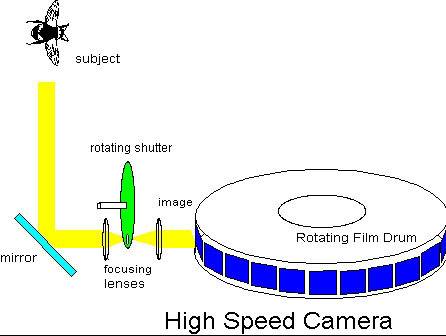
High speed cameras are used to photograph events which take place too quickly to be seen by the human eye. One such high speed camera is composed of a rotating film drum, a rotating shutter and some miscellaneous optics. The film is fastened along the outside of the drum (along its entire circumference) and the drum is driven by high pressure gas.
You desire to photograph the dynamics of a bumblebee in flight and estimate that its wings flap somewhere about 10,000 times a second. The radius of the film drum is r = 0.501 m and you've loaded it with 35mm film .
Questions:
(a) How many photographs will fit along the circumference of the drum? (Assume 35mm length is one photo)
Hint: One photo fits on every 35mm of film length. The total length of the film is equal to the circumference of the film drum.
(b) You desire to take the photographs at a frequency of 20,000 Hz. What is the angular frequency of the shutter? (Note: shutter has one hole in it!)
Hint: There are 2*p radians per revolution. You desire the solution in units of radians per second.
(c) What must the angular frequency of the film drum be?
(d) When the drum has taken its pictures, the gas is turned off and the drum slows down uniformly, finally setting to a standstill after 2 minutes. What was the angular acceleration of the film drum after turning off the gas?
(e) How many times does the film drum rotate after the gas is turned off and before coming to rest? Give your answers in revolutions.
Rotational Kinematics
So I'm pretty sure I'm just asking someone to point out the obvious for me, but I've been trying to figure out where to start on this problem for way too long. I don't want the answers, just some guidance on how to start in terms of what is given and what conversions need to be made. Thank you for your help in advance!
Problem:
High speed cameras are used to photograph events which take place too quickly to be seen by the human eye. One such high speed camera is composed of a rotating film drum, a rotating shutter and some miscellaneous optics. The film is fastened along the outside of the drum (along its entire circumference) and the drum is driven by high pressure gas.
You desire to photograph the dynamics of a bumblebee in flight and estimate that its wings flap somewhere about 10,000 times a second. The radius of the film drum is r = 0.501 m and you've loaded it with 35mm film .
Questions:
(a) How many photographs will fit along the circumference of the drum? (Assume 35mm length is one photo)
Hint: One photo fits on every 35mm of film length. The total length of the film is equal to the circumference of the film drum.
(b) You desire to take the photographs at a frequency of 20,000 Hz. What is the angular frequency of the shutter? (Note: shutter has one hole in it!)
Hint: There are 2*p radians per revolution. You desire the solution in units of radians per second.
(c) What must the angular frequency of the film drum be?
(d) When the drum has taken its pictures, the gas is turned off and the drum slows down uniformly, finally setting to a standstill after 2 minutes. What was the angular acceleration of the film drum after turning off the gas?
(e) How many times does the film drum rotate after the gas is turned off and before coming to rest? Give your answers in revolutions.
Last edited: