How Do You Calculate the Speed of a Block Launched by Compressed Springs?

  • Thread starter Thread starter pureouchies4717
  • Start date Start date
  • Tags Tags
    Spring
Click For Summary
SUMMARY

The discussion focuses on calculating the speed of a block launched by compressed springs using the principles of conservation of energy. In scenario A, the block is launched with an initial speed \( v_0 \) derived from the potential energy stored in a single spring, represented by the equation \( E_{total} = \frac{1}{2} k x^2 \). In scenario B, two identical springs compressing the block result in a new speed \( v \), where the spring constant effectively doubles to \( 2k \). By equating the energy expressions from both scenarios, one can derive a relationship between \( v_0 \) and \( v \).

PREREQUISITES
  • Understanding of conservation of energy principles
  • Familiarity with kinetic and potential energy equations
  • Knowledge of spring constants and Hooke's Law
  • Basic algebra for manipulating equations
NEXT STEPS
  • Study the conservation of energy in mechanical systems
  • Learn about Hooke's Law and its applications in spring mechanics
  • Explore the derivation of energy equations for different mechanical scenarios
  • Investigate the effects of multiple springs on energy calculations
USEFUL FOR

Students in physics, engineers working with mechanical systems, and anyone interested in the dynamics of spring mechanics and energy conservation principles.

pureouchies4717
Messages
98
Reaction score
0
hey guys, how would i go about solving this?

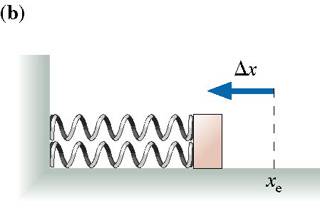
The spring in the figure (a) is compressed by length x. It launches the block across a frictionless surface with speed v_0. The two springs in the figure (b) are identical to the spring of the figure (a). They are compressed by the same length Deltax and used to launch the same block.What is the block's speed?
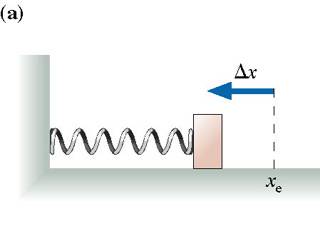
knight_Figure_10_38a.jpg


knight_Figure_10_38b.jpg
i know that this has to do something with v_0 raised to a power, but i can't figure out which power. please help
 
Last edited:
Physics news on Phys.org
I guess you'll need to use the conservation of energy (Etotal)before the motion= (Etotal)after the motion.

Think carefully: at the initial situation of pic A, what energy does the block contain (i.e. does it have any kinetic energy?, or potential energy?). Write down formulas for the types of energy the block has (i.e. kinetic energy= [tex]\frac{1}{2} mv^2[/tex] and add them. Now take a closer look at the variables in the formula:which values do they have in this situation?

Next consider the types of energies the block has when it has just left the spring and repeat the steps you took when you found an expression for the energy the block had at the initial situation. Be sure to equal both obtained equations and use it to obtain an expression for [tex]v_0[/tex].

Then consider situation B and do the same things you've done for situation A in order to obtain a different equation, but be sure to take into consideration that now there are two springs pushing the block, so instead of the spring constant C in part A you now are dealing with 2C. The equation you get from analyzing situation B can be written down in a way so you get an expression for v.

Now you only have to take a look at the expression of [tex]v_0[/tex] and compare it to the one you have for v.

Good luck! And if you don't understand some of my explanation, don't hesitate and please ask!

EDIT: :P Just found out you've already solved the problem ;)
 
Last edited:

Similar threads

  • · Replies 5 ·
Replies
5
Views
10K
Replies
17
Views
2K
Replies
3
Views
2K
Replies
29
Views
3K
Replies
8
Views
6K
Replies
4
Views
2K
  • · Replies 4 ·
Replies
4
Views
2K
  • · Replies 4 ·
Replies
4
Views
2K
  • · Replies 3 ·
Replies
3
Views
3K
  • · Replies 3 ·
Replies
3
Views
4K