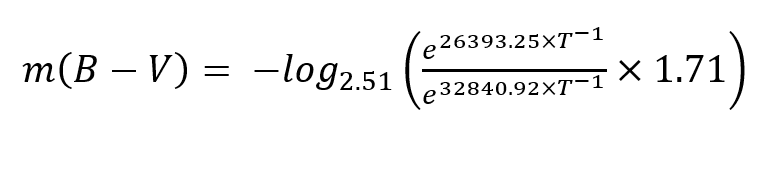
How do you calculate the uncertainty in T using graphs?

Click For Summary

Discussion Overview

The discussion revolves around calculating the uncertainty in temperature (T) using the magnitude difference (m(B-V)) from graphs. Participants explore various methods for determining T based on given uncertainties in m(B-V), including graphical intersections and mathematical derivations.

Discussion Character

  • Exploratory
  • Technical explanation
  • Mathematical reasoning
  • Debate/contested

Main Points Raised

  • One participant suggests calculating T at the extremes of the uncertainty in m(B-V) to find the difference in T values as a way to estimate uncertainty.
  • Another proposes using the derivative of T with respect to m(B-V) for error propagation, noting that this method assumes small errors.
  • A different approach involves inverting the equation to express T in terms of m(B-V) and applying standard error propagation techniques.
  • Some participants discuss the concept of monotonic functions and how it relates to the uncertainty in T, questioning the assumption of linear proportionality in the presence of significant uncertainty.
  • There are multiple calculations presented for T at specific m(B-V) values, with differing results leading to questions about the accuracy and methods used.
  • One participant points out the potential for asymmetric uncertainties based on the calculated T values, suggesting that the upper and lower uncertainties may need to be reported separately.

Areas of Agreement / Disagreement

Participants express differing views on the best method to calculate uncertainty in T, with no consensus reached on a single approach. There is also disagreement on the implications of monotonicity and linearity in the context of uncertainty calculations.

Contextual Notes

Some calculations depend on the accuracy of the input values for m(B-V) and the assumptions made about the relationship between m(B-V) and T. The discussion highlights the complexity of error propagation and the potential for asymmetric uncertainties.

Who May Find This Useful

Readers interested in error analysis, temperature calculations in astrophysics, or those working with magnitude differences in observational data may find the discussion relevant.

heavystray
Messages
71
Reaction score
0
i have an equation like this:
upload_2018-1-27_2-6-36.png

Given m(B-V)= 1.2 +- 0.2
How do you calculate the uncertainty in T? (btw, I solve T using graphs by finding the intersection point)

My idea was first to calculate T when m(B-V) =0.2, and I then calculate T when m(B-V)= 1.2 + 0.2(its uncertainty). and then find the difference between the two T. Your help would be greatly appreciated
 

Attachments

  • upload_2018-1-27_2-6-36.png
    upload_2018-1-27_2-6-36.png
    3.4 KB · Views: 1,134
Last edited:
Physics news on Phys.org
Your attachment cannot be viewed.
 
kuruman said:
Your attachment cannot be viewed.
ughh thanks for pointing that out, sorry!
 
There is the simple way -- assume that the solution for T is monotone in m(B-V). Evaluate T for m(B-V) = 1.4 and for m(B-V) = 1.0. See what the range is.

Evaluating the error range by looking at a partial derivative of T with respect to m(B-V) and then multiplying by the error bound on m(B-V) sounds like way too much work and may not even be accurate.
 
Take the derivative of both sides. You get something of the form:
dm(B-V) = (...) dT
where I'm too lazy to figure out the part in parentheses.
Then the error is
dT = dm(B-V) / (...)
then just let dm = 0.2

This assumes that the error is small, so that you can treat the error in T as linearly proportional to the error in m. This will fail if the error is actually not small.
 
  • Like
Likes   Reactions: jbriggs444
You can invert the equation and solve for T in terms of m(B-V). Then do standard error propagation. Use
$$\frac{{e^{\frac{a}{T}} } } {{e^{\frac{b}{T}}}}=e^{\frac{1}{T}(a-b)}$$
 
jbriggs444 said:
There is the simple way -- assume that the solution for T is monotone in m(B-V). Evaluate T for m(B-V) = 1.4 and for m(B-V) = 1.0. See what the range is.

Evaluating the error range by looking at a partial derivative of T with respect to m(B-V) and then multiplying by the error bound on m(B-V) sounds like way too much work and may not even be accurate.

what do you mean the for T is monotone? so the range would be divided by two right? thanks for the reply
 
kuruman said:
You can invert the equation and solve for T in terms of m(B-V). Then do standard error propagation. Use
$$\frac{{e^{\frac{a}{T}} } } {{e^{\frac{b}{T}}}}=e^{\frac{1}{T}(a-b)}$$

Wait, I'm really sorry, the equation supposed to have minus one after e, that's why i can't solve for T in terms of m(B-V) numerically. sorry again for uploading the wrong eq. thanks for the reply
upload_2018-1-27_10-2-58.png
 

Attachments

  • upload_2018-1-27_10-2-58.png
    upload_2018-1-27_10-2-58.png
    3.5 KB · Views: 585
heavystray said:
Wait, I'm really sorry, the equation supposed to have minus one after e, that's why i can't solve for T in terms of m(B-V) numerically.
That makes a big difference. Thanks for the clarification.
 
  • #10
heavystray said:
what do you mean the for T is monotone? so the range would be divided by two right? thanks for the reply
A function is monotone if it it always increases when its argument increases. Or if it always decreases when its argument increases. If a function is monotone then it takes on its extreme values at the extreme values of its input. This is a less strict condition than "linearly proportional".

The range would not be divided by two. The uncertainty could be different on each side of the measured/computed value.

WIth an uncertainty that is nearly as much as 20% of the measured value it might be wise to discard the assumption of linear proportionality.
 
  • #11
What is the value of T that gives m(B-V) = 1.2? I assume it is an experimental number.
 
  • #12
jbriggs444 said:
A function is monotone if it it always increases when its argument increases. Or if it always decreases when its argument increases. If a function is monotone then it takes on its extreme values at the extreme values of its input. This is a less strict condition than "linearly proportional".

The range would not be divided by two. The uncertainty could be different on each side of the measured/computed value.

WIth an uncertainty that is nearly as much as 20% of the measured value it might be wise to discard the assumption of linear proportionality.

if we use the above eq. when
m(B-V)= 1.2, T= 3930
when m(B-V)= 1, T= 4420
when m(B-V)= 1.4, T= 3530

so the uncertainty of T= is 4420-3530?

OR
we have to do it separately on both sides?
upper uncertainty= 3920-3530
lower uncertainty= 4420-3920

Thanks
 
Last edited:
  • #13
kuruman said:
What is the value of T that gives m(B-V) = 1.2? I assume it is an experimental number.

if we use the above eq. when m(B-V)= 1.2, T= 3930
when m(B-V)= 1, T= 4420
when m(B-V)= 1.4, T= 3530
 
  • #14
heavystray said:
if we use the above eq. when m(B-V)= 1.2, T= 3930
For m(B-V) = 1.2 I got T = 4960 for log base 2.51. The natural log gave me 3714 which is closer to your value of 3930.
 
  • #15
kuruman said:
For m(B-V) = 1.2 I got T = 4960 for log base 2.51. The natural log gave me 3714 which is closer to your value of 3930.
wait, how do you find the 4960?
 
  • #16
jbriggs444 said:
A function is monotone if it it always increases when its argument increases. Or if it always decreases when its argument increases. If a function is monotone then it takes on its extreme values at the extreme values of its input. This is a less strict condition than "linearly proportional".

The range would not be divided by two. The uncertainty could be different on each side of the measured/computed value.

WIth an uncertainty that is nearly as much as 20% of the measured value it might be wise to discard the assumption of linear proportionality.

if we use the above eq. when
m(B-V)= 1.2, T= 3930
when m(B-V)= 1, T= 4420
when m(B-V)= 1.4, T= 3530

so the uncertainty of T= is 4420-3530?

OR
we have to do it separately on both sides?
upper uncertainty= 3920-3530
lower uncertainty= 4420-3920

Thanks
 
  • #17

Similar threads

  • · Replies 1 ·
Replies
1
Views
3K
  • · Replies 7 ·
Replies
7
Views
3K
  • · Replies 4 ·
Replies
4
Views
2K
  • · Replies 6 ·
Replies
6
Views
2K
Replies
15
Views
1K
  • · Replies 8 ·
Replies
8
Views
2K
Replies
6
Views
2K
  • · Replies 20 ·
Replies
20
Views
2K
  • · Replies 48 ·
2
Replies
48
Views
5K
  • · Replies 1 ·
Replies
1
Views
2K