How Do You Calculate Torque for a Shaft Using a Torque Multiplier?

  • Thread starter Thread starter GRUMPYBLADE
  • Start date Start date
  • Tags Tags
    Calculation Torque
Click For Summary

Discussion Overview

The discussion revolves around calculating the force required at a shaft to achieve a specified torque using a torque multiplier with a 125:1 ratio. Participants explore the mechanics of torque, force, and gear ratios, with varying levels of expertise and understanding of the topic.

Discussion Character

  • Technical explanation
  • Debate/contested
  • Exploratory

Main Points Raised

  • One participant seeks help to calculate the force required at the shaft to achieve the indicated torque.
  • Another participant provides basic formulas for torque and power, questioning if the inquiry is a homework question.
  • A participant clarifies that the torque multiplier has a 125:1 ratio and expresses uncertainty about the solution, indicating a lack of expertise in the area.
  • There is a discussion about the relationship between torque and gear ratios, with one participant suggesting a formula for calculating torque based on the multiplier ratio.
  • Another participant questions whether the gearing also multiplies the force and attempts a calculation involving torque and radius.
  • A participant explains that if the output gear is the same size as the input gear, the torque does not increase, and they provide calculations for input torque based on the output torque and multiplier ratio.
  • One participant describes the torque multiplier as an arrangement of gears and expresses concern about the calculated input torque figure, referencing their previous experience with a lever and chain setup.

Areas of Agreement / Disagreement

Participants express differing views on how the torque multiplier functions and its impact on torque and force. There is no consensus on the calculations or the mechanics of the torque multiplier.

Contextual Notes

Some participants express uncertainty regarding the calculations and the operation of the torque multiplier, indicating potential missing assumptions or misunderstandings about the mechanics involved.

GRUMPYBLADE
Messages
5
Reaction score
0
Can anyone help?

I need a calculation to find the force required @ the shaft indicated, to achieve torque indicated at the locating faces.
Assemtorqueshaft.jpg
[/PLAIN]
 
Engineering news on Phys.org
I can't see what that 'torque multiplier" is. Is this a homework question?

The formulae you need are:

torque = force x distance
power = torque x angular speed

Here, distance is the radius from the axes at which you apply your force.
 
Hello Brewnog,

The torque multiplier has a 125:1 ratio and drives the shaft via the square cut out, this is actualy a work related question, but I'm still unclear as to the solution. This is not really my field of expertise, as I live in a cardboard box just past junction38 on the M1.

 
Hello Brewnog,

The torque multiplier has a 125:1 ratio and drives the shaft via the square cut out, this is actualy a work related question, but I am still unclear as to the solution. this is not really my field of expertise, as I live in a cardboard box just past junction38 on the M1
 
Well, I can't really understand how your torque multiplier works but if it has a ratio 0f 125:1 then

T1 = T2 x 125

or T2 = T1 x 125 depending on what part the torque is acting on.
 
Hello Topher925,

Surely it is not just a direct corelation? doesn't the gearing also multiply the amount of force? I don't know whether I am right but if I apply 19.2 ft/lb x 125 = 2400 x 5" (radius of gear) = 12000 ft/lb.

Just got to nip out to feed the ferret
 
Well I'll answer, but only since we Yorkshiremen have to stick together.

If the output gear were twice the size of the input gear, the torque would be doubled (speed would be halved) as per my second equation. Because the gears are the same size, the speed of the output gear is the same as that of the input gear, and torque is not increased. In fact, you lose a bit of torque to mechanical losses.

I still can't see how the torque multiplier works, but to achieve 12,000ft-lbs at your output shaft, and your torque multiplier is 125:1, then the input torque will be 12,000 / 125, or 12,000 x 125, depending on which way round your torque multiplier multiplies. The input torque would be a little over 96ft-lbs or 1,500,000ft-lbs respectively.

The first formula I quoted only applies if you are dealing with a force, not a torque.

Just got to nip out to feed the ferret

I do hope that's not a euphemism.
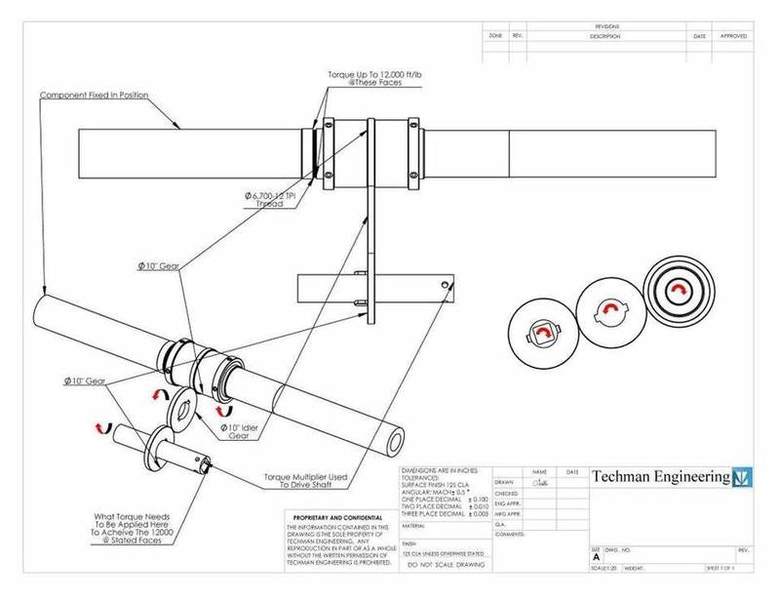
 
The torque multiplier is an enclosed arrangement of gears, with an input socket (to take a torque wrench), and output sprocket,(which fits the drive shaft), designed so you can set your torque wrench to 125th of the final output.

I'm still a little worried about the 96ft/lb figure, we started off using a lever and chain, knowing exactly how much force to apply, this moved the sleeve from hand-tight to 12000ft/lb approx 1" arouhd the diameter, using this as a guide we have torqued to approx 34ft/lb to achieve the same movement.

Got to go, the lurcher is pining
 

Similar threads

  • · Replies 5 ·
Replies
5
Views
5K
Replies
2
Views
3K
  • · Replies 5 ·
Replies
5
Views
2K
Replies
3
Views
5K
  • · Replies 8 ·
Replies
8
Views
3K
  • · Replies 2 ·
Replies
2
Views
2K
Replies
5
Views
3K
  • · Replies 2 ·
Replies
2
Views
4K
  • · Replies 6 ·
Replies
6
Views
4K