How Do You Derive the Full Energy Momentum Relation Using Lorentz Factor?

Join the discussion
Registration is free. Start your own thread to ask a follow-up.
7 replies · 2K views · last reply
Glenn G
Messages
113
Reaction score
12
Hi community,
There is a step on the wiki page about a derivation.
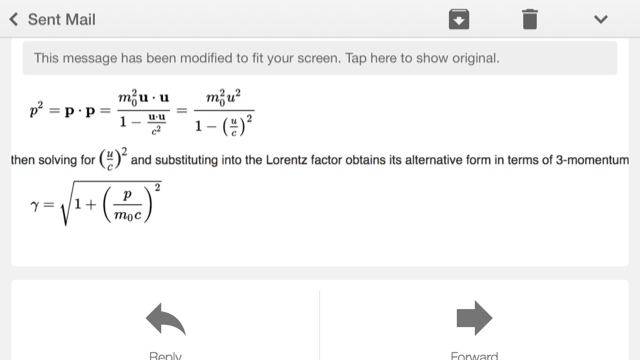
Screenshot of an email showing equations: p squared equals p dot p, equal to m0 squared u dot u over 1 minus u dot u over c squared, equal to m0 squared u squared over 1 minus (u/c) squared; then the Lorentz factor gamma equals the square root of 1 plus (p over m0 c) squared.

I don't seem to get the same thing when I try and solve for (u/c)^2 and then plug into Lorentz factor to get the new Lorentz factor so you can get the full energy momentum relation

My gamma term looks more like 1/ ((mo^2u^2/p^2))^-1/2 when I've subbed for (u/c)^2??

Can anyone help or any other resources to show easy as poss how to derive the full equation?
Thanks
G.
 
Physics news on Phys.org
I rearranged the top expression and made (u/c)^2 the subject but then you still have the u^2 that was in the numerator of the momentum expression? Confused.
 
Yes, so you have not solved for u^2/c^2. You need to actually solve for u^2/c^2.

Edit: Hint: Solve for u^2. The speed of light is just a constant.
 
Handwritten derivation on lined paper titled 'Derivation of energy-momentum relation', starting with E = γ m0 c^2 and p = γ m0 u, with γ = 1/sqrt(1 - u^2/c^2), followed by algebra in β^2 and ending with γ = (1 - p^2/(m0^2 c^2 + p^2))^(-1/2).

I got this far and became a bit convoluted. Will try for u^2 then.
Thanks.
G.
 
Hint:
$$
1 = \frac{m^2 c^2 + p^2}{m^2 c^2 + p^2}
$$
...
 
  • Like
Likes   Reactions: Glenn G
Ooh, that's cheeky. I'll have another play this evening, thanks Orodruin.