How Do You Derive the Moment of Inertia for a Film Projection Wheel with Holes?

Click For Summary

Homework Help Overview

The discussion revolves around deriving the moment of inertia for a film projection wheel that has four holes in its center. Participants are exploring the implications of these holes on the overall moment of inertia, particularly in the context of rotational dynamics.

Discussion Character

  • Exploratory, Conceptual clarification, Mathematical reasoning, Assumption checking

Approaches and Questions Raised

  • Participants discuss the addition of inertias for multiple masses and the concept of negative mass disks due to the holes. There is uncertainty about how to set up the integral for the moment of inertia and whether integration is necessary. Some participants suggest using known formulas for inertia, while others express confusion about applying the parallel axis theorem and how it relates to the holes.

Discussion Status

The discussion is active, with participants raising questions about the correct approach to account for the holes in the wheel. Some guidance has been provided regarding the use of the parallel axis theorem and the need to calculate moments of inertia for the holes, but there is still a lack of consensus on the best method to derive the final formula.

Contextual Notes

Participants are navigating through assumptions about mass distribution and the geometry of the wheel. There is mention of specific values, such as the mass of the disk being 10 kg, but the exact details of the setup and dimensions are not fully clarified.

leospyder
Messages
9
Reaction score
0
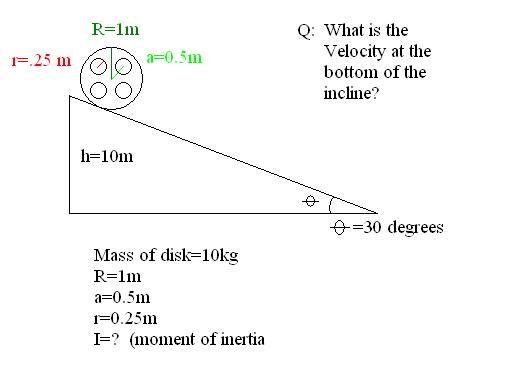
I need to derive the formula for this "film projection wheel" (it just has four holes in the center). I've looked all over google AND Hyperphysics but I haven't found a site that shows how to derive the formulas.
Please can someone help me (my physics teacher is a dick: he's been missing for 3/4 of the semester).:mad:
problem.jpg
 
Physics news on Phys.org
You add Inertias when you have more than one mass, right?

The film wheel is just a disk with 4 "negative mass disks" added to it, off-axis.
(use parallel-axis : add the Inertia of the center-of-mass around the axis to the Inertia around the center-of-mass)
 
the problem is i literally don't know where to begin. I understand subtracting the holes to get the moment. But i don't even know how to set-up the integral. I only know (integral)r(squared)dm, I am lost as to where to go from there.
 
You don't need to integrate. Most mortals look up Inertia formulas in a table.
Inertia of a disk around its center-of-mass is ½ M R^2 (axis perp to surface).
 
ok i found the MOI but what happens with the 4 holes? LIghtgrav, you said I should subtract the holes so would
the total moment of inertia be:

I= 1/2m(r)^2 - 4[1/2m(r)^2] but is it easy as subtracting the 4 holes, because
they are not concentric?


I was also told about the Parallel axis theorem but I am not sure what its used for exactly; would the d in the parallel axis theorem be 0.25 m (from the picture I included)?
 
As I see your diagram, the .25 m are the little (negative) disk radii.
The Inertia of the center-of-mass around the axis "d" is "a", which
points from the axis (the reel center) to the center of that (negative) disk.
This is EXACTLY what the parallel axis is for. You'll need it again
(the reel rotates around an axis at its edge, not at its center!)

Careful with your symbols ... I = ½ M R^2 - 4 (½ m r^2 + m a^2).
Can you figure out what "m" should be, if M = 10 kg ?
 
Last edited:
As I see your diagram, the .25 m are the little (negative) disk radii.
The Inertia of the center-of-mass around the axis "d" is "a", which
points from the axis (the reel center) to the center of that (negative) disk.
This is EXACTLY what the parallel axis is for. You'll need it again
(the reel rotates around an axis at its edge, not at its center!)

Careful with your symbols ... I = ½ M R^2 - 4 (½ m r^2 + m a^2).
Can you figure out what "m" should be, if M = 10 kg ?

Im confused now, because in an earlier post you said I could just subtract the four moments of inertia from the moment of inertia of the large circle. So is that correct or is the parallel axis theorem the correct formula to use? Also why is
I = ½ M R^2 - 4 (½ m r^2 + m a^2) ?
I assume your applying the Parallel Axis Theorem but how does this relate to the formula (im not questioning what you have, just why it is)?

Also to answer you question, m would be 10kg-4[pi(little r)^2]
 
As I see your diagram, the .25 m are the little (negative) disk radii.
The Inertia of the center-of-mass around the axis "d" is "a", which
points from the axis (the reel center) to the center of that (negative) disk.
This is EXACTLY what the parallel axis is for. You'll need it again
(the reel rotates around an axis at its edge, not at its center!)
So does this mean that saying I = I_cm + ml^2 is the proper moment of inertia for the reel rotating about is edge (I_cm is the moi that we derived and then subtracted the four "negative masses")?
Basically, I'm bothered by not understanding what to do about the holes in the reel. And it's not even my problem
 
leospyder said:
Im confused now, because in an earlier post you said I could just subtract the four moments of inertia from the moment of inertia of the large circle. So is that correct or is the parallel axis theorem the correct formula to use?
Yes and yes. You need to find the moments of inertia of the holes about the axis of rotation (not just their centers); that requires using the Parallel Axis Theorem.

Also why is
I = ½ M R^2 - 4 (½ m r^2 + m a^2) ?
I assume your applying the Parallel Axis Theorem but how does this relate to the formula (im not questioning what you have, just why it is)?
For how the parallel axis theorem relates to this formula, see my comment above.

Realize that in the formula provided by lightgrav:
M is the mass of a solid disk of radius R (if the holes were filled)
m is the mass of a disk of radius r with the same density as the solid disk​

You are given that the mass of "the disk" is 10 Kg. I assume that this is the mass of the "film projection wheel", holes and all. You'll have to figure out the surface density of the disk and use that to calculate M and m.
 

Similar threads

Replies
2
Views
4K
Replies
1
Views
3K
  • · Replies 7 ·
Replies
7
Views
2K
Replies
9
Views
44K
  • · Replies 5 ·
Replies
5
Views
21K
Replies
4
Views
8K
Replies
1
Views
3K
  • · Replies 5 ·
Replies
5
Views
5K
Replies
8
Views
5K
Replies
3
Views
2K