How Do You Form and Expand a Cubic Equation from Given Intersections?

  • Thread starter Thread starter Physiona
  • Start date Start date
  • Tags Tags
    Functional
Join the discussion
Ask a follow-up here, or get your own question answered by working scientists, mathematicians and engineers — people, not an autocomplete.
Real named experts · corrections over time · the nuance an AI answer skips
30 replies · 4K views
Physiona
Messages
131
Reaction score
9
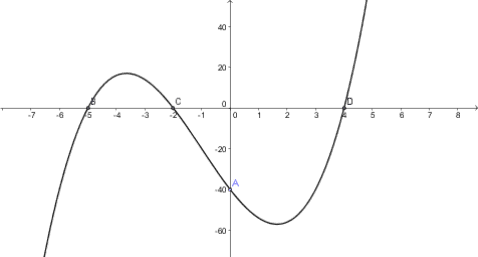
Shown below is the graph of
chart?cht=tx&chf=bg,s,FFFFFF00&chco=000000&chl=y%3Df%28x%29.png


The graph interests the
chart?cht=tx&chf=bg,s,FFFFFF00&chco=000000&chl=x.png
axis at 3 points, B, C and D.

Given the points of intersection, and the brackets below, form and expand an equation for

the graph of
chart?cht=tx&chf=bg,s,FFFFFF00&chco=000000&chl=y%3Df%28x%29.png
image?rev=4&h=257&w=478&ac=1.png


000000&chl=%28x%5C+%5C+%5C+%5C+%5C+%29%5C+%28x%5C+%5C+%5C+%5C+%29%5C+%28x%5C+%5C+%5C+%5C+%29%3D0.png


ATTEMPT:
I've assumed to involve the points of intersection for the x-axis which is 4, -2, and -5. It looks to be a cubic graph where x3. I'm not entirely convinced on how I progress from here if this way is correct. Any guidance? Thank you.
 

Attachments

  • chart?cht=tx&chf=bg,s,FFFFFF00&chco=000000&chl=y%3Df%28x%29.png
    chart?cht=tx&chf=bg,s,FFFFFF00&chco=000000&chl=y%3Df%28x%29.png
    430 bytes · Views: 954
  • chart?cht=tx&chf=bg,s,FFFFFF00&chco=000000&chl=x.png
    chart?cht=tx&chf=bg,s,FFFFFF00&chco=000000&chl=x.png
    202 bytes · Views: 927
  • chart?cht=tx&chf=bg,s,FFFFFF00&chco=000000&chl=y%3Df%28x%29.png
    chart?cht=tx&chf=bg,s,FFFFFF00&chco=000000&chl=y%3Df%28x%29.png
    440 bytes · Views: 935
  • image?rev=4&h=257&w=478&ac=1.png
    image?rev=4&h=257&w=478&ac=1.png
    3.7 KB · Views: 1,061
  • 000000&chl=%28x%5C+%5C+%5C+%5C+%5C+%29%5C+%28x%5C+%5C+%5C+%5C+%29%5C+%28x%5C+%5C+%5C+%5C+%29%3D0.png
    000000&chl=%28x%5C+%5C+%5C+%5C+%5C+%29%5C+%28x%5C+%5C+%5C+%5C+%29%5C+%28x%5C+%5C+%5C+%5C+%29%3D0.png
    592 bytes · Views: 981
Physics news on Phys.org
Physiona said:
Shown below is the graph of View attachment 222920

The graph interests the View attachment 222921axis at 3 points, B, C and D.

Given the points of intersection, and the brackets below, form and expand an equation for

the graph of View attachment 222922View attachment 222923

View attachment 222924

ATTEMPT:
I've assumed to involve the points of intersection for the x-axis which is 4, -2, and -5. It looks to be a cubic graph where x3. I'm not entirely convinced on how I progress from here if this way is correct. Any guidance? Thank you.
When you factor a cubic, you get something that looks like ##(x-a)(x-b)(x-c)##. What do a, b and c represent?
 
Physiona said:
Shown below is the graph of View attachment 222920

The graph interests the View attachment 222921axis at 3 points, B, C and D.

Given the points of intersection, and the brackets below, form and expand an equation for

the graph of View attachment 222922View attachment 222923


View attachment 222924

ATTEMPT:
I've assumed to involve the points of intersection for the x-axis which is 4, -2, and -5. It looks to be a cubic graph where x3. I'm not entirely convinced on how I progress from here if this way is correct. Any guidance? Thank you.
What does it mean for a polynomial ##f(x)## that ##f(a)=0\,##? What happens, if you divide such a polynomial by ##x-a\,##?
 
tnich said:
When you factor a cubic, you get something that looks like ##(x-a)(x-b)(x-c)##. What do a, b and c represent?
Will they not represent the points of intersection on the graph on the x axis? I'm not entirely sure
 
fresh_42 said:
What does it mean for a polynomial ##f(x)## that ##f(a)=0\,##? What happens, if you divide such a polynomial by ##x-a\,##?
I don't understand your point clearly. At this stage I don't have the value of the equation of the function.
 
Physiona said:
Will they not represent the points of intersection on the graph on the x axis? I'm not entirely sure
That's right. They are the roots of the equation, the values of x at which f(x) = 0. So if f(x) = (x-a)(x-b)(x-c), then . . . ?
 
  • Like
Likes   Reactions: Physiona
Physiona said:
I don't understand your point clearly. At this stage I don't have the value of the equation of the function.
Polynomials can be divided. This means for two polynomials ##f(x)## and ##g(x)## we can find polynomials ##q(x)## and ##r(x)## such that ##f(x)=q(x)\cdot g(x) + r(x)## with ##\deg r(x) < \deg g(x)##. Now insert ##a## in this equation with ##f(a)=0## and a suitable ##g(x)##.
 
tnich said:
That's right. They are the roots of the equation, the values of x at which f(x) = 0. So if f(x) = (x-a)(x-b)(x-c), then . . . ?
Will ##(x-a)##= ##(x-5)## and ##(x-b)##= ##(x-2)## and then ##(x-c)##= ##(x+4)##
And then factorised out to form an equation is x3+4x2-2x2-8x-5x2-20x?
 
Physiona said:
Will ##(x-a)##= ##(x-5)## and ##(x-b)##= ##(x-2)## and then ##(x-c)##= ##(x+4)##
And then factorised out to form an equation is x3+4x2-2x2-8x-5x2-20x?
Not quite. You have a sign wrong in one of the factors.
 
tnich said:
Not quite. You have a sign wrong in one of the factors.
Is ##(x+4)##, ##(x-4)##? Is that the error?
 
tnich said:
Nope.
That is one error, but you have similar errors in the other factors. If a = -2, what is (x-a)?
 
tnich said:
That is one error, but you have similar errors in the other factors. If a = -2, what is (x-a)?
Oh, hang on. Is it ##(x+2)## (because (x-(-2)) makes x+2..
And ##(x+5)##, and then ##(x-4)##?
Is this right?
 
Physiona said:
Oh, hang on. Is it ##(x+2)## (because (x-(-2)) makes x+2..
And ##(x+5)##, and then ##(x-4)##?
Is this right?
Yes, that's right. Think about what it means to say f(x) = (x-a)(x-b)(x-c). If x = a, what can you say about f(x)?
 
Will ##f(x)## be ##f(-2)##? as under this circumstance, ##a=-2##..
 
Physiona said:
Will ##f(x)## be ##f(-2)##? as under this circumstance, ##a=-2##..
That's true, but not what I was getting at. If f(x) = (x-a)(x-b)(x-c) and you substitute a for x in the equation, what answer do you get?
 
tnich said:
That's true, but not what I was getting at. If f(x) = (x-a)(x-b)(x-c) and you substitute a for x in the equation, what answer do you get?
Will I have to substitute ##a=-2## in all of the polynomial do for x?
I.e. ##(x-b)## ---> ##(-2+5)##?
And then multiply them all out? Please correct me if I'm wrong as I'm not sure.
 
Physiona said:
Will I have to substitute ##a=-2## in all of the polynomial do for x?
I.e. ##(x-b)## ---> ##(-2+5)##?
And then multiply them all out? Please correct me if I'm wrong as I'm not sure.
That is the basic idea, but try it and I think you will quickly see a shortcut.
 
tnich said:
That is the basic idea, but try it and I think you will quickly see a shortcut.
I get ##(-2+2)(-2+5)(-2-4)##
When I multiply it out I get zero for one set ---> ##(-2+2)(-2+5)## =0.
They all cancel out to zero. Meaning ##x## is zero..?
P.S: does ##y= f(x)## represent the y intercept by any chance? So ##f(0) = -40##?
 
The final equation I get is x3+3x2-18x-40
 
You started with f(x) = (x-a)(x-b)(x-c). Then you set x = a, so you substituted a for x in the equation to give you f(a) = (a-a)(a-b)(a-c) = 0. You can see that if you set x = a or b or c, you will get the same result. The point is, if you know what values make a polynomial equal to zero (the roots), you can write the polynomial.
 
  • Like
Likes   Reactions: Physiona
tnich said:
You started with f(x) = (x-a)(x-b)(x-c). Then you set x = a, so you substituted a for x in the equation to give you f(a) = (a-a)(a-b)(a-c) = 0. You can see that if you set x = a or b or c, you will get the same result. The point is, if you know what values make a polynomial equal to zero (the roots), you can write the polynomial.
Right that makes sense now. Thank you.
 
tnich said:
That's right.
I have another question if that's okay to ask? It's not based on the same topic though..
 
tnich said:
You started with f(x) = (x-a)(x-b)(x-c). Then you set x = a, so you substituted a for x in the equation to give you f(a) = (a-a)(a-b)(a-c) = 0. You can see that if you set x = a or b or c, you will get the same result. The point is, if you know what values make a polynomial equal to zero (the roots), you can write the polynomial.
He should have started with ##k(x-a)(x-b)(x-c)## with ##k## unknown. It was just luck he got ##f(0)=-40##.
 
LCKurtz said:
He should have started with ##k(x-a)(x-b)(x-c)## with ##k## unknown. It was just luck he got ##f(0)=-40##.
Erm, are you talking about me? I'm a female and I've finished the problem thank you very much. I know where I went wrong and my mistakes, and yes I did intend to do that method at the start just didn't post it on here as I was looking for an alternative to quickly approach if, so it wasn't luck. Thank you either way. :smile: