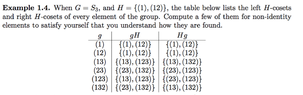
How do you get g = (123) from the table?

  • Context:
  • Thread starter Thread starter Guest2
  • Start date Start date
  • Tags Tags
    Mystery Table
Join the discussion
Registration is free. Ask a follow-up in this thread, or start your own.
3 replies · 2K views
Guest2
Messages
192
Reaction score
0
View attachment 5399

Could someone please explain how they're getting the answers in the table, for example $g = (123)$.
 

Attachments

  • Screen Shot 2016-03-14 at 13.53.08.png
    Screen Shot 2016-03-14 at 13.53.08.png
    23.3 KB · Views: 137
Physics news on Phys.org
$$(123)(1)$$

$(123)$ represents the function that maps $1$ to $2$, $2$ to $3$ and $3$ to $1$.
$(1)$ represents the identity function, i.e. the function that maps $1$ to $1$, $2$ to $2$ and $3$ to $3$.

So to compute $(123)(1)$ we do the following:

From the right cycle we have that $1$ is mapped to $1$, and at the first cycle $1$ is mapped to $2$, therefore we get that $1$ is mapped to $2$.
From the right cycle we have that $2$ is mapped to $2$, and at the first cycle $2$ is mapped to $3$, therefore we get that $2$ is mapped to $3$.
From the right cycle we have that $3$ is mapped to $3$, and at the first cycle $3$ is mapped to $1$, therefore we get that $3$ is mapped to $1$.

So, we get $(123)(1)=(123)$.
$$(123)(12)$$

$(123)$ represents the function that maps $1$ to $2$, $2$ to $3$ and $3$ to $1$.
$(12)$ represents the function that maps $1$ to $2$, $2$ to $1$ and $3$ to $3$.

So to compute $(123)(12)$ we do the following:

From the right cycle we have that $1$ is mapped to $2$, and at the first cycle $2$ is mapped to $3$, therefore we get that $1$ is mapped to $3$.
From the right cycle we have that $2$ is mapped to $1$, and at the first cycle $1$ is mapped to $2$, therefore we get that $2$ is mapped to $2$.
From the right cycle we have that $3$ is mapped to $3$, and at the first cycle $3$ is mapped to $1$, therefore we get that $3$ is mapped to $1$.

So, we get $(123)(12)=(13)$.
 
mathmari said:
$$(123)(1)$$

$(123)$ represents the function that maps $1$ to $2$, $2$ to $3$ and $3$ to $1$.
$(1)$ represents the identity function, i.e. the function that maps $1$ to $1$, $2$ to $2$ and $3$ to $3$.

So to compute $(123)(1)$ we do the following:

From the right cycle we have that $1$ is mapped to $1$, and at the first cycle $1$ is mapped to $2$, therefore we get that $1$ is mapped to $2$.
From the right cycle we have that $2$ is mapped to $2$, and at the first cycle $2$ is mapped to $3$, therefore we get that $2$ is mapped to $3$.
From the right cycle we have that $3$ is mapped to $3$, and at the first cycle $3$ is mapped to $1$, therefore we get that $3$ is mapped to $1$.

So, we get $(123)(1)=(123)$.
$$(123)(12)$$

$(123)$ represents the function that maps $1$ to $2$, $2$ to $3$ and $3$ to $1$.
$(12)$ represents the function that maps $1$ to $2$, $2$ to $1$ and $3$ to $3$.

So to compute $(123)(12)$ we do the following:

From the right cycle we have that $1$ is mapped to $2$, and at the first cycle $2$ is mapped to $3$, therefore we get that $1$ is mapped to $3$.
From the right cycle we have that $2$ is mapped to $1$, and at the first cycle $1$ is mapped to $2$, therefore we get that $2$ is mapped to $2$.
From the right cycle we have that $3$ is mapped to $3$, and at the first cycle $3$ is mapped to $1$, therefore we get that $3$ is mapped to $1$.

So, we get $(123)(12)=(13)$.
Wonderful explanations, thanks!
 
mathmari said:
$$(123)(1)$$

$(123)$ represents the function that maps $1$ to $2$, $2$ to $3$ and $3$ to $1$.
$(1)$ represents the identity function, i.e. the function that maps $1$ to $1$, $2$ to $2$ and $3$ to $3$.

So to compute $(123)(1)$ we do the following:

From the right cycle we have that $1$ is mapped to $1$, and at the first cycle $1$ is mapped to $2$, therefore we get that $1$ is mapped to $2$.
From the right cycle we have that $2$ is mapped to $2$, and at the first cycle $2$ is mapped to $3$, therefore we get that $2$ is mapped to $3$.
From the right cycle we have that $3$ is mapped to $3$, and at the first cycle $3$ is mapped to $1$, therefore we get that $3$ is mapped to $1$.

So, we get $(123)(1)=(123)$.

$$(123)(12)$$

$(123)$ represents the function that maps $1$ to $2$, $2$ to $3$ and $3$ to $1$.
$(12)$ represents the function that maps $1$ to $2$, $2$ to $1$ and $3$ to $3$.

So to compute $(123)(12)$ we do the following:

From the right cycle we have that $1$ is mapped to $2$, and at the first cycle $2$ is mapped to $3$, therefore we get that $1$ is mapped to $3$.
From the right cycle we have that $2$ is mapped to $1$, and at the first cycle $1$ is mapped to $2$, therefore we get that $2$ is mapped to $2$.
From the right cycle we have that $3$ is mapped to $3$, and at the first cycle $3$ is mapped to $1$, therefore we get that $3$ is mapped to $1$.

So, we get $(123)(12)=(13)$.

Spoken like a pro.