How Do You Prove Electromagnetic Field Quantization?

Click For Summary
The discussion focuses on proving the quantization of electromagnetic fields through a specific integral involving the electromagnetic tensor Fμν and the vector potential Aμ. Participants analyze the derivation process, addressing concerns about the placement of factors of A, the presence of overall minus signs, and the proper raising and lowering of indices. Key points include the necessity of integration by parts to correctly manipulate derivatives and factors of A, as well as the importance of maintaining consistent index notation to avoid errors. The conversation highlights the complexities involved in tensor calculus and the need for careful attention to detail in mathematical proofs. Understanding these principles is crucial for successfully completing the proof of electromagnetic field quantization.
  • #31
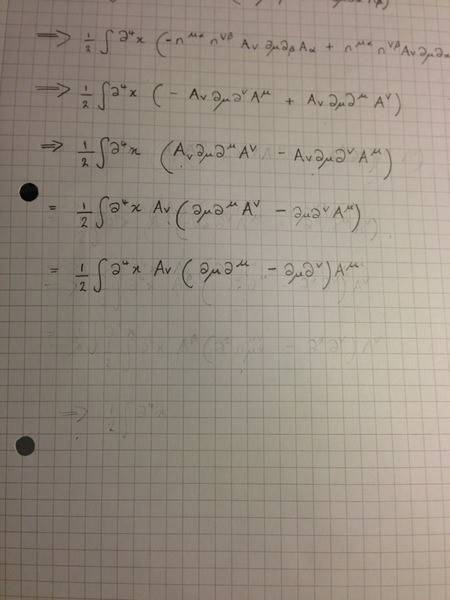
This:
ImageUploadedByPhysics Forums1379452078.975363.jpg
 
Physics news on Phys.org
  • #32
That doesn't really explain what you're thinking. What you're doing is like taking x(ay+bx) and saying it's equal to x(a+b)y. You're just replacing one variable by another for no apparent reason.
 
  • #33
Hmm... I figured I could rearrange and use the results of integration by parts to achieve the rearrangement that I did.. But I guess what I did was wrong...
 
  • #34
I'm thinking I might need to permute the indices and do some more raising and lowering?

\frac{1}{2}\int\partial^{4}x(-A_{v}\partial_{\mu}\partial^{\nu}A^{\mu}+A_{\nu}\partial_{\mu}\partial^{\mu}A^{\nu})


\frac{1}{2}\int\partial^{4}x(A_{v}\partial_{\mu}\partial^{\mu}A^{\nu}-A_{\nu}\partial_{\mu}\partial^{\nu}A^{\mu})


\frac{1}{2}\int\partial^{4}xA_{\nu}(\partial_{\mu}\partial^{\mu}A^{\nu}-\partial_{\mu}\partial^{\nu}A^{\mu})


\frac{1}{2}\int\partial^{4}xA_{\nu}(\square n_{\mu\nu}-\partial_{\mu}\partial^{\nu})A^{\mu}<br />
 
Last edited:
  • #35
Do you understand why what you did was wrong? Do you see that ##A_\nu \partial_\mu \partial^\mu A^\nu## and ##A_\nu \partial_\mu \partial^\mu A^\mu## aren't equal to each other? You've now made this same mistake several times, so it seems like you're just pushing symbols around without any understanding.
 
  • #36
I see what I did was wrong, and I can see that I have made the mistake several times. I guess I just don't spot it, but I am not at all confident with this...I had another go in the penultimate post, but I don't think the way I've permuted indices is correct..
 
  • #37
smallgirl said:
\frac{1}{2}\int\partial^{4}xA_{\nu}(\partial_{\mu}\partial^{\mu}A^{\nu}-\partial_{\mu}\partial^{\nu}A^{\mu})
\frac{1}{2}\int\partial^{4}xA_{\nu}(\square n_{\mu\nu}-\partial_{\mu}\partial^{\nu})A^{\mu}<br />
That's pretty close. Start with the first integral and do it one step at a time.
  1. First, replace ##\partial_\mu\partial^\mu## with ##\Box##.
  2. Then raise the index on ##A_\nu##. When you do that, you have to lower ##\nu## on the other terms.
  3. Next, replace ##A_\nu## (it should only appear once at this point) with ##A_\nu = \eta_{\mu\nu} A^\mu##.
  4. Now you should have ##A^\mu## on the right on both terms, so you can pull it out to the right.
At this point, you should have
$$\frac{1}{2}\int d^4x\,A^\nu(\Box \eta_{\mu\nu}-\partial_\mu\partial_\nu) A^\mu$$ Now if you want to, you can relabel ##\mu \leftrightarrow \nu## so that it'll match up exactly with the expression from the homework assignment.
 

Similar threads

  • · Replies 1 ·
Replies
1
Views
2K
  • · Replies 5 ·
Replies
5
Views
4K
  • · Replies 2 ·
Replies
2
Views
2K
  • · Replies 2 ·
Replies
2
Views
2K
  • · Replies 2 ·
Replies
2
Views
2K
  • · Replies 5 ·
Replies
5
Views
2K
  • · Replies 1 ·
Replies
1
Views
2K
  • · Replies 16 ·
Replies
16
Views
3K
  • · Replies 2 ·
Replies
2
Views
4K
  • · Replies 30 ·
2
Replies
30
Views
7K