How do you solve this equation used to calibrate an ammeter?

  • Thread starter Thread starter rexxii
  • Start date Start date
  • Tags Tags
    Ammeter
Click For Summary
SUMMARY

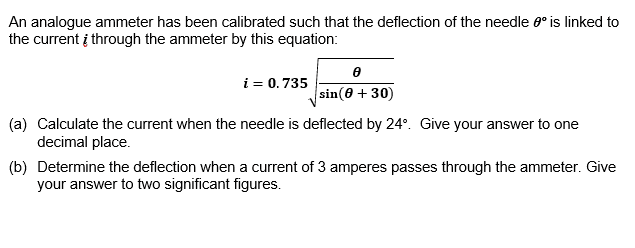
The discussion focuses on solving the equation for calibrating an ammeter, specifically the equation $$\theta = (i/0.735)^2 \sin(\theta + 30)$$. Participants clarify that there is only one theta, which appears in two different forms. Solutions include graphing the relationship between current (i) and theta, using numerical methods for refinement, and employing the EXCEL Solver tool for accurate results. Additionally, it is emphasized that graphing software requires angles in radians, which is crucial for correct plotting.

PREREQUISITES
  • Understanding of trigonometric functions and their properties
  • Familiarity with numerical methods for solving equations
  • Basic knowledge of graphing software and its requirements
  • Experience with EXCEL Solver for optimization problems
NEXT STEPS
  • Learn how to convert angles between degrees and radians for accurate graphing
  • Explore numerical methods for iterative solutions, such as Newton-Raphson
  • Investigate advanced features of EXCEL Solver for complex equations
  • Study graphing techniques for plotting implicit functions
USEFUL FOR

Students and professionals in physics and engineering, mathematicians, and anyone involved in calibrating instruments or solving trigonometric equations.
rexxii
Messages
11
Reaction score
0
Homework Statement
algebra with two unknowns
Relevant Equations
two thetas in equation
Please can someone tell me how to solve the below:
we have been given:

241543
can someone please explain how we deal with two theatas? please ignore full stops wouldn't line up any other way!​
 
Last edited by a moderator:
Physics news on Phys.org
I can't tell what you're doing here or what the question is. Could you please fix your post and remove the formatting?
 
vela said:
I can't tell what you're doing here or what the question is. Could you please fix your post and remove the formatting?
Hi Vela, I apologise, new here. please see amendment
 
rexxii said:
Please can someone tell me how to solve the below:
we have been given:

View attachment 241543
can someone please explain how we deal with two theatas? please ignore full stops wouldn't line up any other way!​

There is only one theta, not two. However, that theta appears in two places and in two different forms.

If you want to find the value of ##\theta## corresponding to a given current ##i##, you can just draw a graph of ##i## vs. ##\theta## and pick out an approximate solution from the graph. You can refine it (i.e., get a more accurate solution) using any number of numerical equation-solving methods. Alternatively, you can submit the problem to a software package for solution. For example, using the EXCEL Solver tool should enable you to complete the job.

Another way is to re-write the equation as
$$\theta = (i/0.735)^2 \sin(\theta + 3),$$
plot the two curves ##y = \theta## and ##y = (i/0.735)^2 \sin(\theta+30)##, and see where the two curves cross one another.
 
Last edited:
Ray Vickson said:
There is only one theta, not two. However, that theta appears in two places and in two different forms.

If you want to find the value of ##\theta## corresponding to a given current ##i##, you can just draw a graph of ##i## vs. ##\theta## and pick out an approximate solution from the graph. You can refine it (i.e., get a more accurate solution) using any number of numerical equation-solving methods. Alternatively, you can submit the problem to a software package for solution. For example, using the EXCEL Solver tool should enable you to complete the job.

Another way is to re-write the equation as
$$\theta = (i/0.735)^2 \sin(\theta + 3),$$
plot the two curves ##y = \theta## and ##y = (i/0.735)^2 \sin(\theta+30)##, and see where the two curves cross one another.
hi,

thank you for the advice - i understand what you mean partly.

However, how can i define this on a graph? I cannot put theta into a graphing software.

I would have thought I plot y=3 and y=0.735 sqrt route (x/sin(x+30) but that doesn't seem to be working please could you expand on what you mean?

Thank you
 
Graphing software generally expects the argument of sin to be in radians; your formula uses degrees.

However I think the intention is that you rearrange the equation as <br /> \theta = \left(\frac{3}{0.753}\right)^2 \sin(\theta + 30)<br /> as @Ray Vickson has done, and then iterate <br /> \theta_{n+1} = \left(\frac{3}{0.753}\right)^2 \sin(\theta_n + 30)<br /> to convergence, as can be done on a standard scientific calculator.

You will require an initial guess for \theta_0, and the first part of the question should provide that.
 
rexxii said:
hi,

thank you for the advice - i understand what you mean partly.

However, how can i define this on a graph? I cannot put theta into a graphing software.

I would have thought I plot y=3 and y=0.735 sqrt route (x/sin(x+30) but that doesn't seem to be working please could you expand on what you mean?

Thank you

Show the details: why does it not work? It works for me, but I need to be careful about converting ##\theta## from degrees to radians.
 

Similar threads

  • · Replies 26 ·
Replies
26
Views
8K
  • · Replies 23 ·
Replies
23
Views
3K
Replies
23
Views
5K
  • · Replies 10 ·
Replies
10
Views
2K
Replies
8
Views
4K
  • · Replies 6 ·
Replies
6
Views
5K
Replies
18
Views
3K
  • · Replies 4 ·
Replies
4
Views
1K
Replies
9
Views
2K
  • · Replies 4 ·
Replies
4
Views
2K