Discussion Overview
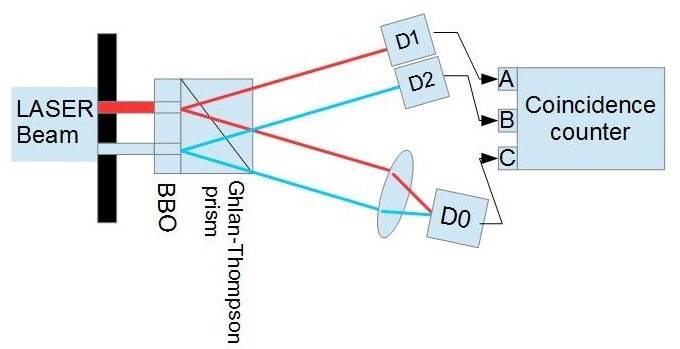
The discussion revolves around the impact of detector placement on the detection ratios in the double slit experiment, specifically focusing on a setup that utilizes fixed detectors instead of coincidence counters. Participants explore the implications of using simple counters and the need for lenses to focus the beams from the slits.
Discussion Character
- Exploratory
- Technical explanation
- Debate/contested
Main Points Raised
- One participant questions whether the ratio between detections at D0 and the sum of detections at D1 and D2 will be close to 1, suggesting the need for fixed detectors and simple counters.
- Another participant expresses a need for more context to engage with the problem effectively.
- It is noted that a coincidence counter cannot operate without additional information, and that in the proposed setup, photon counters are used instead.
- One participant suggests that the detectors should capture most of the beams, leading to an expectation of n detections at D0 and n/2 at D1 and D2 after n photons enter the double slit.
- Concerns are raised about the terminology used, particularly the term "beam" in relation to word count.
- A participant discusses the use of a laser source and the necessity of a filter to control the photon count, indicating that adjustments to the apparatus may be needed before applying the filter.
- One participant proposes focusing on the calculations related to the source rather than the results, suggesting that understanding single photon interference can be beneficial if approached later in the process.
Areas of Agreement / Disagreement
Participants express varying levels of understanding and focus on different aspects of the experiment, indicating that multiple competing views remain regarding the setup and implications of detector placement. The discussion does not reach a consensus.
Contextual Notes
Some participants highlight the need for additional context and clarification regarding the experimental setup and terminology, indicating potential limitations in understanding the implications of the proposed configurations.