gnits
- 137
- 46
- Homework Statement
- Analysis of SHM of a mass
- Relevant Equations
- F=ma
Could I please ask for views on this question:
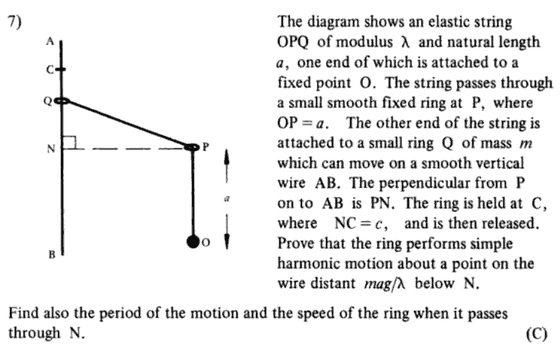
I've answered the whole thing and agree with the answers given in the textbook.
Here are those answers (where Y is the modulus of elasticity of the string = lamda in the question):
Period of motion = 2 * PI * sqrt( ma/Y )
Speed passing through N = sqrt( 2gc + Yc^2/ma )
In answering the last part I made use of conservation of energy as follows:
let D = distance from N to lowest point reached by ring.
Let L = |PN|
Let zero potential energy be at the level of O then:
Energy at C = energy at Lowest point so:
Potential Energy of mass at highest point + elastic energy at highest point = elastic energy at lowest point
so, using energy in elastic string = Yx^2/2a where x = extention and a = natural length gives:
Y(L^2 + c^2) / (2a) + mg(c+D) = Y(L^2 + D^2) / (2a)
and this leads to two values for D:
D = -c
and
D = (2agm/Y) + c
Which one is the correct one and why?
The first one seems to imply that the mass will go down to a position eqally distant below the level of O as it was above the level of O and so as energy is not lost in the system, would this not give an oscillation about the point N? (rather then the answer of a point mag/Y below N)
The second solution would imply a depth greater then that which it started out above N by an amount 2agm/Y.
Thanks for any help in clarifying,
Mitch.
I've answered the whole thing and agree with the answers given in the textbook.
Here are those answers (where Y is the modulus of elasticity of the string = lamda in the question):
Period of motion = 2 * PI * sqrt( ma/Y )
Speed passing through N = sqrt( 2gc + Yc^2/ma )
In answering the last part I made use of conservation of energy as follows:
let D = distance from N to lowest point reached by ring.
Let L = |PN|
Let zero potential energy be at the level of O then:
Energy at C = energy at Lowest point so:
Potential Energy of mass at highest point + elastic energy at highest point = elastic energy at lowest point
so, using energy in elastic string = Yx^2/2a where x = extention and a = natural length gives:
Y(L^2 + c^2) / (2a) + mg(c+D) = Y(L^2 + D^2) / (2a)
and this leads to two values for D:
D = -c
and
D = (2agm/Y) + c
Which one is the correct one and why?
The first one seems to imply that the mass will go down to a position eqally distant below the level of O as it was above the level of O and so as energy is not lost in the system, would this not give an oscillation about the point N? (rather then the answer of a point mag/Y below N)
The second solution would imply a depth greater then that which it started out above N by an amount 2agm/Y.
Thanks for any help in clarifying,
Mitch.
Attachments

Last edited: