gnits
- 137
- 46
- Homework Statement
- To find the velocity of a mass attached to the midpoint of a spring
- Relevant Equations
- E=Yx^2/2a
Could I please ask for help regarding part (a) of this question:
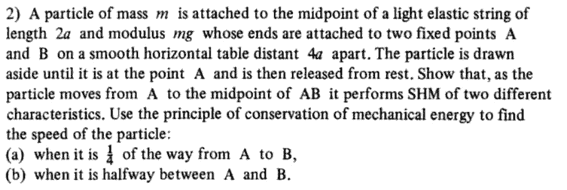
If I get part (a) then part (b) will follow. So, here's my answer to part (a):
I'll be using the formula Elastic Potential Energy in a spring = (Yx^2)/(2a)
Where Y is the modulus of the spring, x the extension and a the natural length of the spring.
And we are given that Y = mg and so we have Elastic Potential Energy in this spring = (mgx^2)/(2a)
I will logically split the spring into two parts, that to the left of the particle and that to the right. Each of these has a natural length of a.
Here's a sketch of the situation.
<------------4a------------->
A --------------------------- B
We are told that the particle is pulled back until it is at point A.
So here the left hand part of the spring as an extension (compression) of length a (because natural length is a and actual length is 0)
And the right hand part an extension of 3a (because natural length is a and actual length is 4a)
So in this position the energy in the system is:
mga^2/2a + mg(3a)^2/2a
Now, when the particle is 1/4 of the way from A to B then the elastic potential energy in the left hand part of the spring is 0 because it is at it's natural length of a.
And the right hand part now has an extension of 2a (because it has length 3a and natural length a).
And the mass also has kinetic energy. Equating energy before with energy 'now' we get:
mga^2/2a + mg(3a)^2/2a = mg(2a)^2/2a + (1/2)mv^2
which leads to v^2 = 6ga
But answer in book is v^2 = 5ga
Thanks for any help in pointing out my error,
Mitch.
If I get part (a) then part (b) will follow. So, here's my answer to part (a):
I'll be using the formula Elastic Potential Energy in a spring = (Yx^2)/(2a)
Where Y is the modulus of the spring, x the extension and a the natural length of the spring.
And we are given that Y = mg and so we have Elastic Potential Energy in this spring = (mgx^2)/(2a)
I will logically split the spring into two parts, that to the left of the particle and that to the right. Each of these has a natural length of a.
Here's a sketch of the situation.
<------------4a------------->
A --------------------------- B
We are told that the particle is pulled back until it is at point A.
So here the left hand part of the spring as an extension (compression) of length a (because natural length is a and actual length is 0)
And the right hand part an extension of 3a (because natural length is a and actual length is 4a)
So in this position the energy in the system is:
mga^2/2a + mg(3a)^2/2a
Now, when the particle is 1/4 of the way from A to B then the elastic potential energy in the left hand part of the spring is 0 because it is at it's natural length of a.
And the right hand part now has an extension of 2a (because it has length 3a and natural length a).
And the mass also has kinetic energy. Equating energy before with energy 'now' we get:
mga^2/2a + mg(3a)^2/2a = mg(2a)^2/2a + (1/2)mv^2
which leads to v^2 = 6ga
But answer in book is v^2 = 5ga
Thanks for any help in pointing out my error,
Mitch.