How Does Finite Size Scaling Reveal Cluster Behavior in 1D Percolation?

Click For Summary

Discussion Overview

The discussion revolves around understanding finite size scaling in the context of one-dimensional percolation, specifically how to simulate and analyze the largest cluster size in relation to system size. Participants explore the interpretation of a problem statement related to plotting cluster size against system size to demonstrate certain probabilistic behaviors in percolation theory.

Discussion Character

  • Homework-related
  • Exploratory
  • Technical explanation

Main Points Raised

  • One participant expresses difficulty in interpreting the problem statement regarding finite size scaling and seeks clarification on the simulation process.
  • Another participant emphasizes the need to present the original question in full to facilitate better understanding and identification of misunderstandings.
  • A later reply provides the complete problem statement, which includes instructions for numerical simulation and plotting requirements.
  • Some participants share external resources that may assist in understanding the percolation threshold and simulation techniques.
  • One participant notes that while interesting effects can be observed in 2D models, they find the behavior in 1D perplexing and uncertain about what to expect.
  • Discussion includes a comparison of percolation in different dimensions, with one participant explaining the connectivity requirements in 1D, 2D, and 3D percolation scenarios.

Areas of Agreement / Disagreement

Participants generally agree on the need for clarity regarding the original problem statement, but there is uncertainty about the expected outcomes of 1D percolation compared to higher dimensions. The discussion remains unresolved regarding the specific behaviors and interpretations of the results in 1D.

Contextual Notes

Participants express varying levels of understanding about the implications of finite size scaling and the expected results in 1D percolation, indicating potential gaps in assumptions or interpretations of the problem.

Mikkel
Messages
26
Reaction score
1
TL;DR
Simulate 1d percolation. I have to show that the probability of any site belonging to the largest cluster vanishes as N -> infinity
Hello

I am struggeling with a problem, or perhaps more with understanding the problem.
I have to simulate a one dimensional percolation in Python and that part I can do. The issue is understanding the next line of the problem, which I will post here:
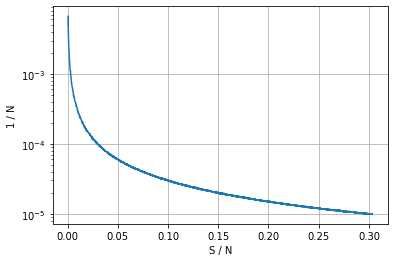
"For the largest cluster size S, use finite size scaling, i.e., allow N to increase and plot s ≡ S/N vs. 1/N, to show that the probability of any site to belong to the largest cluster vanishes in the thermodynamic limit. Hint: Use N raised to some power between 2 and 5".
So, the way I understand this is to, let N increase some amount each iteration and find the largest cluster. I save these values and plot S/N vs. 1/N ending up with the attached plot.
I'm just unsure wheter or not this is correctly interpreted and would love to hear others input
Percolation1D.png

Thanks!
 
Physics news on Phys.org
I think you need to post the original question, exactly as it was presented.
If you present your interpretation only, it will prevent us from identifying your misunderstanding.
Please provide a reference, or a link to the original source of the question.
 
Baluncore said:
I think you need to post the original question, exactly as it was presented.
If you present your interpretation only, it will prevent us from identifying your misunderstanding.
Please provide a reference, or a link to the original source of the question.
You might be right, but the whole question is pretty much in the quotation marks. I will post the entire question below:
"For a given value of p, 0 ≤ p ≤ 1, numerically find the largest connected cluster of sites. For the largest cluster size S, use finite size scaling, i.e., allow N to increase and plot s ≡ S/N vs. 1/N, to show that the probability of any site to belong to the largest cluster vanishes in the thermodynamic limit. (Hint: reasonable system sizes for finite size scaling are N = 10m, with m ∈ {2,3,4,5}.)"
 
3D percolation involves connectivity from the top 2D layer to the bottom 2D layer.
2D percolation involves connectivity from the top row of sites to the bottom row of sites.
1D percolation is more confusing.

You could consider a 1D column of sites. It will be open only if all sites from top to bottom are open.
Alternatively, a horizontal 1D line of sites, with percolation downwards, across one layer only, will be open if anyone site is open.

How do you visualise a 1D array of sites ?

http://web.mit.edu/8.334/www/grades/projects/projects10/Gardner_Webpage/OneD.htm
 
Last edited:

Similar threads

Replies
12
Views
7K
  • · Replies 1 ·
Replies
1
Views
3K
  • · Replies 2 ·
Replies
2
Views
3K
  • · Replies 2 ·
Replies
2
Views
5K