How Does Longitudinal Stress Affect a Body's Internal Tension?

Join the discussion
Ask a follow-up here, or get your own question answered by working scientists, mathematicians and engineers — people, not an autocomplete.
Real named experts · corrections over time · the nuance an AI answer skips
34 replies · 2K views
jbriggs444 said:
No. You misunderstand the proposal.

We are not messing with the definition of force. We are messing with the definition of stress, tension and pressure.

Right. Under the proposal, ##F=\frac{1}{2}P\ dV## and ##F=\frac{1}{2}Pa##. Meanwhile, atmospheric pressure, for instance, is doubled. As a result, forces and accelerations are unchanged.

No one is claiming that this is useful. Or even natural. Only that it is a possible convention.

You quoted me in post 28. I said that it was technically correct, but silly. I am not sure what you are trying to correct.

Knowing that continuum stresses and strains “look like” forces and displacements makes life simpler. One has to memorize fewer equations.

Or are we in violent agreement with each other.
 
Last edited:
Physics news on Phys.org
Orodruin said:
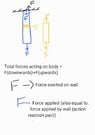
Please show your attempt.
 

Attachments

  • Notes_240114_225012_1.jpg
    Notes_240114_225012_1.jpg
    19.7 KB · Views: 120
It is unclear from your diagram what forces are from the wall and what is the internal tension force. All forces have the same size F, but that comes later from the equilibrium equations. You should be calling the tension force something else, like T. I also suggest that you make the FBD of the part of the rod below some mid-point of the rod so that you have the internal force T rather than the force from the wall on the rod.
 
The top blue and black arrows are reversed.
The force exerted by the bar on the wall (black arrow) is pulling on the wall rather than pushing in.
 
Orodruin said:
It is unclear from your diagram what forces are from the wall and what is the internal tension force. All forces have the same size F, but that comes later from the equilibrium equations. You should be calling the tension force something else, like T. I also suggest that you make the FBD of the part of the rod below some mid-point of the rod so that you have the internal force T rather than the force from the wall on the rod.
Can you please show me the corrected version?