How Does Longitudinal Stress Affect a Body's Internal Tension?

34 replies · 4K views · last reply
jbriggs444 said:
No. You misunderstand the proposal.

We are not messing with the definition of force. We are messing with the definition of stress, tension and pressure.

Right. Under the proposal, ##F=\frac{1}{2}P\ dV## and ##F=\frac{1}{2}Pa##. Meanwhile, atmospheric pressure, for instance, is doubled. As a result, forces and accelerations are unchanged.

No one is claiming that this is useful. Or even natural. Only that it is a possible convention.

You quoted me in post 28. I said that it was technically correct, but silly. I am not sure what you are trying to correct.

Knowing that continuum stresses and strains “look like” forces and displacements makes life simpler. One has to memorize fewer equations.

Or are we in violent agreement with each other.
 
Last edited:
Orodruin said:
Please show your attempt.
 
Attachments
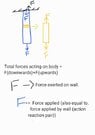
  • Hand-drawn diagram of a rod hanging from a ceiling with force F pulling down at the bottom and F pulling up at the top, a cut section shown with an arrow, and handwritten notes: Total forces acting on body = F(downwards)+F(upwards), and F with an arrow labelled force exerted on wall.
    Notes_240114_225012_1.jpg
    19.7 KB · Views: 145
It is unclear from your diagram what forces are from the wall and what is the internal tension force. All forces have the same size F, but that comes later from the equilibrium equations. You should be calling the tension force something else, like T. I also suggest that you make the FBD of the part of the rod below some mid-point of the rod so that you have the internal force T rather than the force from the wall on the rod.
 
The top blue and black arrows are reversed.
The force exerted by the bar on the wall (black arrow) is pulling on the wall rather than pushing in.
 
Orodruin said:
It is unclear from your diagram what forces are from the wall and what is the internal tension force. All forces have the same size F, but that comes later from the equilibrium equations. You should be calling the tension force something else, like T. I also suggest that you make the FBD of the part of the rod below some mid-point of the rod so that you have the internal force T rather than the force from the wall on the rod.
Can you please show me the corrected version?