How Does Longitudinal Stress Affect a Body's Internal Tension?

Click For Summary
SUMMARY

The discussion clarifies the concept of stress in a rod subjected to forces at both ends. The correct formula for stress is defined as Stress = F/A, where F represents the internal force at any cross section of the rod, not 2F as initially assumed by some participants. This misunderstanding arises from conflating tension with external forces; tension is defined as the force exerted by the material, which remains F regardless of the number of forces applied at the ends. The conversation emphasizes the importance of understanding free body diagrams (FBD) and the nature of internal versus external forces in mechanics.

PREREQUISITES
  • Understanding of basic mechanics, specifically the concepts of force and tension.
  • Familiarity with stress and strain in materials science.
  • Knowledge of free body diagrams (FBD) and their application in analyzing forces.
  • Basic principles of equilibrium in static systems.
NEXT STEPS
  • Study the derivation and application of the stress formula: Stress = Force/Area.
  • Learn about free body diagrams (FBD) and their role in analyzing forces in static and dynamic systems.
  • Explore the concepts of tensile and compressive stress in materials science.
  • Investigate the relationship between force, mass, and acceleration as described by Newton's second law (F=ma).
USEFUL FOR

Students of physics and engineering, particularly those studying mechanics, materials science, and structural analysis will benefit from this discussion. It is also valuable for educators seeking to clarify common misconceptions about stress and tension in materials.

  • #31
jbriggs444 said:
No. You misunderstand the proposal.

We are not messing with the definition of force. We are messing with the definition of stress, tension and pressure.

Right. Under the proposal, ##F=\frac{1}{2}P\ dV## and ##F=\frac{1}{2}Pa##. Meanwhile, atmospheric pressure, for instance, is doubled. As a result, forces and accelerations are unchanged.

No one is claiming that this is useful. Or even natural. Only that it is a possible convention.

You quoted me in post 28. I said that it was technically correct, but silly. I am not sure what you are trying to correct.

Knowing that continuum stresses and strains “look like” forces and displacements makes life simpler. One has to memorize fewer equations.

Or are we in violent agreement with each other.
 
Last edited:
Physics news on Phys.org
  • #32
Orodruin said:
Please show your attempt.
 

Attachments

  • Notes_240114_225012_1.jpg
    Notes_240114_225012_1.jpg
    19.7 KB · Views: 97
  • #33
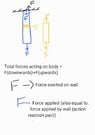
It is unclear from your diagram what forces are from the wall and what is the internal tension force. All forces have the same size F, but that comes later from the equilibrium equations. You should be calling the tension force something else, like T. I also suggest that you make the FBD of the part of the rod below some mid-point of the rod so that you have the internal force T rather than the force from the wall on the rod.
 
  • #34
The top blue and black arrows are reversed.
The force exerted by the bar on the wall (black arrow) is pulling on the wall rather than pushing in.
 
  • #35
Orodruin said:
It is unclear from your diagram what forces are from the wall and what is the internal tension force. All forces have the same size F, but that comes later from the equilibrium equations. You should be calling the tension force something else, like T. I also suggest that you make the FBD of the part of the rod below some mid-point of the rod so that you have the internal force T rather than the force from the wall on the rod.
Can you please show me the corrected version?
 

Similar threads

  • · Replies 6 ·
Replies
6
Views
1K
Replies
6
Views
1K
Replies
7
Views
4K
Replies
2
Views
4K
  • · Replies 11 ·
Replies
11
Views
3K
  • · Replies 1 ·
Replies
1
Views
2K
  • · Replies 5 ·
Replies
5
Views
2K
Replies
13
Views
5K
  • · Replies 2 ·
Replies
2
Views
2K
  • · Replies 10 ·
Replies
10
Views
2K