How Does the Constant '2' Arise in Binomial Theorem Equalities?

  • Context:
  • Thread starter Thread starter gladeligen
  • Start date Start date
  • Tags Tags
    Explain
Join the discussion
Ask a follow-up here, or get your own question answered by working scientists, mathematicians and engineers — people, not an autocomplete.
Real named experts · corrections over time · the nuance an AI answer skips
1 reply · 2K views
gladeligen
Messages
1
Reaction score
0
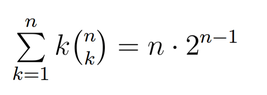
View attachment 6378

Hi!

My first post!

I was wondering if anyone could explain this equality in words?
I do not understand how the k became a constant (2) on the right side?Best
Flippa
 

Attachments
  • 2017-01-30 (2).png
    2017-01-30 (2).png
    5.6 KB · Views: 140
Physics news on Phys.org
Hi, and welcome to the forum!

Proving equalities in words is not something mathematicians usually do. They usually prove equalities by a series of formulas. Perhaps the most intuitive type of proofs of similar facts is combinatorial proofs, where you consider a set and count its size in two different ways. You can find one such proof on StackExchange. It relies on the fact that $\sum_{k=0}^n\binom{n}{k}=2^n$. This fact also has a combinatorial proof: $\binom{n}{k}$ is the number of subsets of size $k$ of the set of size $n$, so the left-hand side is the number of all subsets of a set of size $n$. This number is known to be $2^n$ because each of the $n$ elements either occurs in a subset or does not (thus $n$ consecutive independent yes/no choices). There are many other proofs of the same fact on the SE page and pages linked therein: some use induction, others differentiation, etc.