How Does the Flow Equation Apply in Higher Dimensional Phase Spaces?

  • Context: Undergrad 
  • Thread starter Thread starter Kashmir
  • Start date Start date
  • Tags Tags
    Dimensions
Kashmir
Messages
466
Reaction score
74
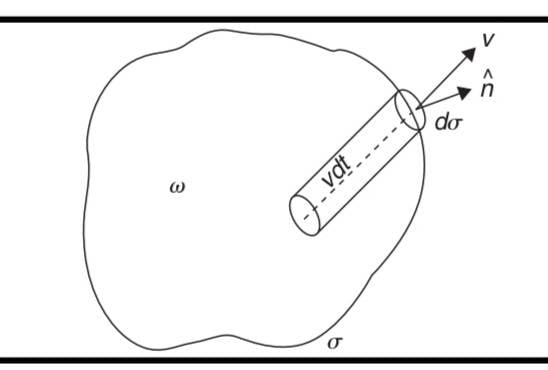
We are in phase space of ##6N## dimensions. Each point ##\mathbf r## in this space has ##6N## coordinates.
IMG_20220404_130052.JPG

Pathria writes "Consider an arbitrary "volume" ##\omega## in the relevant region of the phase space and let the "surface" enclosing this volume be denoted by ##\sigma## then the net rate at which the representative points "flow" out of ##\omega## (across the bounding surface ##\sigma## ) is given by
##
\int \rho \boldsymbol{v} \cdot \hat{\boldsymbol{n}} d \sigma
##"

Where ##\boldsymbol{v}## is velocity and ##\rho## is number density function

I can understand why the equation is true in 3D however in higher dimensions I'm not sure why it holds . Please help me
 
Last edited:
on Phys.org
Could you see why it would hold in 2D, where the two dimensions would be ##p_x## and ##x##?

(Note that ##\mathbf{v}## here is a generalization of velocity, not the actual velocity of a particle.)
 
  • Like
Likes   Reactions: Kashmir
DrClaude said:
Could you see why it would hold in 2D, where the two dimensions would be ##p_x## and ##x##?

(Note that ##\mathbf{v}## here is a generalization of velocity, not the actual velocity of a particle.)
No sir, I cannot.
 
But you can see how it works in 3D?
 
  • Like
Likes   Reactions: Kashmir
DrClaude said:
But you can see how it works in 3D?
I had forgotten that we were talking about genralised velocities. I had in mind a 3D spatial velocity vector.
 
Kashmir said:
I had forgotten that we were talking about genralised velocities. I had in mind a 3D spatial velocity vector.
You have to generalize to the time derivative of the coordinates, but the principle is the same.
 
DrClaude said:
You have to generalize to the time derivative of the coordinates, but the principle is the same.
I understand that we have a generalized velocity vector now, however I don't get how the same principle would apply?

Is it that it's proof is advanced so the author has skipped it?
 
Kashmir said:
I understand that we have a generalized velocity vector now, however I don't get how the same principle would apply?
The same conservation principles apply, that points in phase space can only move around, they never get created or destroyed.

Kashmir said:
Is it that it's proof is advanced so the author has skipped it?
Don't take this the wrong way, but I would say the author doesn't give a proof because they consider this trivial. Again, just think in terms of basic conservation principles.
 
  • Like
Likes   Reactions: Kashmir

Similar threads

  • · Replies 7 ·
Replies
7
Views
2K
  • · Replies 7 ·
Replies
7
Views
2K
  • · Replies 4 ·
Replies
4
Views
2K
  • · Replies 2 ·
Replies
2
Views
2K
  • · Replies 1 ·
Replies
1
Views
3K
  • · Replies 3 ·
Replies
3
Views
2K
  • · Replies 1 ·
Replies
1
Views
2K
  • · Replies 5 ·
Replies
5
Views
2K
  • · Replies 2 ·
Replies
2
Views
1K
  • · Replies 18 ·
Replies
18
Views
3K