How Does the Raising Operator Work in Quantum Mechanics?

Click For Summary
The discussion focuses on the raising operator \( a^\dagger \) in quantum mechanics and its effect on eigenstates. It is established that applying the raising operator to an eigenstate \( |n\rangle \) results in a new eigenstate \( |n+1\rangle \), with the eigenvalue increasing by one. The commutation relation between the number operator \( \hat{N} \) and the raising operator is used to derive this result. There is a mention of normalization, indicating that the resulting state may require a normalization factor. The participants conclude that the explanation provided is sufficient for the context of the question.
Sekonda
Messages
201
Reaction score
0
Hey,

I have a question on showing how the raising operator in QM raises a particular eigenstate by 1 unit, the question is showed below:
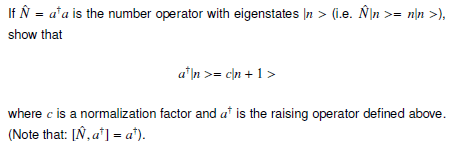
Raising_Operator_Q.png


I think I know how to do this but not sure if what I'm doing is sufficient:

\hat{N}a^{\dagger}|n>=([\hat{N},a^{\dagger}]+a^{\dagger}\hat{N})|n>

So I considered the N operator acting on the raising operator, we know the commutation relation stated on the RHS, so this simplifies to:

\hat{N}a^{\dagger}|n>=(a^{\dagger}+a^{\dagger}\hat{N})|n>

Letting N act on the state N we attain:

\hat{N}a^{\dagger}|n>=(1+n)a^{\dagger}|n>

I'm not sure if it's enough to say now that by definition of the raising operator 'a-dagger', it raises the state n to n+1 and we conclude that 'a-dagger' acting on a state n is equal to some constant multiplied by (1+n) and the state 1+n.

Cheers,
SK
 
Physics news on Phys.org
I'd be more explicit than that:

from (given) ##[\hat{N},a^\dagger]|n\rangle = a^\dagger |n\rangle## ... expand the commutator

##\Leftrightarrow \hat{N}[a^\dagger|n\rangle ] - a^\dagger [\hat{N}|n\rangle ] = a^\dagger |n\rangle## ... since: ##\hat{N}|n\rangle = n|n\rangle## (given)

##\Leftrightarrow \hat{N}[a^\dagger|n\rangle] - n[a^\dagger|n\rangle] = a^\dagger |n\rangle##

##\Rightarrow \hat{N}[a^\dagger|n\rangle] = a^\dagger |n\rangle+na^\dagger|n\rangle = (n+1)[a^\dagger |n\rangle]##

i.e. ##a^\dagger |n\rangle## is an eigenstate of ##\hat{N}## with eigenvalue n+1 ...

##\Rightarrow a^\dagger |n\rangle=|n+1\rangle##

... is |n+1> normalized already?
 
Last edited:
BTW: It can be useful, if you are writing a LOT of fancy notation, to define the most common combinations ... eg: ##\renewcommand{\bra}[1]{\langle {#1} |}
\renewcommand{\ket}[1]{|{#1}\rangle}
\renewcommand{\braket}[1]{ \langle #1 \rangle }##

\renewcommand{\bra}[1]{\langle {#1} |}
\renewcommand{\ket}[1]{|{#1}\rangle}
\renewcommand{\braket}[1]{ \langle #1 \rangle }

so that \bra{n}\; \ket{n,l,m,s}\; \braket{\psi}\; \bra{\psi}H\ket{\psi} gives you: $$\bra{n}\; \ket{n,l,m,s}\; \braket{\psi}\; \bra{\psi}H\ket{\psi}$$
 
Ahh yes, that's better. I think the ket 'n+1' is not normalised already but that's only due to the normalisation factor 'c' they've put in in the question.

I think what you have written is sufficient, they do not ask you to determine 'c' - so I presume we don't have to in this case.

Also your second post coding hasn't all come up properly on my screen!
 

Similar threads

  • · Replies 2 ·
Replies
2
Views
2K
Replies
1
Views
2K
Replies
1
Views
2K
  • · Replies 12 ·
Replies
12
Views
2K
  • · Replies 3 ·
Replies
3
Views
2K
Replies
1
Views
2K
  • · Replies 5 ·
Replies
5
Views
2K
Replies
4
Views
2K
  • · Replies 9 ·
Replies
9
Views
2K
  • · Replies 1 ·
Replies
1
Views
2K