How electrons get deflected in magnetic field while moving?

Click For Summary
SUMMARY

The discussion centers on the behavior of electrons in a magnetic field, specifically how they are deflected due to the Lorentz force, expressed as F = q(v × B). The force is always perpendicular to both the velocity of the electron and the magnetic field, leading to a helical trajectory in a homogeneous magnetic field. The right-hand rule is used to determine the direction of the force. An example calculation is provided, demonstrating that with a charge (q) of 1 C, a velocity (v) of 1 m/s, and a magnetic field (B) of 1 T, the resulting force (F) is 1 N.

PREREQUISITES
  • Understanding of the Lorentz force law
  • Familiarity with vector cross products
  • Knowledge of the right-hand rule for vector direction
  • Basic concepts of electromagnetism
NEXT STEPS
  • Study the implications of the Lorentz force in particle physics
  • Learn about the applications of magnetic fields in cyclotrons and synchrotrons
  • Explore the mathematical foundations of vector calculus
  • Investigate the behavior of charged particles in non-homogeneous magnetic fields
USEFUL FOR

Students and professionals in physics, particularly those focusing on electromagnetism, particle physics, and engineering applications involving magnetic fields.
mo0nfang
Messages
13
Reaction score
0
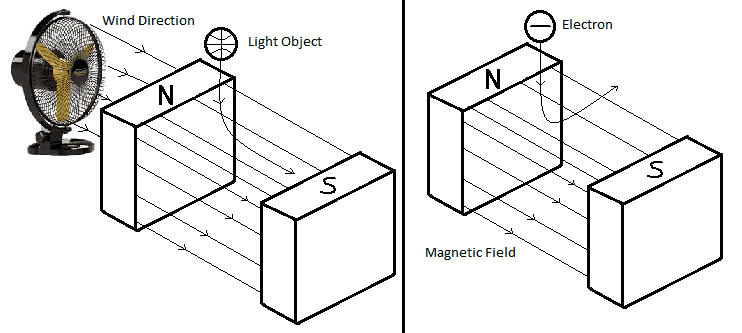
I don't understand why electron moves this way... e.g. A light object (crampled paper) going down until gets hit by the wind will go parallel (at least a few seconds) to the wind direction ... why not with electron?

z5CAT.png
 
Physics news on Phys.org
A B-field does not behave like wind.
 
Dale said:
A B-field does not behave like wind.
I know, I just want to give an example of a force.. I don't understand why electrons move that way... If I push a table forward, it will probably move forward (except with some uncommon circumstances)... I can't imagine pushing a table forward and then it moves left, right, or any other direction.
 
The force of a moving charge in an magnetic field is given by
$$\vec{F}=q \frac{\vec{v}}{c} \times \vec{B},$$
where ##q## is the charge, ##\vec{v}## the particle's velocity, ##c## the speed of light (in a vacuum), and ##\vec{B}## the magnetic field.

This is sometimes a bit complicated to figure out. The cross product is telling you that the force is always perpendicular to the velocity of the particle and the magnetic field. You get the direction by the right-hand rule, i.e., putting the thumb of your right hand in direction of the particle's velocity and the index finger in direction of the magnetic field, then your middle finger points in the direction of the magnetic force on the particle.

Since the force is always perpendicular to the force, a magnetic field doesn't change the magnetitude of the particle's velocity but only its direction. For a homogeneous magnetic field the trajectory of the particle is a helix, i.e., it is moving with a constant component of the velocity in direction of the magnetic field, and the projection of the velocity to the plane perpendicular the field is a circle.
 
vanhees71 said:
The force of a moving charge in an magnetic field is given by
$$\vec{F}=q \frac{\vec{v}}{c} \times \vec{B},$$
where ##q## is the charge, ##\vec{v}## the particle's velocity, ##c## the speed of light (in a vacuum), and ##\vec{B}## the magnetic field.

This is sometimes a bit complicated to figure out. The cross product is telling you that the force is always perpendicular to the velocity of the particle and the magnetic field. You get the direction by the right-hand rule, i.e., putting the thumb of your right hand in direction of the particle's velocity and the index finger in direction of the magnetic field, then your middle finger points in the direction of the magnetic force on the particle.

Since the force is always perpendicular to the force, a magnetic field doesn't change the magnetitude of the particle's velocity but only its direction. For a homogeneous magnetic field the trajectory of the particle is a helix, i.e., it is moving with a constant component of the velocity in direction of the magnetic field, and the projection of the velocity to the plane perpendicular the field is a circle.

Can this: f = q + v x B be used instead to make it simpler? also can you please give simple value of q, v, & B, as well as the solution...
 
mo0nfang said:
I know, I just want to give an example of a force.. I don't understand why electrons move that way... If I push a table forward, it will probably move forward (except with some uncommon circumstances)... I can't imagine pushing a table forward and then it moves left, right, or any other direction.
A B-field is not a push. It is not a wind. It is not any other mechanical analogy.

A B-field exerts a force given by ##F=qv \times B##. That is it. If you wish to make an analogy with something else then it needs to behave approximately like that.
 
Dale said:
A B-field is not a push. It is not a wind. It is not any other mechanical analogy.

A B-field exerts a force given by ##F=qv \times B##. That is it. If you wish to make an analogy with something else then it needs to behave approximately like that.
I don't know what value will I substitute to q, v, & B to get the value of Force... Can you please give simple value of q, v, & B, as well as the solution...
 
mo0nfang said:
I don't know what value will I substitute to q, v, & B to get the value of Force... Can you please give simple value of q, v, & B, as well as the solution...
What do you mean by substitute a value?
 
mo0nfang said:
I don't know what value will I substitute to q, v, & B to get the value of Force... Can you please give simple value of q, v, & B, as well as the solution...
How about q = 1 C, v = 1 m/s down, and B = 1 T to the left. Then F = 1 N forwards. That would be the force on a 1 C charge falling at 1 m/s through a 1 T field.

If you want the force from a different charge or field configuration then substitute the values you want.
 
Last edited:

Similar threads

  • · Replies 5 ·
Replies
5
Views
1K
  • · Replies 23 ·
Replies
23
Views
5K
  • · Replies 2 ·
Replies
2
Views
2K
  • · Replies 6 ·
Replies
6
Views
2K
  • · Replies 7 ·
Replies
7
Views
2K
  • · Replies 2 ·
Replies
2
Views
1K
  • · Replies 14 ·
Replies
14
Views
3K
  • · Replies 1 ·
Replies
1
Views
2K
  • · Replies 16 ·
Replies
16
Views
2K
  • · Replies 15 ·
Replies
15
Views
2K