SUMMARY
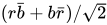
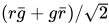
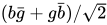
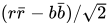
The discussion centers on the classification of quarks within the first generation, specifically addressing the number of distinct quarks based on their properties. There are six fundamental quarks: up, down, strange, charm, bottom, and top, each with an associated antiquark. The first generation consists of the up quark and down quark, each possessing three color charges (red, green, blue), leading to a total of 12 distinct quarks when including their antiquarks. The conversation also touches on the interactions of quarks with electromagnetic and weak nuclear forces, emphasizing that quarks do not oscillate between types but can decay through weak interactions.
PREREQUISITES
- Understanding of particle physics terminology, including quarks and antiquarks.
- Familiarity with the Standard Model of particle physics.
- Knowledge of color charge and its implications in quantum chromodynamics (QCD).
- Basic comprehension of weak nuclear interactions and decay processes.
NEXT STEPS
- Study the properties and interactions of quarks in the Standard Model.
- Explore quantum chromodynamics (QCD) and its role in particle interactions.
- Learn about the Gell-Mann-Nishijima formula and its application in particle classification.
- Investigate the mechanisms of weak decay processes in particle physics.
USEFUL FOR
Physicists, students of particle physics, and anyone interested in the fundamental components of matter and their interactions within the Standard Model.