MHB How many necklaces can we create?

  • Thread starter Thread starter mathmari
  • Start date Start date
Click For Summary
The discussion centers on calculating the number of distinct necklaces that can be created using $m$ symmetric beads and $k$ colors, utilizing Burnside's Formula. Participants confirm that the group of permutations for the beads is the dihedral group $D_m$, which accounts for both rotations and reflections. They explore how different configurations remain unchanged under specific rotations, noting that if all beads are the same color, they remain unchanged under any rotation. The conversation highlights that for odd $m$, a necklace must have all beads the same color to be unchanged under certain rotations, particularly when $m$ and the rotation number are co-prime. Overall, the complexity of counting configurations increases significantly with larger values of $m$ and $k$.
  • #31
mathmari said:
The second bead and the last but one should also be of the same colour, right?

Right.
So we have AB.BA
 
Physics news on Phys.org
  • #32
I like Serena said:
Right.
So we have AB.BA

So for that reflection there are $k^{\lceil \frac{m}{2}\rceil}$ necklaces that stay unchanged, or not? (Wondering)
 
  • #33
mathmari said:
So for that reflection there are $k^{\lceil \frac{m}{2}\rceil}$ necklaces that stay unchanged, or not? (Wondering)

Yeap.
The axis of symmetry always goes through either 0, 1, or 2 beads.
In all those cases we get $\lceil \frac{m}{2}\rceil$ choices for the color. (Nod)
 
  • #34
I like Serena said:
The axis of symmetry always goes through either 0, 1, or 2 beads.

When the number of beads is odd the axis of symmetry goes through $1$ bead and when the number of beads is even the axis of symmetry goes through $2$ beads, right? (Wondering)

When goes the axis of symmetry through $0$ beads? (Wondering)
 
  • #35
mathmari said:
When the number of beads is odd the axis of symmetry goes through $1$ bead and when the number of beads is even the axis of symmetry goes through $2$ beads, right? (Wondering)

When goes the axis of symmetry through $0$ beads? (Wondering)

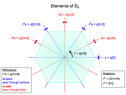
Take a look at $D_6$:
View attachment 5402

The axis of symmetry of $s$ in this picture goes through $2$ beads.
The axis of $rs$ goes through $0$ beads. (Thinking)
 

Attachments

  • 4565394280.png
    4565394280.png
    23.2 KB · Views: 108
  • #36
I like Serena said:
Take a look at $D_6$:The axis of symmetry of $s$ in this picture goes through $2$ beads.
The axis of $rs$ goes through $0$ beads. (Thinking)

I got stuck right now... Isn't $m$ constant in this example, $m=6$ ? (Wondering)
How can we take cases if $m$ is odd or even? (Wondering)
 
  • #37
mathmari said:
I got stuck right now... Isn't $m$ constant in this example, $m=6$ ? (Wondering)
How can we take cases if $m$ is odd or even? (Wondering)

I'm afraid $m$ has a different meaning in the picture. (Worried)
In the picture the number of beads is $6$.
And $m$ represents what we called $i$, the number of rotations that we apply.
 
  • #38
I like Serena said:
I'm afraid $m$ has a different meaning in the picture. (Worried)
In the picture the number of beads is $6$.
And $m$ represents what we called $i$, the number of rotations that we apply.

When we have an odd number of beads, would we have again that when the number of reflections is even then the symmetry axis goes through two vertices and when it is odd then the symmetry axis goes through sides? (Wondering)
 
  • #39
mathmari said:
When we have an odd number of beads, would we have again that when the number of reflections is even then the symmetry axis goes through two vertices and when it is odd then the symmetry axis goes through sides? (Wondering)

Suppose we take a look at $D_5$, which is represented by a pentagon.
What would it look like? (Wondering)
 
  • #40
I like Serena said:
Suppose we take a look at $D_5$, which is represented by a pentagon.
What would it look like? (Wondering)

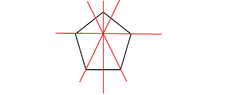
It is of the following form:

View attachment 5403

right? (Wondering)
 

Attachments

  • pent.png
    pent.png
    4.1 KB · Views: 97
  • #41
mathmari said:
It is of the following form:


right? (Wondering)

The vertical line is an axis of symmetry with 2 vertices to the left and 2 to the right.
However, the horizontal line has 1 above and 2 below. (Worried)
 
  • #42
I like Serena said:
The vertical line is an axis of symmetry with 2 vertices to the left and 2 to the right.
However, the horizontal line has 1 above and 2 below. (Worried)

So, when we have an odd number of beads the necklace is unchanged only under the reflection with the vertical line as the axis of symmetry, or not? (Wondering)
Or do we consider also the other two lines as the axis of symmetry of a reflection? (Wondering)
 
  • #43
mathmari said:
So, when we have an odd number of beads the necklace is unchanged only under the reflection with the vertical line as the axis of symmetry, or not? (Wondering)
Or do we consider also the other two lines as the axis of symmetry of a reflection? (Wondering)

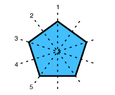
The picture should be like:
View attachment 5410

There are 5 axes of symmetry, each intersecting with 1 bead. (Thinking)
 

Attachments

  • 4d9213b908d82fbed032d1ef82b09035.png
    4d9213b908d82fbed032d1ef82b09035.png
    5.5 KB · Views: 104
  • #44
I like Serena said:
The picture should be like:There are 5 axes of symmetry, each intersecting with 1 bead. (Thinking)

Ah ok... I see... (Thinking)

So, when we have an odd number of beads, there are $k^{\lfloor \frac{m}{2}\rfloor+1}=k^{\lceil \frac{m}{2}\rceil}$ necklaces that stay unchanged under a reflection, or not? (Wondering)

And when we have an even number of beads, there are either $k^{\frac{m}{2}}$ necklaces, when we rotate by an odd $i$, or $k^{\frac{m-2}{2}+2}=k^{\frac{m+2}{2}}=k^{\frac{m}{2}+1}$ necklaces, when we rotate by an even $i$ that stay unchanged under a reflection, right? (Wondering)
 
  • #45
Right. (Nod)
 

Similar threads

  • · Replies 26 ·
Replies
26
Views
847
  • · Replies 18 ·
Replies
18
Views
2K
  • · Replies 7 ·
Replies
7
Views
2K
Replies
1
Views
2K
  • · Replies 34 ·
2
Replies
34
Views
5K
Replies
5
Views
2K
Replies
8
Views
2K
  • · Replies 3 ·
Replies
3
Views
2K
Replies
8
Views
3K
  • · Replies 9 ·
Replies
9
Views
2K