How much energy was Superman exposed to?

Click For Summary
SUMMARY

In the forum discussion, users calculated the energy Superman was exposed to during the explosion of a sun in Action Comics #867. The total energy of the explosion is 1e44 joules, and Superman's distance from the explosion is 35.98 million miles. By applying the inverse square law, the energy striking Superman can be determined using the formula e = E * (a/A), where E is the total energy, a is Superman's exposed surface area of 1.175 m², and A is the surface area of a sphere with a radius equal to Superman's distance from the sun. The final calculation yields an energy exposure of approximately 2.79e21 joules/m².

PREREQUISITES
  • Understanding of the inverse square law
  • Basic knowledge of energy calculations in physics
  • Familiarity with surface area formulas, specifically for spheres
  • Ability to convert units from miles to meters
NEXT STEPS
  • Learn how to apply the inverse square law in various physics scenarios
  • Study energy exposure calculations in astrophysics
  • Explore the implications of orientation on energy absorption
  • Investigate the effects of distance on energy intensity
USEFUL FOR

This discussion is beneficial for comic book enthusiasts, physics students, and anyone interested in energy calculations related to fictional scenarios involving superheroes.

RosutoTakeshi
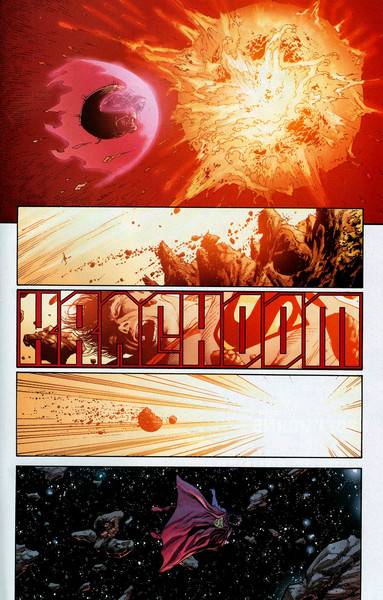
In Action Comics #867, Superman survived the explosion of a sun

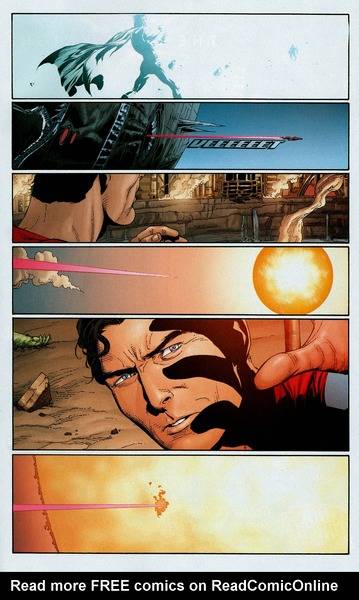
tCjvtoARIRj6Myaajmp3ErQ8JbgAYa9VaPqb5wyzH_lMdJCPwKTO5EvcfN1XH6fMSGLZwEVEeZu7=s0.jpg

zzU5XAtN2zktmvz1J6ePA7cAk-3qhZ9k3ZZ-4FHiX-ZRwyvJmgIQRd18SHnJkZErTnxcrkfrNC8Z=s0.jpg


wNBnmJo8vQwQqKD_WSWqx-0MtRFLkkW2FD5qhOtZEZJ9uUTqojI8A_oFUGPVs6zmVSxmAGdotiKs=s0.jpg


What I would like to know is, how much energy was he exposed to?
- I know there's the Inverse square law to consider
- And I know because of that, he did not get hit by the entire energy of that explosion because his surface area is very small

I just want to know how much energy actually hit him
For analysis purposes
- Total energy of exploding sun is 1e44 joules
- Supermans distance from explosion is 35.98 million milesquare
- His surface area is 2.35 m^2

Thanks in advance

 
Physics news on Phys.org
So what is the problem? You have correctly identified the inverse square law. Essentially you need to multiply the total energy release by the quotient between Superman's area and the area of a sphere with the distance to the explosion as its radius. This should be fairly straight forward.

RosutoTakeshi said:
- His surface area is 2.35 m^2
That is a quite fat Superman. The area exposed would also depend on Superman's orientation.
 
Orodruin said:
So what is the problem? You have correctly identified the inverse square law. Essentially you need to multiply the total energy release by the quotient between Superman's area and the area of a sphere with the distance to the explosion as its radius. This should be fairly straight forward.That is a quite fat Superman. The area exposed would also depend on Superman's orientation.

I do not know the formula to properly calculate it. The necessary steps

And I apologize, his "exposed" body surface area is 1.175m^2
 
RosutoTakeshi said:
I do not know the formula to properly calculate it. The necessary steps

And I apologize, his "exposed" body surface area is 1.175m^2
Surface area of sphere:
A = 4 \pi r^2
 
Janus said:
Surface area of sphere:
A = 4 \pi r^2

Yea, the surface area for the sun is a bit above 6.08e18m^2

But I still do not know what to do next with that information. What is the next step?
 
RosutoTakeshi said:
But I still do not know what to do next with that information. What is the next step?
Orodruin said:
you need to multiply the total energy release by the quotient between Superman's area and the area of a sphere with the distance to the explosion as its radius.
 
That's what I don't know how to do, that's what I'm saying
 
I don't know how to do that. I want to learn
 
RosutoTakeshi said:
That's what I don't know how to do, that's what I'm saying
Exactly what do you have a problem with? Multiplication and division?
 
  • Like
Likes   Reactions: RosutoTakeshi
  • #10
Orodruin said:
Exactly what do you have a problem with? Multiplication and division?
No no, lol, I mean which one do I do first? You said multiply total energy release (1e44 joules) between Superman's area (1.175m^2) and area of the sphere (6.08e18m^2) with distance to explosion as its radius (432,288 miles)

So... is it..

... yeah I'm confused
 
  • Like
Likes   Reactions: Physicsphysics
  • #11
Orodruin said:
Exactly what do you have a problem with? Multiplication and division?
I got four different numbers here and no idea what to do with them. Do I divide the surface area of the sun by supes surface area before multiplying it by the total energy release? This is where I'm confused
 
  • #12
RosutoTakeshi said:
That's what I don't know how to do, that's what I'm saying
Okay. First, you know how much energy is released by the sun's explosion, 1E44 joules.

As that energy travels outward from the sun, the sphere that contains that energy expands. Now while the total energy does not decrease, it is being spread thinner and thinner over the surface of the sphere. Since the surface area increases by the square of the radius, the energy per square meter decrease by the square of the radius (this is where the inverse square law come in. The total energy released by the star does not decrease with distance, just the intensity per square meter.
Thus if you take the total energy given off by the sun, and multiply this by Superman's exposed surface area divided by the surface area of a sphere with the radius of Superman's distance from the sun, you get the total energy striking Superman.
 
  • Like
Likes   Reactions: Bandersnatch and RosutoTakeshi
  • #13
Janus said:
Thus if you take the total energy given off by the sun, and multiply this by Superman's exposed surface area divided by the surface area of a sphere with the radius of Superman's distance from the sun, you get the total energy striking Superman.
Forgive my lack of intellect, but "that" is what is confusing me. How does "that" look? I know I'm thinking too hard about it and I'm sure it's very simple, but I don't know how to do "that". How does that look in an equation? Would you mind showing me an example of how it looks? I hate feeling stupid
 
  • #14
Does it look like this?

1e44 × (1.175m^2/6.08E18)
 
  • #15
RosutoTakeshi said:
Forgive my lack of intellect, but "that" is what is confusing me. How does "that" look? I know I'm thinking too hard about it and I'm sure it's very simple, but I don't know how to do "that". How does that look in an equation? Would you mind showing me an example of how it looks? I hate feeling stupid
E= total energy released by the star
R = the distance of Superman from the sun
a = Superman's exposed surface

then
if A equals the surface area of a sphere with a radius equal to Superman's distance from the sun, then
A = 4*pi*R

And e, the amount of energy striking Superman is

e = E * a/A
 
  • Like
Likes   Reactions: RosutoTakeshi
  • #16
RosutoTakeshi said:
Does it look like this?

1e44 × (1.175m^2/6.08E18)
close, but you are using the surface area that you gave for the Sun earlier. You don't even need to know that to solve your equation. You need the surface area of a sphere with radius of 35.98 million miles . (which is what I assumed you meant even though you wrote "milesquare")
Be sure to convert miles to meters before making the calculation.
 
  • Like
Likes   Reactions: RosutoTakeshi
  • #17
Also consider that the totality of energy does not arrive in a zero thickness expanding shell. Thus Superman's rate of energy exposure will depend on the actual temporal thickness of the energy shell, and his distance from the nova will presumably increase during that time period, thus reducing his actual energy impact.

Furthermore, it is likely that his orientation will change like a flag (cape?) in the wind, thus reducing his areal exposure.
 
  • Like
Likes   Reactions: RosutoTakeshi
  • #18
Janus said:
E= total energy released by the star
R = the distance of Superman from the sun
a = Superman's exposed surface

then
if A equals the surface area of a sphere with a radius equal to Superman's distance from the sun, then
A = 4*pi*R

And e, the amount of energy striking Superman is

e = E * a/A
Ok... ok I'm going to attempt this

E = 1e44 joules
R = 35,980,000 miles (57,904,197,120 meters)
a = 1.175m^2

A = 4 * 3.14 * 57,904,197,120
A = 4.21E22m^2

e = 1e44 * (1.175m^2/4.21E22m^2)
e = 2.79e21 joules/m^2
 
Last edited by a moderator:
  • #19
Noel said:
Also consider that the totality of energy does not arrive in a zero thickness expanding shell. Thus Superman's rate of energy exposure will depend on the actual temporal thickness of the energy shell, and his distance from the nova will presumably increase during that time period, thus reducing his actual energy impact.

Furthermore, it is likely that his orientation will change like a flag (cape?) in the wind, thus reducing his areal exposure.
Yes, but for simplicity sake, I'm just going with (his distance from the explosion did not increase upon impact)
 
  • #20
Janus said:
close, but you are using the surface area that you gave for the Sun earlier. You don't even need to know that to solve your equation. You need the surface area of a sphere with radius of 35.98 million miles . (which is what I assumed you meant even though you wrote "milesquare")
Be sure to convert miles to meters before making the calculation.
Did I get it right?
 
  • #21
RosutoTakeshi said:
Ok... ok I'm going to attempt this

E = 1e44 joules
R = 35,980,000 miles (57,904,197,120 meters)
a = 1.175m^2

A = 4 * 3.14 * 57,904,197,120
A = 4.21E22m^2

e = 1e44 * (1.175m^2/4.21E22m^2)
e = 2.79e21 joules/m^2
Looks good.
 
  • Like
Likes   Reactions: Physicsphysics and RosutoTakeshi
  • #22
Janus said:
Looks good
Thanks a lot for the assistance, I appreciate it
 

Similar threads

  • · Replies 14 ·
Replies
14
Views
3K
Replies
5
Views
4K
  • · Replies 12 ·
Replies
12
Views
5K
  • · Replies 26 ·
Replies
26
Views
4K
  • · Replies 2 ·
Replies
2
Views
10K
  • · Replies 8 ·
Replies
8
Views
15K
  • · Replies 28 ·
Replies
28
Views
4K
Replies
23
Views
3K
  • · Replies 34 ·
2
Replies
34
Views
4K
  • · Replies 36 ·
2
Replies
36
Views
12K