Superman created virtual particles?

Join the discussion
Ask a follow-up here, or get your own question answered by working scientists, mathematicians and engineers — people, not an autocomplete.
Real named experts · corrections over time · the nuance an AI answer skips
14 replies · 3K views
RosutoTakeshi
Messages
28
Reaction score
6
Comic is Superman/Batman #80

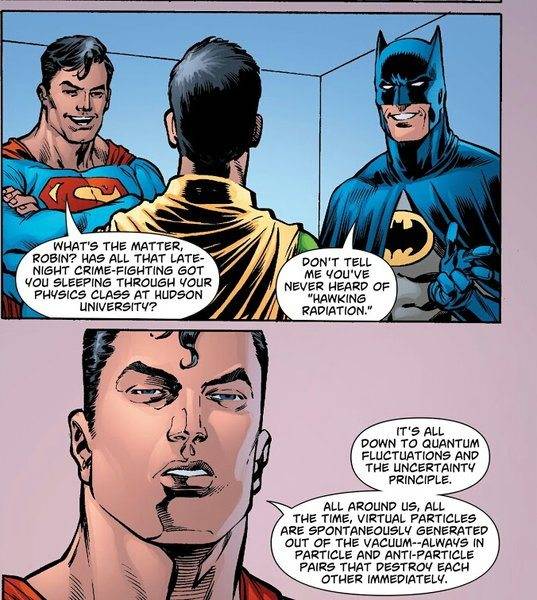
RCO001_1468984782-1.jpg


Superman explains that virtual particles are always spontaneous generated
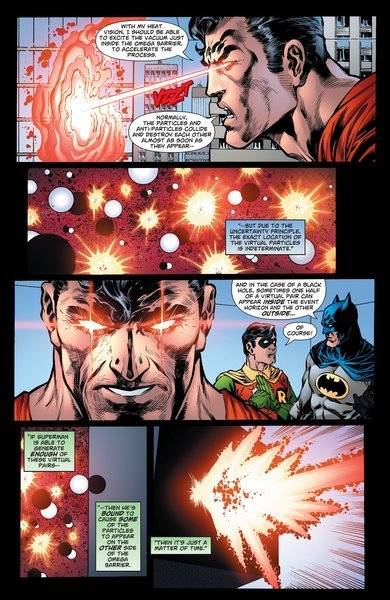
RCO013_1468984782-1.jpg


And that he's using his heat vision to (excite) the vacuum in order to accelerate the process. He's generating more virtual particles
RCO014_1468984782.jpg


So my question is, how much energy or heat did he have to use in order to create virtual particles, so they would annihilate themselves with the antiparticles?
 

Attachments

  • RCO001_1468984782-1.jpg
    RCO001_1468984782-1.jpg
    35.4 KB · Views: 1,103
  • RCO013_1468984782-1.jpg
    RCO013_1468984782-1.jpg
    71.6 KB · Views: 1,175
  • RCO014_1468984782.jpg
    RCO014_1468984782.jpg
    56.9 KB · Views: 992
  • Like
Likes   Reactions: atyy
on Phys.org
RosutoTakeshi said:
So my question is, how much energy or heat did he have to use in order to create virtual particles ...
None, since it's not possible. Virtual particles don't exist. They are a mathematical fiction. That's what "virtual" means in this context.

You really should not take the "physics" of comic books seriously.
 
Vanadium 50 said:
It's a comic book, not a textbook. The science isn't right, but it's not about the science.

I know it's not a textbook
 
  • Like
Likes   Reactions: atyy
phinds said:
None, since it's not possible. Virtual particles don't exist. They are a mathematical fiction. That's what "virtual" means in this context.

You really should not take the "physics" of comic books seriously.

Not taking it seriously at all. That's why this post is listed in the "science fiction" category
 
  • Like
Likes   Reactions: atyy
Now that we've gotten the obvious out of the way, I'll change the question

What amount of energy would it take to cause a (real) particle to collide with its antiparticle pair? Or is this not possible at all?
 
  • Like
Likes   Reactions: atyy
RosutoTakeshi said:
Now that we've gotten the obvious out of the way, I'll change the question
People assume you mean what you say and we are not mind readers. We answered the question you asked. It was in no way "obvious" that you already knew that your question was meaningless.
What amount of energy would it take to cause a (real) particle to collide with its antiparticle pair? Or is this not possible at all?
Very little because you don't need to push them together or anything. They LIKE joining up and annihilating each other, at least to the extent that quantum objects enjoy anything (most of them are just grumpy). The problem would be getting them to move around and I think you do that with magnetic fields that could, in the case of single particles already close to each other, probably be quite weak.
 
  • Like
Likes   Reactions: RosutoTakeshi
phinds said:
People assume you mean what you say and we are not mind readers. We answered the question you asked. It was in no way "obvious" that you already knew that your question was meaningless.

Doesn't take a mind reader. And it was obvious to me, since this post is listed in the (Science fiction) category. But I'll do better at explaining next time

phinds said:
Very little because you don't need to push them together or anything. They LIKE joining up and annihilating each other, at least to the extent that quantum objects enjoy anything (most of them are just grumpy). The problem would be getting them to move around and I think you do that with magnetic fields that could, in the case of single particles already close to each other, probably be quite weak

Thanks, that's what I was looking for. I appreciate it
 
Virtual particles have neither positions nor trajectories, so the concept of "pushing them together" is meaningless. As such, any discussion on how much energy it takes to accomplish it is meaningless as well.
 
  • Like
Likes   Reactions: RosutoTakeshi
Vanadium 50 said:
It's a comic book, not a textbook. The science isn't right, but it's not about the science.
phinds said:
None, since it's not possible. Virtual particles don't exist. They are a mathematical fiction. That's what "virtual" means in this context.

You really should not take the "physics" of comic books seriously.
One may want to distinguish between Fiction and Fantasy.
 
Vanadium 50 said:
Virtual particles have neither positions nor trajectories, so the concept of "pushing them together" is meaningless. As such, any discussion on how much energy it takes to accomplish it is meaningless as well.
Got it. Understood
 
symbolipoint said:
One may want to distinguish between Fiction and Fantasy.
That's a good point. I don't read much fantasy beyond Tolkien and tend to have a mindset towards science fiction instead of fantasy.
 
What are you talking about? Virtual particles exist, they just can't be observed. Where do you think an electron gets its intrinsic angular momentum?

Virtual particles

The thing is, superman doesn't create virtual particles. That is a common misconception. Superman actually turns virtual particles into real particles by his laser eye beam and then causes those real particles to annihilate, producing a bunch of radiation.
 
Last edited:
Last edited:
  • Like
Likes   Reactions: weirdoguy
Alright whatever
 
Last edited: