How scientists ensured this fundamental property of magnets?

Click For Summary
SUMMARY

This discussion centers on the fundamental properties of magnets, specifically addressing the magnetic pole model as described in Maxwell's treatise. It establishes that only the extremities of a magnet act as centers of force, while the interior remains free from magnetic action. The conversation highlights that while a uniformly magnetized cylinder exhibits this property, non-uniformly magnetized shapes can challenge this notion, allowing for variations in magnetic pole distribution. The use of magnetic field sensors, such as Hall probes, is suggested for empirical measurement of these properties.

PREREQUISITES
  • Understanding of magnetic pole models
  • Familiarity with Maxwell's treatise on electromagnetism
  • Knowledge of magnetic field sensors, specifically Hall probes
  • Concept of uniformly and non-uniformly magnetized materials
NEXT STEPS
  • Research the principles of magnetic pole models in depth
  • Study Maxwell's treatise, particularly Vol II, Article 373
  • Explore the functionality and applications of Hall probes in measuring magnetic fields
  • Investigate the differences between uniformly and non-uniformly magnetized materials
USEFUL FOR

Physicists, electrical engineers, and students of electromagnetism seeking to deepen their understanding of magnetic properties and their practical applications.

faheemahmed6000
Messages
16
Reaction score
0
Firstly, please note that I am talking about the period BEFORE electricity and magnetism were unified. So I am NOT seeking for answers based on Ampere atomic current model of magnets.

I have read the following statement about the property of magnets at two different places. One from here:
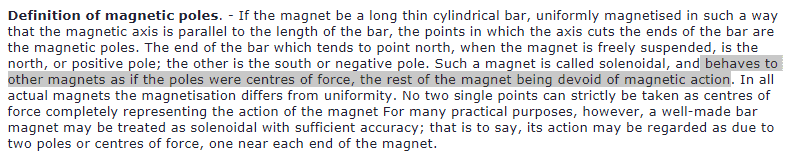
Capture.PNG

and the other from Maxwell's treatise Vol II, Article 373:
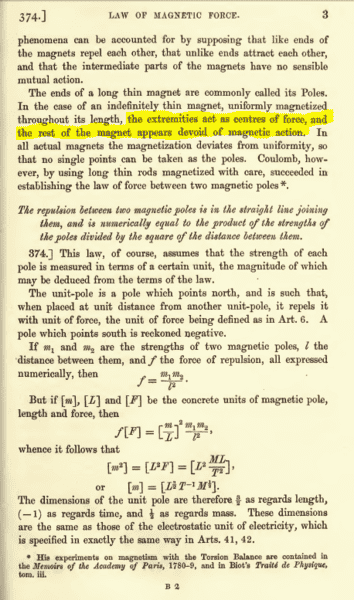
magnetic poles treatise.PNG


It says that in the magnetic pole model, only the surfaces at the extremities (poles) act as centers of force and the rest of the magnet appears free from magnetic action.

How can we ensure this? For example, why cannot we have half of the magnet's volume being north pole and the other half volume being south pole? Why do we necessarily have the surfaces at the extremities as centers of force instead of volumes (analogous to the charge model)?
 

Attachments

  • Capture.PNG
    Capture.PNG
    11.9 KB · Views: 537
  • magnetic poles treatise.PNG
    magnetic poles treatise.PNG
    66.4 KB · Views: 491
Last edited:
Physics news on Phys.org
That is an approximation, you can calculate that it is usually a good approximation and you can use a magnetic field sensor (like a Hall probe) to measure it.

Imagine a solenoid as long chain of NS magnets in a row, partially overlapping: N S/N S/N S/N S where "X/Y" means both are at the same place. The net result is N ... S.
 
faheemahmed6000 said:
For example, why cannot we have half of the magnet's volume being north pole and the other half volume being south pole?
You certainly can. This is not a “fundamental property of magnets” in general, but a feature of a specific type of magnet: a uniformly magnetized cylinder. If you have a non-uniformly magnetized cylinder or a uniformly magnetized non-cylinder you can change that.
 

Similar threads

  • · Replies 6 ·
Replies
6
Views
2K
  • · Replies 1 ·
Replies
1
Views
2K
  • · Replies 14 ·
Replies
14
Views
2K
  • · Replies 5 ·
Replies
5
Views
2K
  • · Replies 7 ·
Replies
7
Views
13K
  • · Replies 2 ·
Replies
2
Views
2K
  • · Replies 1 ·
Replies
1
Views
2K
  • · Replies 5 ·
Replies
5
Views
2K
  • · Replies 22 ·
Replies
22
Views
3K
  • · Replies 9 ·
Replies
9
Views
5K