How should an H bridge circuit be analyzed?

Click For Summary

Discussion Overview

The discussion revolves around the analysis of an H bridge circuit, particularly in the context of motor control. Participants explore methods for modeling the circuit, including the treatment of the motor and its load, as well as the tools and techniques for accurate analysis.

Discussion Character

  • Technical explanation
  • Debate/contested
  • Mathematical reasoning

Main Points Raised

  • One participant suggests replacing the transistors in the H bridge with their circuit models but questions how to model the motor, wondering if it should be replaced with its load resistance.
  • Another participant proposes that motors are typically simulated as a series RL circuit to accurately capture transients during switching.
  • A follow-up question is raised about how to determine the values for the motor's resistance and inductance if the motor is available.
  • It is mentioned that high-end multimeters can measure both inductance and resistance of motor windings, while a combination of cheaper tools may be used for cost efficiency and accuracy.
  • One participant expresses concern that their multimeter lacks the capability to measure inductance and wonders if hand calculations could suffice for analyzing the H bridge, or if using a SPICE program would be necessary due to complexity.
  • Another participant notes that voltage surges are a significant issue in H bridges and that calculating these manually is challenging, suggesting that SPICE is preferable for such analyses.

Areas of Agreement / Disagreement

There is no clear consensus on the best method for analyzing the H bridge circuit, with participants presenting various approaches and tools, indicating multiple competing views on the analysis process.

Contextual Notes

Participants express uncertainty regarding the modeling of the motor and the effectiveness of different measurement tools, highlighting limitations in their current resources and knowledge of power electronics.

Who May Find This Useful

This discussion may be useful for individuals interested in circuit analysis, particularly in the context of motor control and H bridge circuits, as well as those exploring measurement techniques for motor parameters.

Boltzman Oscillation
Messages
233
Reaction score
26
Homework Statement
How should an H bridge circuit be analyzed?
Relevant Equations
Basic KCL, KVL, transistor equations
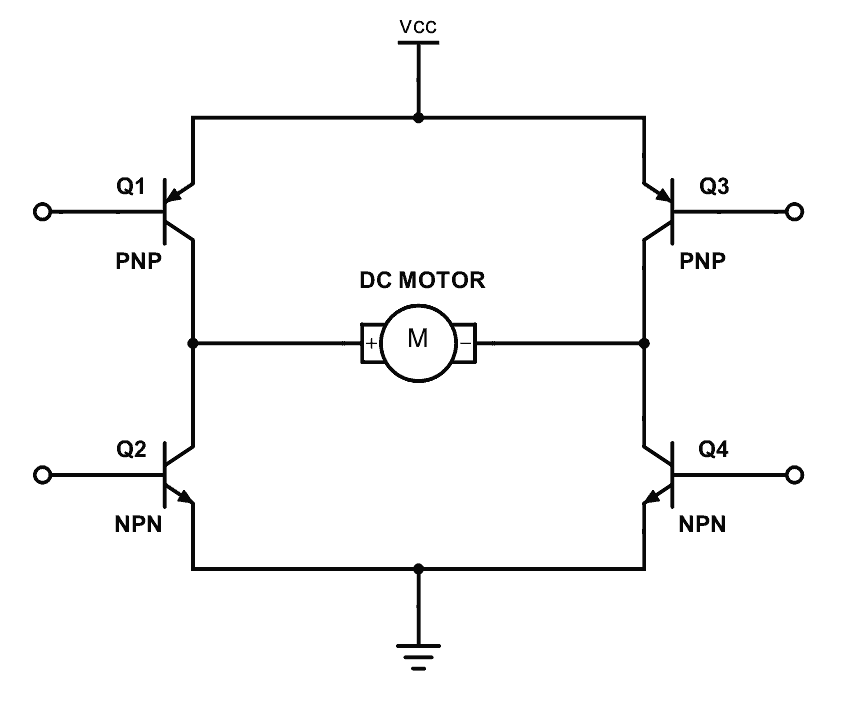
If I am given an H bridge circuit such as that below:
1577067105797.png


How would I go on analyzing it? I would personally replace all of the transistors by their circuit models but then what would I do with the motor? Do I replace the motor with it's load resistance or is there more to it? I guess motors are dealt with power electronics, I have not covered power electronics in my study (i don't plan on doing so).
 
Physics news on Phys.org
Typically motors are simulated as series RL circuit. It allows accurate sumulation of transients during motor switching.
 
trurle said:
Typically motors are simulated as series RL circuit. It allows accurate sumulation of transients during motor switching.
if i have a motor with me is there a way to determine those values?
 
Boltzmann Oscillation said:
if i have a motor with me is there a way to determine those values?
High end multimeters allows to measure both inductance and resistance of motor winding.
In my workshop, i prefer to use a combination of cheap multimeter for resistance measurement and a dedicated LC meter for measurement of inductance though - more cost efficient and accurate. Standard meter-long multimeter leads have enough self-inductance to distort reading from smaller motors.
 
trurle said:
High end multimeters allows to measure both inductance and resistance of motor winding.
In my workshop, i prefer to use a combination of cheap multimeter for resistance measurement and a dedicated LC meter for measurement of inductance though - more cost efficient and accurate. Standard meter-long multimeter leads have enough self-inductance to distort reading from smaller motors.
Darn, my multimeter doesn't include that operation. I was wondering if I could analyze this hbridge by hand calculation or if I should just use a SPICE program because it will be too complicated by hand?
 
Boltzmann Oscillation said:
Darn, my multimeter doesn't include that operation. I was wondering if I could analyze this hbridge by hand calculation or if I should just use a SPICE program because it will be too complicated by hand?
Voltage surges which are dominant problem of H bridges are difficult to calculate manually; SPICE is preferrable.
 

Similar threads

  • · Replies 2 ·
Replies
2
Views
2K
  • · Replies 8 ·
Replies
8
Views
3K
  • · Replies 3 ·
Replies
3
Views
2K
  • · Replies 18 ·
Replies
18
Views
4K
Replies
1
Views
2K
  • · Replies 41 ·
2
Replies
41
Views
8K
  • · Replies 10 ·
Replies
10
Views
8K
  • · Replies 9 ·
Replies
9
Views
2K
Replies
8
Views
3K
  • · Replies 15 ·
Replies
15
Views
2K