How Should Frequency X and Y Be Described in SCENAR Therapy?

  • Context: Graduate 
  • Thread starter Thread starter zephiloyd
  • Start date Start date
  • Tags Tags
    Frequency Technology
Click For Summary
SUMMARY

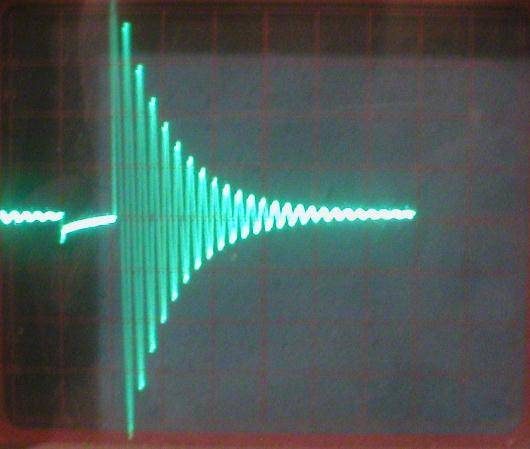
The discussion centers on the description of impulse frequencies in SCENAR therapy, specifically how to mathematically represent the relationship between time (X) and voltage (Y) in the context of the SCENAR device's operation. The SCENAR device transmits short impulses that replicate neuro-impulses, penetrating C-fibres in the skin. The impulse function can be modeled as a decaying sine wave, represented by the equation Asin(ω)e^(-t/τ), where ω = 2πF. The conversation highlights the need for a clearer mathematical framework to describe the resultant frequency of impulses.

PREREQUISITES
  • Understanding of SCENAR therapy and its mechanisms
  • Basic knowledge of electrical impulse characteristics
  • Familiarity with sine wave functions and decay equations
  • Experience with oscilloscope measurements
NEXT STEPS
  • Research mathematical modeling of impulse functions in biomedical devices
  • Explore the properties of decaying sine waves in signal processing
  • Investigate the application of envelope functions in amplitude modulation
  • Visit the RITM OKB forum for insights from SCENAR device manufacturers
USEFUL FOR

SCENAR therapists, biomedical engineers, and researchers interested in impulse therapy and signal processing techniques.

zephiloyd
Messages
5
Reaction score
0
Hello

I am a SCENAR therapist, and I am looking for clarification on something which has confused me for a while. The SCENAR device stimulates the body to heal itself, by transmitting short impulses (measured in microseconds), which replicate neuro-impulses, the property of the impulse is such that it is able to penetrate the C-fibres in the skin, one impulse is as follows (I have connected it to my oscilloscope):
P1010016a.JPG


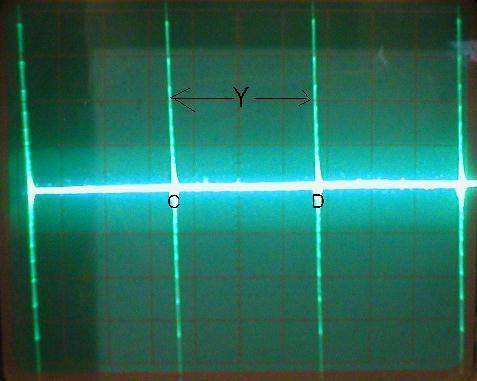
The following shows a number of regular impulses on a set frequency 1/Y (ignore the C and D)
P1010001aaa.JPG
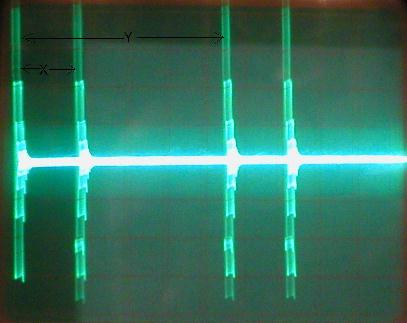
A setting on the device allows another impulse to come almost immediately after the first (represented by time X). This is called "intensity", when Int=2, it shows on the oscilloscope as follows.
p10100017.JPG


I would like to know how to describe this resultant frequency in terms of X and Y

Thanks for you help, regards Phil
 
Last edited:
Physics news on Phys.org
Dear Phil,

You'd better post your question on the RITM OKB's forum as they are the patent holders and the manufacturer of the original scenar devices.

Here is the link for their forum http://www.scenar.com.ru/eng/index.php

Best wishes
SCENAR Australia
 
Thanks, I was going to go there next, although they aren't very active. I wanted an opinion from a scientist, who had nothing to do with scenar.

It seems a simple request, all I want is an equation, surely there must be other scientific equipment where impulses can behave in a similar manner, if so it must be describable using maths.

Regards Phil
 
Hi Phil,

X (horisontal axis) is time in ms and Y (vertical axis) is Voltage, V

Regards
SCENAR Australia
 
I should not have used X and Y, any other algebraic characters would suffice.

In my images they are both time in ms
 
The "impulse" function (not really an impulse ie. dirac delta) can be described by a decaying sine wave. That is a sine wave that quickly dies off and repeats at frequency F.
Where

\omega =2\pi F

Basically:
Asin\omega*e^{-t/\tau}

where A is the maximum amplitude of the voltage, \omega is basically the frequency of the sine wave, and the e^{-t/\tau} defines how fast the sine term decays.

I'm not exactly sure how you would describe the quickly repeated next impulse. Maybe an envelope function similar to an AM radio wave?

Just some thoughts I'm sure someone else can help a bit more.
 

Similar threads

  • · Replies 12 ·
Replies
12
Views
11K
  • · Replies 10 ·
Replies
10
Views
5K
  • · Replies 1 ·
Replies
1
Views
5K
  • · Replies 1 ·
Replies
1
Views
4K