How to attach bearings on shaft

  • Thread starter Thread starter Blad9
  • Start date Start date
  • Tags Tags
    Shaft
Click For Summary
SUMMARY

This discussion focuses on the proper attachment of bearings to a shaft that needs to rotate 90 degrees in both directions. The recommended approach includes using two slide bearings positioned at the top and bottom of the shaft to facilitate rotation. For vertical stability, it is essential to consider the use of external circlips if there is no axial load, or to implement a shoulder on the shaft to support the bearings if axial forces are present. Additionally, techniques such as press fitting or thermal expansion can be utilized for securing the bearings.

PREREQUISITES
  • Understanding of slide bearings and their applications
  • Knowledge of axial loads and bearing support mechanisms
  • Familiarity with press fitting and thermal expansion techniques
  • Basic concepts of mechanical design and shaft construction
NEXT STEPS
  • Research the design and application of slide bearings in rotating systems
  • Learn about axial load considerations in bearing design
  • Study press fitting techniques and their advantages in mechanical assemblies
  • Explore mechanical design principles related to shaft and bearing interactions
USEFUL FOR

Mechanical engineers, hobbyists working on rotating machinery, and anyone involved in the design and assembly of shaft and bearing systems.

Blad9
Messages
14
Reaction score
0
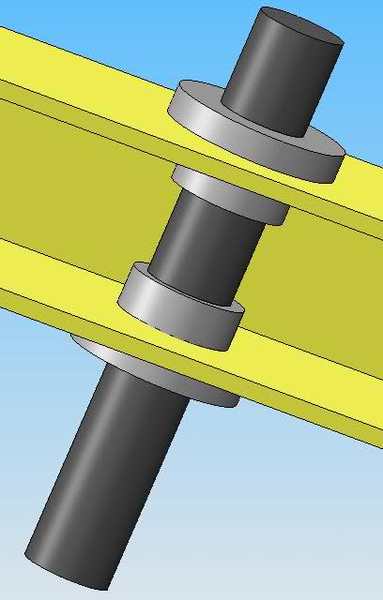
I have a shaft, which I would like to rotate 90 degrees to one side and then 90 degrees back to the other side and so forth. How should I attach the bearings to this shaft? I was thinking to do it as shown in this image:
wl4tj9.jpg

Two slide bearings, one on the top and one on the bottom so the shaft can rotate. But how should I fix this movement vertically? I’m completely new to attaching bearings on shafts, so any help would be appreciated. It does not necessarily have to be done as shown in the image.
 
Engineering news on Phys.org
The shaft at the middle portion can be thicker in diameter than the top and bottom portion.
 
cktoh said:
The shaft at the middle portion can be thicker in diameter than the top and bottom portion.
Yes, true. Didn't think about that. But how should I realize that?
 
If there is no axial load, you can use external circlips
 
if there is a load, perhaps you could look at the workings of a crank on a bicycle. Are you attaching anything to each end of the shaft? some shafts are frozen (reduced in size) then feed into the bearing and gradually heated to create a mate through expansion of metal, or you can have them press fitted.

Hope this helps.

Dunk
 
if you need the shaft bears axial force, the shaft must have a shoulder, one bearing leans against the shoulder, it can support whole shaft.
i suggest you refer to some books show a few structure inside gear box, it is useful for you.
 

Similar threads

  • · Replies 5 ·
Replies
5
Views
5K
Replies
17
Views
4K
  • · Replies 2 ·
Replies
2
Views
2K
  • · Replies 1 ·
Replies
1
Views
3K
Replies
19
Views
3K
Replies
3
Views
5K
Replies
6
Views
2K
  • · Replies 5 ·
Replies
5
Views
2K
  • · Replies 19 ·
Replies
19
Views
4K
Replies
2
Views
1K