Discussion Overview
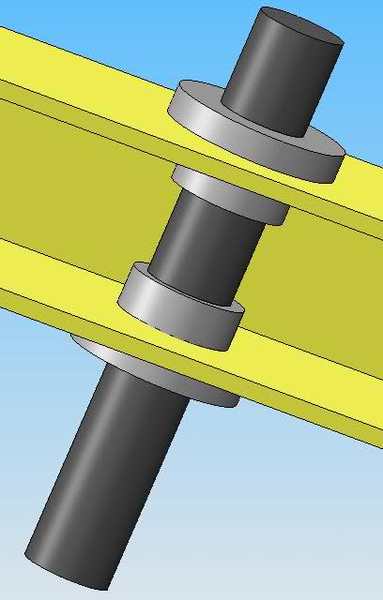
The discussion revolves around the methods for attaching bearings to a shaft that is intended to rotate back and forth. Participants explore various approaches to ensure proper attachment and support for the shaft's movement, considering factors such as load and shaft design.
Discussion Character
- Technical explanation
- Conceptual clarification
- Debate/contested
Main Points Raised
- One participant suggests using two slide bearings, positioned on the top and bottom of the shaft, to allow for rotation, while seeking advice on vertical movement stabilization.
- Another participant notes that the middle portion of the shaft could be thicker than the top and bottom portions, prompting further inquiry on how to implement this design.
- A suggestion is made that if there is no axial load, external circlips could be used for bearing attachment.
- Another participant proposes looking at the mechanics of a bicycle crank for insights, mentioning that some shafts are designed to be frozen and then heated for a tight fit in bearings, or alternatively, press-fitted.
- It is mentioned that if the shaft bears axial force, it should have a shoulder to support the bearing, which would bear the load of the entire shaft.
- A recommendation is made to consult books that illustrate gearbox structures for additional guidance.
Areas of Agreement / Disagreement
Participants express differing views on the best methods for attaching bearings, with no consensus reached on a single approach. Multiple competing ideas regarding shaft design and bearing attachment techniques remain present.
Contextual Notes
Participants have not fully resolved the implications of axial loads on bearing attachment and the specific design choices for the shaft's diameter variations.